




Pavlov’s pouch is
(a) An artificial stomach
(b) A bag containing digestive enzymes
(c) A bag containing food
(d) Opened stomach of a dog
Answer
 Verified
606k+ views
Hint: For scientific purposes, Pavlov's Pouch is an artificially developed pouch. It was designed for the study of digestive tract physiology. It is a small part of the muscular organ that possesses digestive enzymes present in an animal.
Complete step by step answer:
The Russian physiologist Ivan Petrovich Pavlov (1848-1936) surgically developed pockets ('Pavlov pouches') at various points along the digestive tracts of dogs from which he could obtain secretions, the purpose being to research the physiology of the digestive tract. He did so with great success from the salivary glands down to the stomach, liver, and pancreas, and in 1904 (the 4th year it was awarded) he received the Nobel Prize for his work on the physiology of digestion.
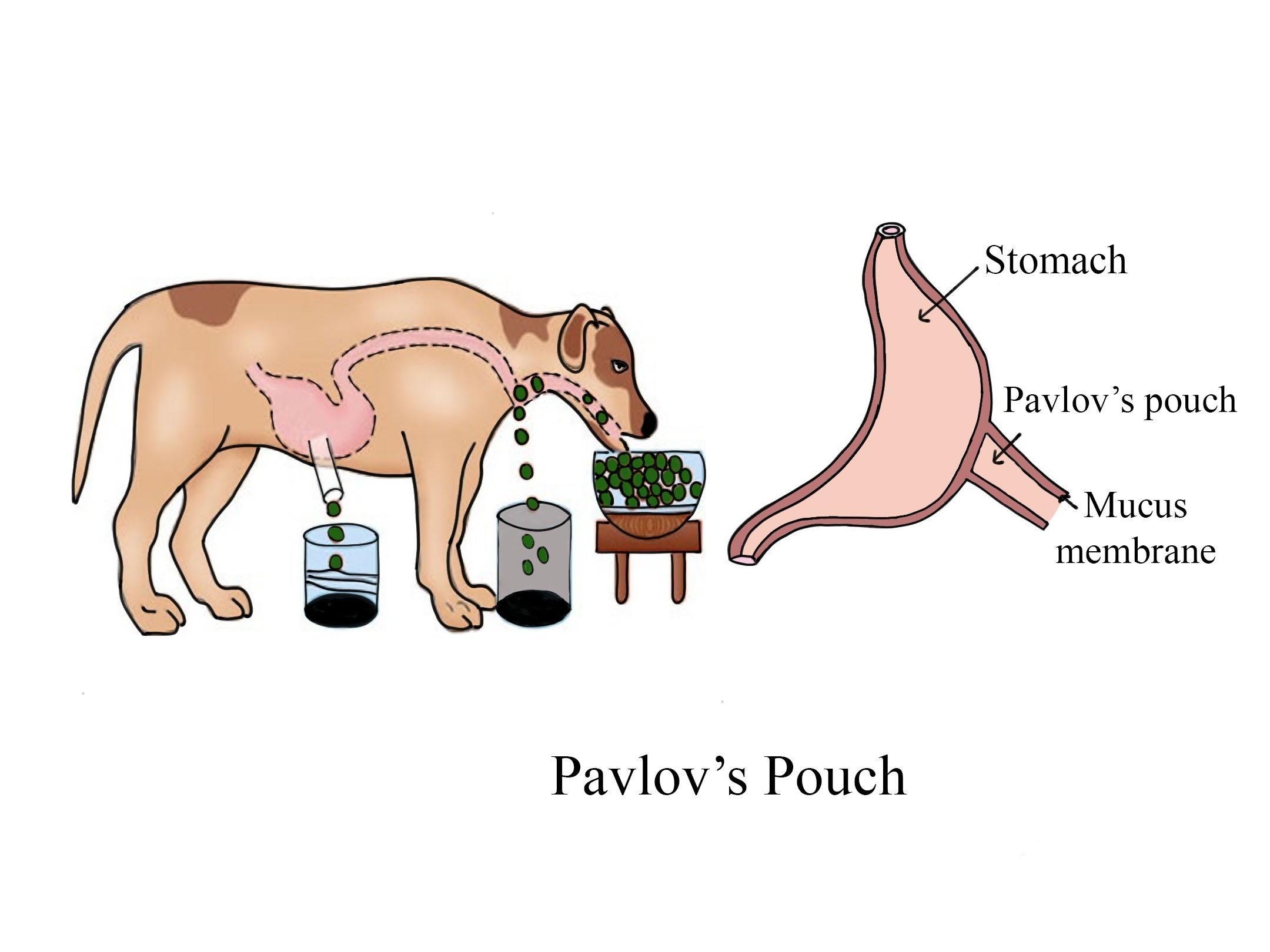
So, the correct answer is, ‘The stomach of a dog’.
Additional information: R. Klemensevich produced the first isolated pouch from the pyloric section of the stomach in 1875. R. Heidenhain in 1879, in order to research the concepts of secretion of the fundic glands, suggested a modified isolated pouch produced from the fundal portion of the stomach. As consumed food did not reach the insulated pouch, pure gastric juice could be collected by making an isolated pouch. However, as a result of denervation, the secretion of juice in the pouch of Heidenhain did not correspond to secretion in the stomach.
Note: I.P. Pavlov, without most defects existing previously, he figured out a way of obtaining an isolated pouch. Longitudinal incisions are made, running parallel to the nerve fibers, according to Pavlov's process. The stomach is divided only by a layer of mucosa from the isolated pouch, leaving between them a bridge of serous and muscular layers onto which the vagus and blood vessels move through the mass of the branches.
Complete step by step answer:
The Russian physiologist Ivan Petrovich Pavlov (1848-1936) surgically developed pockets ('Pavlov pouches') at various points along the digestive tracts of dogs from which he could obtain secretions, the purpose being to research the physiology of the digestive tract. He did so with great success from the salivary glands down to the stomach, liver, and pancreas, and in 1904 (the 4th year it was awarded) he received the Nobel Prize for his work on the physiology of digestion.
So, the correct answer is, ‘The stomach of a dog’.
Additional information: R. Klemensevich produced the first isolated pouch from the pyloric section of the stomach in 1875. R. Heidenhain in 1879, in order to research the concepts of secretion of the fundic glands, suggested a modified isolated pouch produced from the fundal portion of the stomach. As consumed food did not reach the insulated pouch, pure gastric juice could be collected by making an isolated pouch. However, as a result of denervation, the secretion of juice in the pouch of Heidenhain did not correspond to secretion in the stomach.
Note: I.P. Pavlov, without most defects existing previously, he figured out a way of obtaining an isolated pouch. Longitudinal incisions are made, running parallel to the nerve fibers, according to Pavlov's process. The stomach is divided only by a layer of mucosa from the isolated pouch, leaving between them a bridge of serous and muscular layers onto which the vagus and blood vessels move through the mass of the branches.
Recently Updated Pages
Master Class 11 Social Science: Engaging Questions & Answers for Success

Master Class 11 English: Engaging Questions & Answers for Success
Master Class 11 Maths: Engaging Questions & Answers for Success
Master Class 11 Chemistry: Engaging Questions & Answers for Success
Master Class 11 Biology: Engaging Questions & Answers for Success
Master Class 11 Physics: Engaging Questions & Answers for Success
Trending doubts
One Metric ton is equal to kg A 10000 B 1000 C 100 class 11 physics CBSE
Difference Between Prokaryotic Cells and Eukaryotic Cells
Draw a diagram of a plant cell and label at least eight class 11 biology CBSE
Two of the body parts which do not appear in MRI are class 11 biology CBSE
Which gas is abundant in air class 11 chemistry CBSE
10 examples of friction in our daily life