




What is the pathway air follows as it passes through your respiratory system?
Answer
 Verified
530.1k+ views
Hint: Air goes down the pharynx (back of the throat), past the larynx (voice box), and into the trachea when you inhale through your nose or mouth (windpipe). Your trachea is separated into two bronchial tubes, which are air channels. The left lung is served by one bronchial tube, whereas the right lung is served by the other.
Complete answer:
Air enters through the nose (and occasionally the mouth), travels through the nasal cavity, pharynx, larynx, trachea, bronchi and bronchioles, and finally reaches the alveoli.
The external organs of the nose and mouth are where air enters the respiratory system.
Nose: Air is inhaled through the nostrils (and occasionally through the mouth), where it is filtered and moistened by the hairs and cilia. The temperature of breathed air is also moderated by the nasal cavity.
Pharynx: Food, water, and air are all passed through the pharynx. It connects the nose and mouth, and connects the trachea (windpipe) with the oesophagus (food pipe).
The epiglottis closes during swallowing to prevent food from entering the trachea and opens during breathing.
Larynx: This is the voice box located just above the trachea. It has a flap called the epiglottis that closes during swallowing to prevent food from entering the trachea and opens during breathing.
Trachea:The windpipe, which is located beneath the sternum (breastbone) and between the two lungs, now receives air.
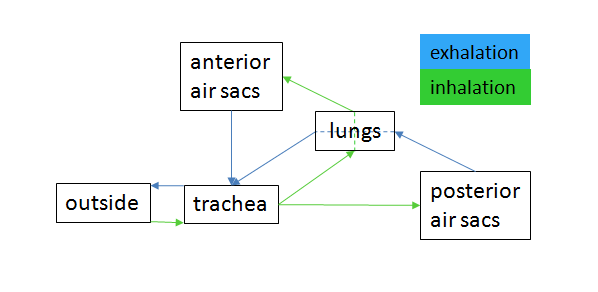
Bronchus: Two bronchi (one for each lung) enter the lungs from the trachea and divide and subdivide into secondary and tertiary bronchi as they progress deeper into the lung.
Bronchioles: The tertiary bronchi branch into fine tubules known as bronchioles, which serve as the final air channels.
Alveoli: The alveoli (sing. alveolus) are tiny sacs with very fine single-celled walls where air comes to an end. These alveoli are encircled by capillaries that connect the pulmonary arteries and veins and allow oxygen and carbon dioxide to be exchanged.
Note:-
The trachea, bronchi, bronchioles, and alveoli are the airways in the respiratory tract. It's vital to remember that gas exchange takes place in the bronchioles, which are passages that branch off from the major bronchi and eventually lead to the alveolar ducts. Diffusion is the process by which oxygen travels from the alveoli to the bloodstream via the capillaries (small blood vessels) that line the alveolar walls. The haemoglobin in red blood cells absorbs oxygen once it enters the bloodstream.
Complete answer:
Air enters through the nose (and occasionally the mouth), travels through the nasal cavity, pharynx, larynx, trachea, bronchi and bronchioles, and finally reaches the alveoli.
The external organs of the nose and mouth are where air enters the respiratory system.
Nose: Air is inhaled through the nostrils (and occasionally through the mouth), where it is filtered and moistened by the hairs and cilia. The temperature of breathed air is also moderated by the nasal cavity.
Pharynx: Food, water, and air are all passed through the pharynx. It connects the nose and mouth, and connects the trachea (windpipe) with the oesophagus (food pipe).
The epiglottis closes during swallowing to prevent food from entering the trachea and opens during breathing.
Larynx: This is the voice box located just above the trachea. It has a flap called the epiglottis that closes during swallowing to prevent food from entering the trachea and opens during breathing.
Trachea:The windpipe, which is located beneath the sternum (breastbone) and between the two lungs, now receives air.
Bronchus: Two bronchi (one for each lung) enter the lungs from the trachea and divide and subdivide into secondary and tertiary bronchi as they progress deeper into the lung.
Bronchioles: The tertiary bronchi branch into fine tubules known as bronchioles, which serve as the final air channels.
Alveoli: The alveoli (sing. alveolus) are tiny sacs with very fine single-celled walls where air comes to an end. These alveoli are encircled by capillaries that connect the pulmonary arteries and veins and allow oxygen and carbon dioxide to be exchanged.
Note:-
The trachea, bronchi, bronchioles, and alveoli are the airways in the respiratory tract. It's vital to remember that gas exchange takes place in the bronchioles, which are passages that branch off from the major bronchi and eventually lead to the alveolar ducts. Diffusion is the process by which oxygen travels from the alveoli to the bloodstream via the capillaries (small blood vessels) that line the alveolar walls. The haemoglobin in red blood cells absorbs oxygen once it enters the bloodstream.
Recently Updated Pages
Master Class 11 English: Engaging Questions & Answers for Success

Master Class 11 Social Science: Engaging Questions & Answers for Success
Master Class 11 Maths: Engaging Questions & Answers for Success
Master Class 11 Biology: Engaging Questions & Answers for Success
Master Class 11 Physics: Engaging Questions & Answers for Success
Master Class 11 Chemistry: Engaging Questions & Answers for Success
Trending doubts
One Metric ton is equal to kg A 10000 B 1000 C 100 class 11 physics CBSE
Difference Between Prokaryotic Cells and Eukaryotic Cells
Find the value of the expression given below sin 30circ class 11 maths CBSE
Difference between physical and chemical change class 11 chemistry CBSE
Two of the body parts which do not appear in MRI are class 11 biology CBSE
Draw a diagram of a plant cell and label at least eight class 11 biology CBSE