




What path will the principle of reversibility of light follow if the direction of travel is reversed?
A) Same
B) Different
C) Both
D) None
Answer
 Verified
619.5k+ views
Hint
In the principle of reversibility of light the light undergoes several reflections and refractions then if its travel direction is reversed the light will retrace or go back via its path.
Complete Step by Step Solution
The light retraces or returns back from its path of travelling when the direction of travel of light is reversed. This is called the principle of reversibility of light. According to the principle of reversibility of light, the light whose direction of travel is reversed suffers a number of reflections and refractions.
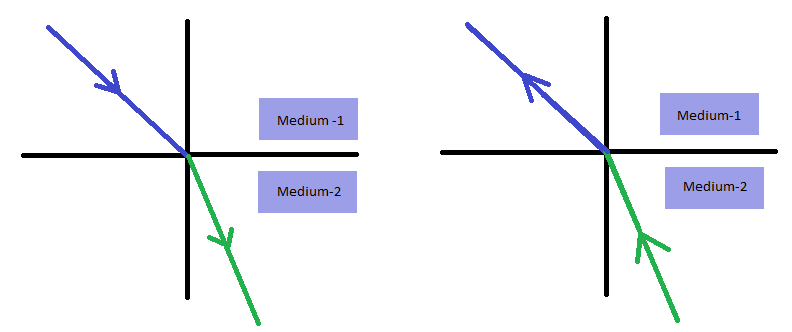
See the above diagram and try to understand how ray of light travels and retraces its path and how its direction gets reversed.
From the above figure, we can say that a light ray is travelling from medium 1 to medium 2 and first it makes an angle of incidence $i$ and also makes an angle of refraction $r$. When light is returning back it is incident from medium 2 to medium 1 then it makes an angle of incidence $r$ and angle of refraction $i$ which shows how the light returns to its same path when the direction of travel is reversed. Therefore, the principle of reversibility of light follows the same path if the direction of travel is reversed.
Hence, option (A) is correct.
Note
The principle of reversibility of light assumes that the attenuation of light when it passes through an optical medium due to refraction, reflection and absorption. This is not affected by the reversal of direction of the ray.
In the principle of reversibility of light the light undergoes several reflections and refractions then if its travel direction is reversed the light will retrace or go back via its path.
Complete Step by Step Solution
The light retraces or returns back from its path of travelling when the direction of travel of light is reversed. This is called the principle of reversibility of light. According to the principle of reversibility of light, the light whose direction of travel is reversed suffers a number of reflections and refractions.
See the above diagram and try to understand how ray of light travels and retraces its path and how its direction gets reversed.
From the above figure, we can say that a light ray is travelling from medium 1 to medium 2 and first it makes an angle of incidence $i$ and also makes an angle of refraction $r$. When light is returning back it is incident from medium 2 to medium 1 then it makes an angle of incidence $r$ and angle of refraction $i$ which shows how the light returns to its same path when the direction of travel is reversed. Therefore, the principle of reversibility of light follows the same path if the direction of travel is reversed.
Hence, option (A) is correct.
Note
The principle of reversibility of light assumes that the attenuation of light when it passes through an optical medium due to refraction, reflection and absorption. This is not affected by the reversal of direction of the ray.
Recently Updated Pages
Basicity of sulphurous acid and sulphuric acid are

Master Class 12 Economics: Engaging Questions & Answers for Success
Master Class 12 Biology: Engaging Questions & Answers for Success
Master Class 11 English: Engaging Questions & Answers for Success
Master Class 11 Physics: Engaging Questions & Answers for Success
Master Class 11 Computer Science: Engaging Questions & Answers for Success
Trending doubts
Draw a labelled sketch of the human eye class 12 physics CBSE
The chemical formula of tear gas is A CO Cl 2 B C 10 class 12 chemistry CBSE
Draw ray diagrams each showing i myopic eye and ii class 12 physics CBSE
Which are the Top 10 Largest Countries of the World?
Differentiate between homogeneous and heterogeneous class 12 chemistry CBSE
Which is the correct genotypic ratio of mendel dihybrid class 12 biology CBSE