




Particle ‘A’ moves with speed $10\,m/s$ in a frictionless circular fixed horizontal pipe of radius $5\,m$ and strikes with ‘B’ of double mass that of A. Coefficient of restitution is $\dfrac{1}{2}$ and particle ‘A’ starts its journey at $t=0$. At what time will the second collision occur?
A. $\dfrac{\pi }{2}\,s$
B. $\dfrac{2\pi }{3}\,s\,$
C. $\dfrac{5\pi }{2}\,s$
D. $4\pi \,s$
Answer
 Verified
590.4k+ views
Hint: Coefficient of restitution is the ratio of final relative velocity and initial relative velocity between two objects after they collide.
Use conservation of momentum to determine velocity of particle ‘B’. Particle ‘A’ will come to rest after collision.
Use definition of speed to obtain time period for both collisions and then add to obtain time of second collision.
Formula used:
$\text{Time taken =}\dfrac{\text{Distance travelled}}{\text{magnitude of velocity}}$
Complete step-by-step answer:
During any collision, the net momentum of the isolated system remains conserved. This is known as the law of conservation of momentum.
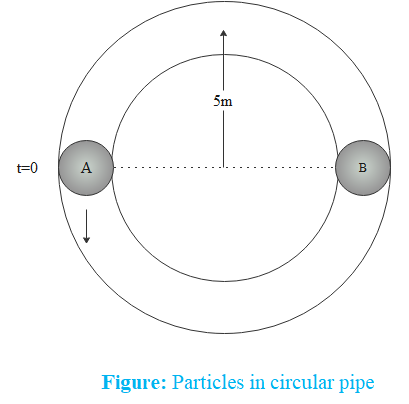
We are given that particle ‘A’ moves with speed $10\,m/s$ in a frictionless circular fixed horizontal pipe of radius $5\,m$ and strikes with ‘B’ of double mass that of A. Let us assume that the mass of particle ‘A’ is ${{m}_{A}}=m$. Then the mass of particle ‘B’ will be ${{m}_{B}}=2m$. The initial velocity of particle ‘B’ is ${{v}_{B}}=0$. Then, initial momentum of the system is
${{p}_{i}}={{m}_{a}}{{v}_{a}}+{{m}_{b}}{{v}_{b}}$
${{p}_{i}}=m\times 10+2m\times 0=10m$ ….(1)
If ${{v}_{A}}'$ and ${{v}_{B}}'$ are the final velocity of particle ‘A’ and ‘B’ respectively, then final momentum of system is
${{p}_{f}}={{m}_{A}}{{v}_{A}}'\,\,+{{m}_{B}}{{v}_{B}}'=m{{v}_{A}}'\,\,+2m{{v}_{B}}'$ ….(2)
By conservation of momentum, (1) equals (2):
$10m=m{{v}_{A}}'\,\,+2m{{v}_{B}}'$
$\Rightarrow {{v}_{A}}'+2{{v}_{B}}'-10=0$ ….(3)
Coefficient of restitution is the ratio of final relative velocity and initial relative velocity between two objects after they collide. It is denoted by e.
Here, $e=\dfrac{1}{2}$. So we can write
$-e=\dfrac{{{v}_{A}}'-{{v}_{B}}'}{{{v}_{A}}-{{v}_{B}}}=-\dfrac{1}{2}$
Substituting the values and solving, we get
$\Rightarrow \dfrac{1}{2}=\dfrac{{{v}_{A}}'-{{v}_{B}}'}{10}$
$\Rightarrow {{v}_{A}}'=-5+{{v}_{B}}'$ ….(4)
By substituting this value in (3), we get
$-5+{{v}_{B}}'+2{{v}_{B}}'-10=3{{v}_{B}}'-15=0$
$\Rightarrow {{v}_{B}}'=5m/s$
$\Rightarrow {{v}_{A}}'=0$
After collision, A stops.
Initial time taken by A to hit B was
${{t}_{1}}=\dfrac{\text{distance travelled}}{\text{velocity}}=\dfrac{\pi \times 5}{10}=\dfrac{\pi }{2}\,s$
Time taken by B to hit A
${{t}_{2}}=\dfrac{\text{distance travelled}}{\text{velocity}}=\dfrac{2\pi \times 5}{5}=2\pi $
Time of second collision, $t={{t}_{1}}+{{t}_{2}}=2.5\pi \,s$
Hence, option C is correct.
So, the correct answer is “Option C”.
Note: Law of conservation of linear momentum is applicable to elastic as well as inelastic collision.
In inelastic collision mechanical energy is not conserved. For perfectly inelastic collision coefficient of restitution is 0.
In a perfectly elastic collision, no kinetic energy is dissipated and therefore, the coefficient of restitution is 1.
Use conservation of momentum to determine velocity of particle ‘B’. Particle ‘A’ will come to rest after collision.
Use definition of speed to obtain time period for both collisions and then add to obtain time of second collision.
Formula used:
$\text{Time taken =}\dfrac{\text{Distance travelled}}{\text{magnitude of velocity}}$
Complete step-by-step answer:
During any collision, the net momentum of the isolated system remains conserved. This is known as the law of conservation of momentum.
We are given that particle ‘A’ moves with speed $10\,m/s$ in a frictionless circular fixed horizontal pipe of radius $5\,m$ and strikes with ‘B’ of double mass that of A. Let us assume that the mass of particle ‘A’ is ${{m}_{A}}=m$. Then the mass of particle ‘B’ will be ${{m}_{B}}=2m$. The initial velocity of particle ‘B’ is ${{v}_{B}}=0$. Then, initial momentum of the system is
${{p}_{i}}={{m}_{a}}{{v}_{a}}+{{m}_{b}}{{v}_{b}}$
${{p}_{i}}=m\times 10+2m\times 0=10m$ ….(1)
If ${{v}_{A}}'$ and ${{v}_{B}}'$ are the final velocity of particle ‘A’ and ‘B’ respectively, then final momentum of system is
${{p}_{f}}={{m}_{A}}{{v}_{A}}'\,\,+{{m}_{B}}{{v}_{B}}'=m{{v}_{A}}'\,\,+2m{{v}_{B}}'$ ….(2)
By conservation of momentum, (1) equals (2):
$10m=m{{v}_{A}}'\,\,+2m{{v}_{B}}'$
$\Rightarrow {{v}_{A}}'+2{{v}_{B}}'-10=0$ ….(3)
Coefficient of restitution is the ratio of final relative velocity and initial relative velocity between two objects after they collide. It is denoted by e.
Here, $e=\dfrac{1}{2}$. So we can write
$-e=\dfrac{{{v}_{A}}'-{{v}_{B}}'}{{{v}_{A}}-{{v}_{B}}}=-\dfrac{1}{2}$
Substituting the values and solving, we get
$\Rightarrow \dfrac{1}{2}=\dfrac{{{v}_{A}}'-{{v}_{B}}'}{10}$
$\Rightarrow {{v}_{A}}'=-5+{{v}_{B}}'$ ….(4)
By substituting this value in (3), we get
$-5+{{v}_{B}}'+2{{v}_{B}}'-10=3{{v}_{B}}'-15=0$
$\Rightarrow {{v}_{B}}'=5m/s$
$\Rightarrow {{v}_{A}}'=0$
After collision, A stops.
Initial time taken by A to hit B was
${{t}_{1}}=\dfrac{\text{distance travelled}}{\text{velocity}}=\dfrac{\pi \times 5}{10}=\dfrac{\pi }{2}\,s$
Time taken by B to hit A
${{t}_{2}}=\dfrac{\text{distance travelled}}{\text{velocity}}=\dfrac{2\pi \times 5}{5}=2\pi $
Time of second collision, $t={{t}_{1}}+{{t}_{2}}=2.5\pi \,s$
Hence, option C is correct.
So, the correct answer is “Option C”.
Note: Law of conservation of linear momentum is applicable to elastic as well as inelastic collision.
In inelastic collision mechanical energy is not conserved. For perfectly inelastic collision coefficient of restitution is 0.
In a perfectly elastic collision, no kinetic energy is dissipated and therefore, the coefficient of restitution is 1.
Recently Updated Pages
Master Class 11 Social Science: Engaging Questions & Answers for Success

Master Class 11 Physics: Engaging Questions & Answers for Success
Master Class 11 Maths: Engaging Questions & Answers for Success
Master Class 11 Economics: Engaging Questions & Answers for Success
Master Class 11 Computer Science: Engaging Questions & Answers for Success
Master Class 11 Chemistry: Engaging Questions & Answers for Success
Trending doubts
One Metric ton is equal to kg A 10000 B 1000 C 100 class 11 physics CBSE
There are 720 permutations of the digits 1 2 3 4 5 class 11 maths CBSE
1 Quintal is equal to a 110 kg b 10 kg c 100kg d 1000 class 11 physics CBSE
State and prove Bernoullis theorem class 11 physics CBSE
Difference Between Prokaryotic Cells and Eukaryotic Cells
Discuss the various forms of bacteria class 11 biology CBSE