



What is the oxidation number of lead in $Pb{F_2}$ ?
a) $0$
b) $ + 2$
c) $ + 1$
d) $ - 1$
Answer
 Verified
620.7k+ views
Hint:
The molecular formula of lead fluoride is $Pb{F_2}$ . If an element is highly electronegative then its oxidation state will be negative.If it is less electronegative than the oxidation state of that element will be positive.
Complete step by step answer:
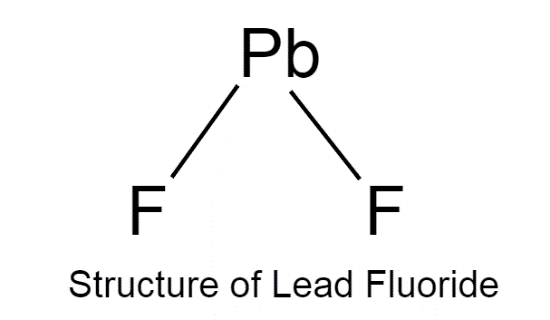
The structure of lead fluoride $Pb{F_2}$ is given below as follows:
Oxidation number is defined as the charge that appears to have on an atom when it forms ionic bonds with other heteroatoms.
To calculate oxidation number of an element in a molecule we will use the following method:
-Check the total charge of the molecule whether it is positive, negative or zero.
-Assume the element to be $x$ whose oxidation state we want to know.
-Oxidation number of the other element present in the molecule.
-Add $x$ and the oxidation number of the other element.
-From all these steps we will get to know the oxidation state of that particular element.
Formula to find oxidation number
$ = x + $ oxidation number of the other element.
Where, $x = $ oxidation state of the element we want to know
So, in lead fluoride $Pb{F_2}$ :
-The total charge of the molecule is zero.
-We assume the oxidation number of lead to be $x$ .
-The oxidation number of fluorine is $ - 1$ because of its high electronegativity. Since there are two fluorines present then the oxidation number of fluorine will be $ - 2$ .
-We will add the charge of fluorine and oxidation number of lead.
Oxidation number $ = x + $ oxidation number of the other element.
Substituting the values we get,
$ = x + \left( { - 2} \right)$
$ = x - 2$
Therefore, $x = 2$
The oxidation number of lead in lead fluoride is $ + 2$ .
So, the correct answer is option b) $ + 2$ .
Note:Due to high electronegativity, fluorine atoms carry negative charge. If oxidation takes place then there will be an increase in oxidation state and if reduction takes place then there will be an increase in oxidation state of that element.
The molecular formula of lead fluoride is $Pb{F_2}$ . If an element is highly electronegative then its oxidation state will be negative.If it is less electronegative than the oxidation state of that element will be positive.
Complete step by step answer:
The structure of lead fluoride $Pb{F_2}$ is given below as follows:
Oxidation number is defined as the charge that appears to have on an atom when it forms ionic bonds with other heteroatoms.
To calculate oxidation number of an element in a molecule we will use the following method:
-Check the total charge of the molecule whether it is positive, negative or zero.
-Assume the element to be $x$ whose oxidation state we want to know.
-Oxidation number of the other element present in the molecule.
-Add $x$ and the oxidation number of the other element.
-From all these steps we will get to know the oxidation state of that particular element.
Formula to find oxidation number
$ = x + $ oxidation number of the other element.
Where, $x = $ oxidation state of the element we want to know
So, in lead fluoride $Pb{F_2}$ :
-The total charge of the molecule is zero.
-We assume the oxidation number of lead to be $x$ .
-The oxidation number of fluorine is $ - 1$ because of its high electronegativity. Since there are two fluorines present then the oxidation number of fluorine will be $ - 2$ .
-We will add the charge of fluorine and oxidation number of lead.
Oxidation number $ = x + $ oxidation number of the other element.
Substituting the values we get,
$ = x + \left( { - 2} \right)$
$ = x - 2$
Therefore, $x = 2$
The oxidation number of lead in lead fluoride is $ + 2$ .
So, the correct answer is option b) $ + 2$ .
Note:Due to high electronegativity, fluorine atoms carry negative charge. If oxidation takes place then there will be an increase in oxidation state and if reduction takes place then there will be an increase in oxidation state of that element.
Recently Updated Pages
Basicity of sulphurous acid and sulphuric acid are

Master Class 12 Economics: Engaging Questions & Answers for Success
Master Class 12 Biology: Engaging Questions & Answers for Success
Master Class 11 English: Engaging Questions & Answers for Success
Master Class 11 Physics: Engaging Questions & Answers for Success
Master Class 11 Computer Science: Engaging Questions & Answers for Success
Trending doubts
Draw a labelled sketch of the human eye class 12 physics CBSE
The chemical formula of tear gas is A CO Cl 2 B C 10 class 12 chemistry CBSE
Draw ray diagrams each showing i myopic eye and ii class 12 physics CBSE
Which are the Top 10 Largest Countries of the World?
Differentiate between homogeneous and heterogeneous class 12 chemistry CBSE
Which is the correct genotypic ratio of mendel dihybrid class 12 biology CBSE