




\[\overset{\to }{\mathop{a}}\,,\overset{\to }{\mathop{b}}\,,\overset{\to }{\mathop{c}}\,\] are those non – coplanar vectors. Then the equation, \[\overset{\to }{\mathop{r}}\,=\left( 1-p-q \right)\overset{\to }{\mathop{a}}\,+p\overset{\to }{\mathop{b}}\,+q\overset{\to }{\mathop{c}}\,\] represents:
(a) A straight line
(b) A plane
(c) A plane passing through the origin
(d) A sphere
Answer
 Verified
612.9k+ views
Hint:\[\overset{\to }{\mathop{a}}\,,\overset{\to }{\mathop{b}}\,\] and \[\overset{\to }{\mathop{c}}\,\] are non –coplanar vectors, represent them in 3D. Take each option, compare the equation given and draw figure and find out what the equation represents.
Complete step-by-step answer:
It is given to us that \[\overset{\to }{\mathop{a}}\,,\overset{\to }{\mathop{b}}\,,\overset{\to }{\mathop{c}}\,\] are 3 non – planar vectors, which means that these 3 vectors \[\overset{\to }{\mathop{a}}\,,\overset{\to }{\mathop{b}}\,\] and \[\overset{\to }{\mathop{c}}\,\] doesn’t lie on the same plane.
Now given to us the equation,
\[\overset{\to }{\mathop{r}}\,=\left( 1-p-q \right)\overset{\to }{\mathop{a}}\,+p\overset{\to }{\mathop{b}}\,+q\overset{\to }{\mathop{c}}\,........(1)\]
Now we need to find what this equation represents.
We can first look into an example of non – coplanar vector \[\overset{\to }{\mathop{a}}\,,\overset{\to }{\mathop{b}}\,\] and \[\overset{\to }{\mathop{c}}\,\].
Now x – axis, y – axis and z – axis, they are all \[{{90}^{\circ }}\] from each other.
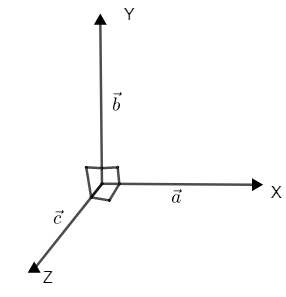
Let us consider first a straight line. Now, non – coplanar vectors doesn’t lie on the same plane, thus they cannot represent a straight line. Thus equation (1) doesn’t represent a straight line.
Now we need to check if equation (1) represents a plane.
Now let's draw the figure as given. Now it became a plane which consists of all the three vectors. Thus we can say that the equation represents a plane.
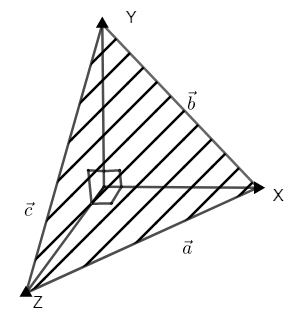
Now let us check with the other option. Now this plane is represented in the three dimensions.
Thus it doesn’t pass through the origin i.e. the plane doesn’t pass through the origin. By comparing the figure and equation (1), it can never represent a sphere.
Thus the equation, \[\overset{\to }{\mathop{r}}\,=\left( 1-p-q \right)\overset{\to }{\mathop{a}}\,+p\overset{\to }{\mathop{b}}\,+q\overset{\to }{\mathop{c}}\,\] represents a plane.
\[\therefore \] Option (b) is the correct answer.
Note: If two vectors are coplanar, then they will lie on the same plane i.e. two vectors are parallel to the xy plane or any plane, they are coplanar. If the given vectors lie in the same line, then they are collinear.
Complete step-by-step answer:
It is given to us that \[\overset{\to }{\mathop{a}}\,,\overset{\to }{\mathop{b}}\,,\overset{\to }{\mathop{c}}\,\] are 3 non – planar vectors, which means that these 3 vectors \[\overset{\to }{\mathop{a}}\,,\overset{\to }{\mathop{b}}\,\] and \[\overset{\to }{\mathop{c}}\,\] doesn’t lie on the same plane.
Now given to us the equation,
\[\overset{\to }{\mathop{r}}\,=\left( 1-p-q \right)\overset{\to }{\mathop{a}}\,+p\overset{\to }{\mathop{b}}\,+q\overset{\to }{\mathop{c}}\,........(1)\]
Now we need to find what this equation represents.
We can first look into an example of non – coplanar vector \[\overset{\to }{\mathop{a}}\,,\overset{\to }{\mathop{b}}\,\] and \[\overset{\to }{\mathop{c}}\,\].
Now x – axis, y – axis and z – axis, they are all \[{{90}^{\circ }}\] from each other.
Let us consider first a straight line. Now, non – coplanar vectors doesn’t lie on the same plane, thus they cannot represent a straight line. Thus equation (1) doesn’t represent a straight line.
Now we need to check if equation (1) represents a plane.
Now let's draw the figure as given. Now it became a plane which consists of all the three vectors. Thus we can say that the equation represents a plane.
Now let us check with the other option. Now this plane is represented in the three dimensions.
Thus it doesn’t pass through the origin i.e. the plane doesn’t pass through the origin. By comparing the figure and equation (1), it can never represent a sphere.
Thus the equation, \[\overset{\to }{\mathop{r}}\,=\left( 1-p-q \right)\overset{\to }{\mathop{a}}\,+p\overset{\to }{\mathop{b}}\,+q\overset{\to }{\mathop{c}}\,\] represents a plane.
\[\therefore \] Option (b) is the correct answer.
Note: If two vectors are coplanar, then they will lie on the same plane i.e. two vectors are parallel to the xy plane or any plane, they are coplanar. If the given vectors lie in the same line, then they are collinear.
Recently Updated Pages
Master Class 11 Business Studies: Engaging Questions & Answers for Success

Master Class 11 Economics: Engaging Questions & Answers for Success
Master Class 11 Computer Science: Engaging Questions & Answers for Success
Master Class 11 English: Engaging Questions & Answers for Success
Master Class 11 Maths: Engaging Questions & Answers for Success
Master Class 11 Biology: Engaging Questions & Answers for Success
Trending doubts
One Metric ton is equal to kg A 10000 B 1000 C 100 class 11 physics CBSE
Discuss the various forms of bacteria class 11 biology CBSE
Draw a diagram of a plant cell and label at least eight class 11 biology CBSE
State the laws of reflection of light
Explain zero factorial class 11 maths CBSE
10 examples of friction in our daily life