




Out of ${H_2}{S_2}{O_3},{H_2}{S_4}{O_6},{H_2}S{O_5}{\text{ and }}{H_2}{S_2}{O_8}$ peroxy acids are:
A. ${H_2}{S_2}{O_3},{H_2}{S_4}{O_6}$
B. ${H_2}{S_4}{O_6},{H_2}S{O_5}$
C. ${H_2}S{O_5}{\text{, }}{H_2}{S_2}{O_8}$
D. ${H_2}{S_2}{O_3},{H_2}{S_2}{O_8}$
Answer
 Verified
627k+ views
Hint: Peroxy acids are those which contain an acidic group $ - OOH$ that is replaced by the $ - OH$ group of an oxyacid. Peroxy acids are frequently used as an oxidant and are also known as peracid.
Complete answer: To find the proxy acid out of the options given we will start by analysing the structures of each compound.
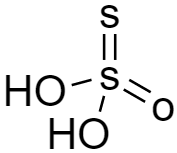
As per the structure of thiosulphuric acid (${H_2}{S_2}{O_3}$) is given below, we can see there is no $ - OOH$ group hence it is not peroxy acid.
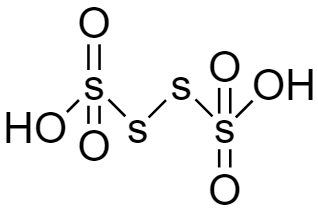
For the structure of Tetrathionic acid (${H_2}{S_4}{O_6}$) given below we can see there is no $ - OOH$ group hence it is also not a peroxy acid.
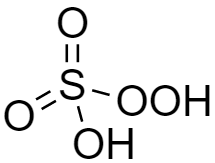
The structure of peroxymonosulfuric acid (${H_2}S{O_5}$) is shown below and we can see there is the presence of one $ - OOH$ group. Hence it is a peroxy acid. This is also known as Caro's acid.
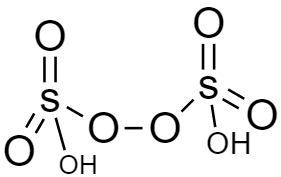
In the structure of peroxodisulfuric acid (${H_2}{S_2}{O_8}$), there is peroxy linkage hence this is also peroxy acid. This is also known as marshall’s acid. The structure is given below:
So, the correct answer is “Option C”.
Additional Information: Caro's acid i.e. peroxymonosulfuric acid is probably the most important inorganic peroxy acid, at least in terms of its production scale. It is used for the bleaching of pulp and the detoxification of cyanide in the mining industries. It is produced by treating sulphuric acid with hydrogen peroxide.
Note: Peroxide acid is generally prepared by reaction of the oxy acid with hydrogen peroxide, some of the sulphuric or other strong acids are often used to accelerate the reaction of weak oxy acid. They readily add oxygen to alkenes to give epoxides and are used to convert ketones into ester and amines into the nitro compound, amine oxides, or nitroso compounds.
Complete answer: To find the proxy acid out of the options given we will start by analysing the structures of each compound.
As per the structure of thiosulphuric acid (${H_2}{S_2}{O_3}$) is given below, we can see there is no $ - OOH$ group hence it is not peroxy acid.
For the structure of Tetrathionic acid (${H_2}{S_4}{O_6}$) given below we can see there is no $ - OOH$ group hence it is also not a peroxy acid.
The structure of peroxymonosulfuric acid (${H_2}S{O_5}$) is shown below and we can see there is the presence of one $ - OOH$ group. Hence it is a peroxy acid. This is also known as Caro's acid.
In the structure of peroxodisulfuric acid (${H_2}{S_2}{O_8}$), there is peroxy linkage hence this is also peroxy acid. This is also known as marshall’s acid. The structure is given below:
So, the correct answer is “Option C”.
Additional Information: Caro's acid i.e. peroxymonosulfuric acid is probably the most important inorganic peroxy acid, at least in terms of its production scale. It is used for the bleaching of pulp and the detoxification of cyanide in the mining industries. It is produced by treating sulphuric acid with hydrogen peroxide.
Note: Peroxide acid is generally prepared by reaction of the oxy acid with hydrogen peroxide, some of the sulphuric or other strong acids are often used to accelerate the reaction of weak oxy acid. They readily add oxygen to alkenes to give epoxides and are used to convert ketones into ester and amines into the nitro compound, amine oxides, or nitroso compounds.
Recently Updated Pages
Master Class 5 English: Engaging Questions & Answers for Success

Master Class 5 Maths: Engaging Questions & Answers for Success
Master Class 5 Social Science: Engaging Questions & Answers for Success
Master Class 5 Science: Engaging Questions & Answers for Success
Class 5 Question and Answer - Your Ultimate Solutions Guide
Master Class 9 General Knowledge: Engaging Questions & Answers for Success
Trending doubts
One Metric ton is equal to kg A 10000 B 1000 C 100 class 11 physics CBSE
What is cell theory Who formulated it class 11 biology CBSE
Phyllotaxy is the arrangement of ALeaflets BLeaves class 11 biology CBSE
Difference Between Prokaryotic Cells and Eukaryotic Cells
The symbiotic association of fungi and algae is called class 11 biology CBSE
Cell theory was formulated by A Schleiden and Schwann class 11 biology CBSE