




Out of 150 students who read newspapers at least one of newspapers; The Times of India, The Hindustan Times, and The Hindu, there are 65 who read The Times of India, 41 who read The Hindu and 50 who read The Hindustan Times. What is the maximum possible number of students who read all three newspapers?
A. 7
B. 42
C. 3
D. Cannot be determined
Answer
 Verified
586.2k+ views
Hint: Let the number of students who read all the newspapers be $x$. Since, we have to find the maximum value of $x$, then there is no student who reads only 2 newspapers. Hence, determine the number of students who read only one newspaper. Then use the condition that there are a total 150 students to find the value of $x$.
Complete step-by-step answer:
Here, we are given that the number of students who read the newspapers is 150.
We have to find the maximum possible number of students who read all the three newspapers.
Then, we will assume, there is no student who reads only 2 newspapers.
That is either a student reads only one newspaper or he reads all the newspapers.
Let the number of students who read all the newspaper be $x$, then the students who read only The Times of India be $65 - x$ , the number of students who read only The Hindustan Times be $50 - x$ and the students who read only The Hindu be $41 - x$.
We will represent the above information in a Venn-diagram.
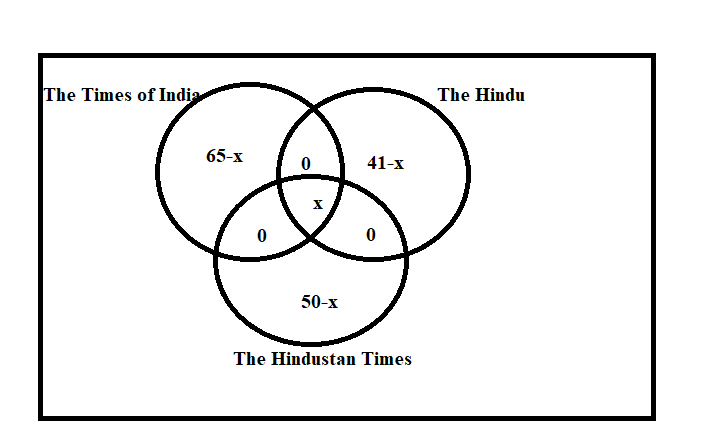
Also, We are given that there are a total of 150 students.
This implies,
$65 - x + 50 - x + 41 - x + x = 150$
On solving the above equation, we will get,
$
65 + 50 + 41 - 2x = 150 \\
\Rightarrow 156 - 2x = 150 \\
\Rightarrow 2x = 6 \\
$
On dividing the equation by 2, we will get,
$x = 3$
Therefore, there can be a maximum of three students who read all the three newspapers.
Hence, option C is correct.
Note: Many students by ignoring the word maximum in the above question. They find the data incomplete and select option D which is incorrect. A Venn-diagram helps us to understand the problem in a better way. But, this question can also be done by using the formula, $n\left( {A \cup B \cup C} \right) = n\left( A \right) + n\left( B \right) + n\left( C \right) - n\left( {A \cap B} \right) - n\left( {B \cap C} \right) - n\left( {A \cap C} \right) + n\left( {A \cap B \cap C} \right)$
Complete step-by-step answer:
Here, we are given that the number of students who read the newspapers is 150.
We have to find the maximum possible number of students who read all the three newspapers.
Then, we will assume, there is no student who reads only 2 newspapers.
That is either a student reads only one newspaper or he reads all the newspapers.
Let the number of students who read all the newspaper be $x$, then the students who read only The Times of India be $65 - x$ , the number of students who read only The Hindustan Times be $50 - x$ and the students who read only The Hindu be $41 - x$.
We will represent the above information in a Venn-diagram.
Also, We are given that there are a total of 150 students.
This implies,
$65 - x + 50 - x + 41 - x + x = 150$
On solving the above equation, we will get,
$
65 + 50 + 41 - 2x = 150 \\
\Rightarrow 156 - 2x = 150 \\
\Rightarrow 2x = 6 \\
$
On dividing the equation by 2, we will get,
$x = 3$
Therefore, there can be a maximum of three students who read all the three newspapers.
Hence, option C is correct.
Note: Many students by ignoring the word maximum in the above question. They find the data incomplete and select option D which is incorrect. A Venn-diagram helps us to understand the problem in a better way. But, this question can also be done by using the formula, $n\left( {A \cup B \cup C} \right) = n\left( A \right) + n\left( B \right) + n\left( C \right) - n\left( {A \cap B} \right) - n\left( {B \cap C} \right) - n\left( {A \cap C} \right) + n\left( {A \cap B \cap C} \right)$
Recently Updated Pages
Master Class 11 Computer Science: Engaging Questions & Answers for Success

Master Class 11 Business Studies: Engaging Questions & Answers for Success
Master Class 11 Economics: Engaging Questions & Answers for Success
Master Class 11 English: Engaging Questions & Answers for Success
Master Class 11 Maths: Engaging Questions & Answers for Success
Master Class 11 Biology: Engaging Questions & Answers for Success
Trending doubts
One Metric ton is equal to kg A 10000 B 1000 C 100 class 11 physics CBSE
There are 720 permutations of the digits 1 2 3 4 5 class 11 maths CBSE
Discuss the various forms of bacteria class 11 biology CBSE
Draw a diagram of a plant cell and label at least eight class 11 biology CBSE
State the laws of reflection of light
10 examples of friction in our daily life