




Out of 100 students, 15 passed in English, 12 passed in Mathematics, 8 in Science, 6 in English & Mathematics, 7Mathematics and Science, 4 English & Science, 4 in all the three. Find how many passes
1.In English & Mathematics but not in Science
2.In Mathematics & Science but not in English
3.In only Mathematics
4.In more than one subject only
Answer
 Verified
610.2k+ views
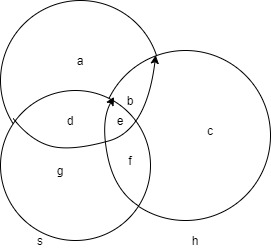
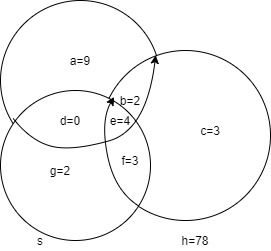
Hint: Draw Venn-diagram for three sets, start from all three regions then complete for two common sets then thirdly for the full set also label the regions so that we can easily solve the questions in different questions in different parts.
Formula used:
1.$n\left( AuBuC \right)=n\left( A \right)+n\left( B \right)+n\left( C \right)=n\left( A\bigcap B \right)-n\left( B\bigcap C \right)-n\left( A\bigcap C \right)+n\left( A\bigcap B\bigcap C \right)$
2.$\text{Number of students studying English }\!\!\And\!\!\text{ Maths but not science}=n\left( E\bigcap M \right)-n\left( E\bigcap M\bigcap S \right)$
3.$\text{Number}$ $\text{Math }\!\!\And\!\!\text{ Science but not English}=n\left( M\bigcap S \right)-n\left( E\bigcap M\bigcap S \right)$
4.$\text{No of students study only Mathematics}=n\left( E\bigcap M \right)-n\left( S\bigcap M \right)+n\left( E\bigcap M\bigcap B \right)$
5.$\text{More than one subject}=n\left( E\bigcap M \right)+n\left( E\bigcap S \right)-n\left( E\bigcap M\bigcap S \right)$
Complete step-by-step answer:
$\begin{align}
& \text{Total number of students}=100 \\
& \text{ Number of students }n\left( E \right)=15 \\
& \text{ }n\left( M \right)=12 \\
& \text{ }n\left( S \right)=8 \\
\end{align}$
$\begin{align}
& \text{ }E\text{ and }M\text{ }n\left( E\bigcap M \right)=6 \\
& \text{ }n\left( M\bigcap S \right)=7 \\
& \text{ }n\left( E\bigcap S \right)=4 \\
& \text{ }n\left( E\bigcap S\bigcap M \right)=4 \\
\end{align}$
\[\begin{align}
& n\left( E\bigcap S\bigcap M \right)=n\left( E \right)+n\left( S \right)+n\left( M \right)-n\left( E\bigcap S \right) \\
& \text{ }-n\left( S\bigcap M \right)-n\left( M\bigcap E \right)+n\left( M\bigcap E\bigcap S \right) \\
\end{align}\]
\[\begin{align}
& =15+12+8-4-7-6+4 \\
& \text{ }=22 \\
\end{align}\]
$\begin{align}
& \text{Number of students those who study either of the three subjects}=22 \\
& a+b+c+d+e+f+g=22 \\
& \text{Therefore number of students those who study none of the subject}=100-22 \\
& \text{ }=78 \\
& \text{ }=h \\
\end{align}$
$\text{Number of students study English }\!\!\And\!\!\text{ Mathematics but not Science}=n\left( E\bigcap M \right)-n\left( E\bigcap M\bigcap S \right)$
$\begin{align}
& =\text{Number of students studyingstuding English }\!\!\And\!\!\text{ Mathematics}-\text{Number of students studyingstuding all three subjects}\text{.} \\
& \text{=6}-4 \\
& =2 \\
\end{align}$
$\text{Number of studentsos students studying Mathematics }\!\!\And\!\!\text{ Science but not English}=n\left( M\bigcap S \right)-n\left( M\bigcap S\bigcap E \right)$ $\begin{align}
& =7-4 \\
& =3 \\
\end{align}$
\[\text{Number of students studying Only Mathematics}=n\left( M \right)-n\left( M\bigcap E \right)-n\left( M\bigcap E \right)+n\left( M\bigcap S\bigcap E \right)\] \[\begin{align}
& =12-\text{6}-7+4 \\
& =3 \\
\end{align}\]
\[\text{Number of students studying more than one subject}=n\left( M\bigcap S \right)+n\left( S\bigcap E \right)+n\left( E\bigcap M \right)-2\left( E\bigcap M\bigcap S \right)\]
$\begin{align}
& =6+7+4-2\times \left( 4 \right) \\
& =17-8=9 \\
\end{align}$
Note: We can plot the values of a, b, c, d, e, f, g & h orally. We start with placing the values of e by i.e. common region of all three subjects. After this we can find the value of e, d and f i.e. common region for two subjects then we calculate a, g, c the region for one subject and finally we can calculate h by subtracting from total$-\left( \text{a}+\text{b}+\text{c}+\text{d}+\text{e}+\text{f}+\text{g} \right)$ .
Formula used:
1.$n\left( AuBuC \right)=n\left( A \right)+n\left( B \right)+n\left( C \right)=n\left( A\bigcap B \right)-n\left( B\bigcap C \right)-n\left( A\bigcap C \right)+n\left( A\bigcap B\bigcap C \right)$
2.$\text{Number of students studying English }\!\!\And\!\!\text{ Maths but not science}=n\left( E\bigcap M \right)-n\left( E\bigcap M\bigcap S \right)$
3.$\text{Number}$ $\text{Math }\!\!\And\!\!\text{ Science but not English}=n\left( M\bigcap S \right)-n\left( E\bigcap M\bigcap S \right)$
4.$\text{No of students study only Mathematics}=n\left( E\bigcap M \right)-n\left( S\bigcap M \right)+n\left( E\bigcap M\bigcap B \right)$
5.$\text{More than one subject}=n\left( E\bigcap M \right)+n\left( E\bigcap S \right)-n\left( E\bigcap M\bigcap S \right)$
Complete step-by-step answer:
$\begin{align}
& \text{Total number of students}=100 \\
& \text{ Number of students }n\left( E \right)=15 \\
& \text{ }n\left( M \right)=12 \\
& \text{ }n\left( S \right)=8 \\
\end{align}$
$\begin{align}
& \text{ }E\text{ and }M\text{ }n\left( E\bigcap M \right)=6 \\
& \text{ }n\left( M\bigcap S \right)=7 \\
& \text{ }n\left( E\bigcap S \right)=4 \\
& \text{ }n\left( E\bigcap S\bigcap M \right)=4 \\
\end{align}$
\[\begin{align}
& n\left( E\bigcap S\bigcap M \right)=n\left( E \right)+n\left( S \right)+n\left( M \right)-n\left( E\bigcap S \right) \\
& \text{ }-n\left( S\bigcap M \right)-n\left( M\bigcap E \right)+n\left( M\bigcap E\bigcap S \right) \\
\end{align}\]
\[\begin{align}
& =15+12+8-4-7-6+4 \\
& \text{ }=22 \\
\end{align}\]
$\begin{align}
& \text{Number of students those who study either of the three subjects}=22 \\
& a+b+c+d+e+f+g=22 \\
& \text{Therefore number of students those who study none of the subject}=100-22 \\
& \text{ }=78 \\
& \text{ }=h \\
\end{align}$
$\text{Number of students study English }\!\!\And\!\!\text{ Mathematics but not Science}=n\left( E\bigcap M \right)-n\left( E\bigcap M\bigcap S \right)$
$\begin{align}
& =\text{Number of students studyingstuding English }\!\!\And\!\!\text{ Mathematics}-\text{Number of students studyingstuding all three subjects}\text{.} \\
& \text{=6}-4 \\
& =2 \\
\end{align}$
$\text{Number of studentsos students studying Mathematics }\!\!\And\!\!\text{ Science but not English}=n\left( M\bigcap S \right)-n\left( M\bigcap S\bigcap E \right)$ $\begin{align}
& =7-4 \\
& =3 \\
\end{align}$
\[\text{Number of students studying Only Mathematics}=n\left( M \right)-n\left( M\bigcap E \right)-n\left( M\bigcap E \right)+n\left( M\bigcap S\bigcap E \right)\] \[\begin{align}
& =12-\text{6}-7+4 \\
& =3 \\
\end{align}\]
\[\text{Number of students studying more than one subject}=n\left( M\bigcap S \right)+n\left( S\bigcap E \right)+n\left( E\bigcap M \right)-2\left( E\bigcap M\bigcap S \right)\]
$\begin{align}
& =6+7+4-2\times \left( 4 \right) \\
& =17-8=9 \\
\end{align}$
Note: We can plot the values of a, b, c, d, e, f, g & h orally. We start with placing the values of e by i.e. common region of all three subjects. After this we can find the value of e, d and f i.e. common region for two subjects then we calculate a, g, c the region for one subject and finally we can calculate h by subtracting from total$-\left( \text{a}+\text{b}+\text{c}+\text{d}+\text{e}+\text{f}+\text{g} \right)$ .
Recently Updated Pages
Master Class 11 English: Engaging Questions & Answers for Success

Master Class 11 Social Science: Engaging Questions & Answers for Success
Master Class 11 Maths: Engaging Questions & Answers for Success
Master Class 11 Biology: Engaging Questions & Answers for Success
Master Class 11 Physics: Engaging Questions & Answers for Success
Master Class 11 Chemistry: Engaging Questions & Answers for Success
Trending doubts
One Metric ton is equal to kg A 10000 B 1000 C 100 class 11 physics CBSE
Difference Between Prokaryotic Cells and Eukaryotic Cells
Difference between physical and chemical change class 11 chemistry CBSE
Find the value of the expression given below sin 30circ class 11 maths CBSE
Two of the body parts which do not appear in MRI are class 11 biology CBSE
Draw a diagram of a plant cell and label at least eight class 11 biology CBSE