




Out of 100 persons in a group, 72 persons speak English and 43 persons speak French. Each one of 100 people speak at least one language. Then how many speak only English? How many speak only French? How many of them speak English and French both?
Answer
 Verified
646.8k+ views
Hint- Here, we will proceed by drawing the Venn diagram corresponding to the problem statement. Then, we will be applying the formula i.e., n(E$ \cup $F) = n(E) + n(F) - n(E$ \cap $F) where E and F are any two sets.
Complete Step-by-Step solution:
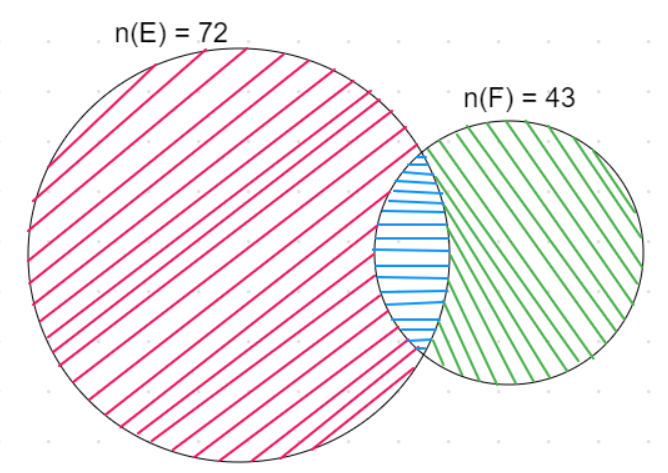
Given, Number of persons who speak English i.e., n(E) = 72
Number of persons who speak French i.e., n(F) = 43
It is also given that every person at least speaks only language which means that the universal set of all the persons is same as the union set of persons who speaks English and French
i.e., n(E$ \cup $F) = 100
As we know that for any two sets E and F, we can write
n(E$ \cup $F) = n(E) + n(F) - n(E$ \cap $F)
$ \Rightarrow $n(E$ \cap $F) = n(E) +n(F) - n(E$ \cup $F)
By substituting n(E) = 72, n(F) = 43 and n(E$ \cup $F) = 100 in the above equation, we have
$ \Rightarrow $n(E$ \cap $F) = 72 + 43 – 100 = 15
Where n(E$ \cap $F) represents the number of persons who speaks both English and French (coloured blue in the figure)
From the figure, we can write
Number of persons who speak only English = n(E) - n(E$ \cap $F) = 72 – 15 = 57
Therefore, 57 persons speak only English (coloured red in the figure).
Similarly, Number of persons who speak only French = n(F) - n(E$ \cap $F) = 43 – 15 = 28
Therefore, 28 persons speak only French (coloured green in the figure).
Also, 15 people speak both English and French (coloured blue in the figure).
Note- In this particular problem, the universal set of all persons is the same as the union set of persons who speak English and French because here each one of 100 people speak at least one language. If we would have given that there can be persons who speak none of these languages then, the universal set of all the persons will be different from the union set of persons who speak English and French.
Complete Step-by-Step solution:
Given, Number of persons who speak English i.e., n(E) = 72
Number of persons who speak French i.e., n(F) = 43
It is also given that every person at least speaks only language which means that the universal set of all the persons is same as the union set of persons who speaks English and French
i.e., n(E$ \cup $F) = 100
As we know that for any two sets E and F, we can write
n(E$ \cup $F) = n(E) + n(F) - n(E$ \cap $F)
$ \Rightarrow $n(E$ \cap $F) = n(E) +n(F) - n(E$ \cup $F)
By substituting n(E) = 72, n(F) = 43 and n(E$ \cup $F) = 100 in the above equation, we have
$ \Rightarrow $n(E$ \cap $F) = 72 + 43 – 100 = 15
Where n(E$ \cap $F) represents the number of persons who speaks both English and French (coloured blue in the figure)
From the figure, we can write
Number of persons who speak only English = n(E) - n(E$ \cap $F) = 72 – 15 = 57
Therefore, 57 persons speak only English (coloured red in the figure).
Similarly, Number of persons who speak only French = n(F) - n(E$ \cap $F) = 43 – 15 = 28
Therefore, 28 persons speak only French (coloured green in the figure).
Also, 15 people speak both English and French (coloured blue in the figure).
Note- In this particular problem, the universal set of all persons is the same as the union set of persons who speak English and French because here each one of 100 people speak at least one language. If we would have given that there can be persons who speak none of these languages then, the universal set of all the persons will be different from the union set of persons who speak English and French.
Recently Updated Pages
Master Class 12 Economics: Engaging Questions & Answers for Success

Master Class 12 English: Engaging Questions & Answers for Success
Master Class 12 Social Science: Engaging Questions & Answers for Success
Master Class 12 Maths: Engaging Questions & Answers for Success
Master Class 12 Physics: Engaging Questions & Answers for Success
Master Class 9 General Knowledge: Engaging Questions & Answers for Success
Trending doubts
Explain the Treaty of Vienna of 1815 class 10 social science CBSE
Why is it 530 pm in india when it is 1200 afternoon class 10 social science CBSE
What is the full form of POSCO class 10 social science CBSE
Define Potential, Developed, Stock and Reserved resources
Which Country Has the Largest Border with India?
Complete the sentence with the most appropriate word class 10 english CBSE