




How do our eyes and brain perceive color pictures?
Answer
 Verified
549.6k+ views
Hint: Image formation is an optical phenomenon and formation of images occurs on the retina of the eye. Humans can see different colors and objects because of the concerted actions of the eyes and brain. Signals of image formation are sent to the brain and the images are perceived on the retina of eyes. Various cells are involved in this work which help us distinguish and identify different colors.
Complete solution:
Brain and eyes work in conjunction with each other ensuring us to see the colourful world.
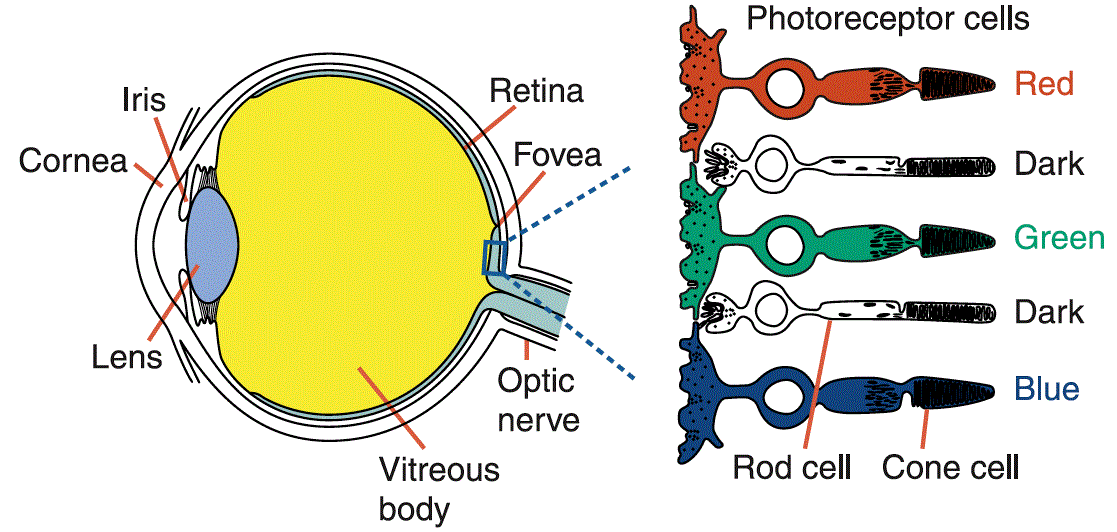
Images are formed on the retina of the eye through certain photoreceptors.
Photoreceptors are cells in the retina which are responsible for our color vision and night vision.
Rods and cones are two kinds of photoreceptors found in the retina of the eye. Cones are sensitive to diverse colours, whereas rods are sensitive to light.
There are generally three different types of cones which can recognize red, green and blue colors. All other colors are recognized as a mix of these three primary colors.
The cones see colours, and the impulse is conveyed to the optic nerve through bipolar neurons. The communication is sent to the occipital lobe, where the colours are seen by the brain.
Note:
The visual system of the human body consists of the - eye, optic nerve and the occipital lobe of the brain. The lens and the retina of the eye are the major parts of the eye which are involved in image formation. Certain disorders lead to inability to distinguish colors called color blindness. In colorblindness the defects occur in the cones of the eye.
Complete solution:
Brain and eyes work in conjunction with each other ensuring us to see the colourful world.
Images are formed on the retina of the eye through certain photoreceptors.
Photoreceptors are cells in the retina which are responsible for our color vision and night vision.
Rods and cones are two kinds of photoreceptors found in the retina of the eye. Cones are sensitive to diverse colours, whereas rods are sensitive to light.
There are generally three different types of cones which can recognize red, green and blue colors. All other colors are recognized as a mix of these three primary colors.
The cones see colours, and the impulse is conveyed to the optic nerve through bipolar neurons. The communication is sent to the occipital lobe, where the colours are seen by the brain.
Note:
The visual system of the human body consists of the - eye, optic nerve and the occipital lobe of the brain. The lens and the retina of the eye are the major parts of the eye which are involved in image formation. Certain disorders lead to inability to distinguish colors called color blindness. In colorblindness the defects occur in the cones of the eye.
Recently Updated Pages
Master Class 11 English: Engaging Questions & Answers for Success

Master Class 11 Social Science: Engaging Questions & Answers for Success
Master Class 11 Maths: Engaging Questions & Answers for Success
Master Class 11 Biology: Engaging Questions & Answers for Success
Master Class 11 Physics: Engaging Questions & Answers for Success
Master Class 11 Chemistry: Engaging Questions & Answers for Success
Trending doubts
One Metric ton is equal to kg A 10000 B 1000 C 100 class 11 physics CBSE
Difference Between Prokaryotic Cells and Eukaryotic Cells
Difference between physical and chemical change class 11 chemistry CBSE
Find the value of the expression given below sin 30circ class 11 maths CBSE
Two of the body parts which do not appear in MRI are class 11 biology CBSE
Draw a diagram of a plant cell and label at least eight class 11 biology CBSE