




Osmoregulation is carried out by
(a)Ureter
(b)Nephron
(c)ACTH
(d)ADH
Answer
 Verified
591.3k+ views
Hint: This is a type of hormone which is synthesized in the hypothalamus and secreted by the posterior pituitary gland. It is also known as Vasopressin.
Complete answer:
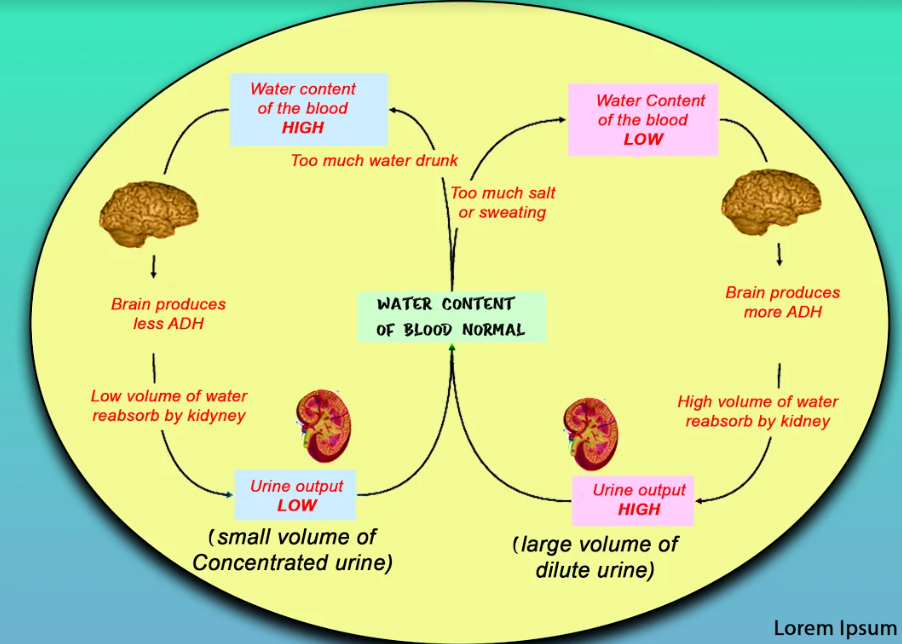
Antidiuretic hormone (ADH) is the hormone that plays a major role in osmoregulation by controlling the amount of urine formation. The process that regulates the osmotic pressure of fluids and electrolyte balance in organisms is osmoregulation. This process is brought about by osmoreceptors, which can detect changes in osmotic pressure. Organisms have osmoreceptors in the hypothalamus. Osmoregulators are also found in the kidneys, besides the brain.
ADH (Antidiuretic Hormone):
-The body maintains water and electrolytes concentration at a relatively constant level by the mechanism of osmoregulation. Hormones are important signaling molecules that control the regulatory process.
-When blood becomes more concentrated and has only a little amount of water intake and excessive loss of water by sweating or by consumption of large amounts of salt. These conditions are responsible for raised plasma solute concentration ie., decrease in blood volume.
-The osmoreceptors of the Hypothalamus detect an increase in plasma solute concentration and signal the posterior pituitary gland to release ADH.
-ADH passes to the kidney via the blood as chemical messengers.
-ADH regulates water reabsorption by increasing the permeability of distal convoluted tubules and collecting ducts to water by opening water channels. Water channels are proteins, which are synthesized by the Golgi complex.
So, the correct answer is ‘ADH’.
Note: -DCT is a distal convoluted duct, which is a part of the nephron.
-In Diuresis, the release of ADH is inhibited When the intake of water is high. It causes the wall of DCT and collecting duct to become impermeable to water causing large volume and hypotonic urine production.
Complete answer:
Antidiuretic hormone (ADH) is the hormone that plays a major role in osmoregulation by controlling the amount of urine formation. The process that regulates the osmotic pressure of fluids and electrolyte balance in organisms is osmoregulation. This process is brought about by osmoreceptors, which can detect changes in osmotic pressure. Organisms have osmoreceptors in the hypothalamus. Osmoregulators are also found in the kidneys, besides the brain.
ADH (Antidiuretic Hormone):
-The body maintains water and electrolytes concentration at a relatively constant level by the mechanism of osmoregulation. Hormones are important signaling molecules that control the regulatory process.
-When blood becomes more concentrated and has only a little amount of water intake and excessive loss of water by sweating or by consumption of large amounts of salt. These conditions are responsible for raised plasma solute concentration ie., decrease in blood volume.
-The osmoreceptors of the Hypothalamus detect an increase in plasma solute concentration and signal the posterior pituitary gland to release ADH.
-ADH passes to the kidney via the blood as chemical messengers.
-ADH regulates water reabsorption by increasing the permeability of distal convoluted tubules and collecting ducts to water by opening water channels. Water channels are proteins, which are synthesized by the Golgi complex.
So, the correct answer is ‘ADH’.
Note: -DCT is a distal convoluted duct, which is a part of the nephron.
-In Diuresis, the release of ADH is inhibited When the intake of water is high. It causes the wall of DCT and collecting duct to become impermeable to water causing large volume and hypotonic urine production.
Recently Updated Pages
Master Class 11 Social Science: Engaging Questions & Answers for Success

Master Class 11 English: Engaging Questions & Answers for Success
Master Class 11 Maths: Engaging Questions & Answers for Success
Master Class 11 Chemistry: Engaging Questions & Answers for Success
Master Class 11 Biology: Engaging Questions & Answers for Success
Master Class 11 Physics: Engaging Questions & Answers for Success
Trending doubts
One Metric ton is equal to kg A 10000 B 1000 C 100 class 11 physics CBSE
Difference Between Prokaryotic Cells and Eukaryotic Cells
Draw a diagram of a plant cell and label at least eight class 11 biology CBSE
Two of the body parts which do not appear in MRI are class 11 biology CBSE
Which gas is abundant in air class 11 chemistry CBSE
10 examples of friction in our daily life