




What is the order of the rotational symmetry of the given figure?

Answer
 Verified
633.3k+ views
Hint: Think of the basic definition of the axis of symmetry and think of the angle by which the rotation of the body about the given axis gives the exact identical figure to find the order of rotational symmetry.
Complete step-by-step answer:
Before starting with the solution, let us discuss the elements of symmetry and when a body is said to be symmetric or asymmetric. First, we will discuss the two major elements of symmetry, which are the line of symmetry and axis of symmetry.
The "Line of Symmetry" is the imaginary line through the body, which divides the body into two equal halves such that the parts on each side of the body are the mirror images of each other. While the axis of symmetry is an axis passing through the body about which the rotation of the body gives the exact identical figure as the initial one, provided the angle of rotation is less than , and the number of times the figure is repeated while rotating it by is the order of the rotational symmetry.
If a body consists of at least one of the elements of symmetry mentioned above is said to be symmetric. We can represent this diagrammatically as:
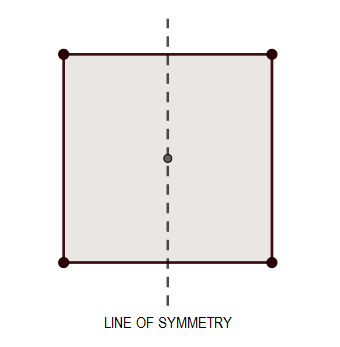
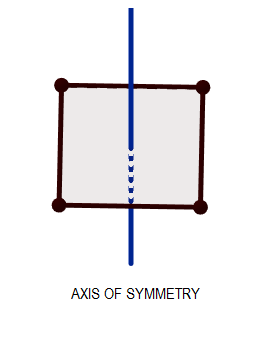
Now let us start the solution to the above question by drawing the diagram of the situation given in the figure.

Now, if we rotate the figure by $60{}^\circ $ about the axis passing through the centre marked in the figure and perpendicular to the plane of the paper, we will find the figure we get is exactly the same as the figure given. So, for every $60{}^\circ $ rotation, we get the same identical figure. Therefore, we can say that the order of rotational symmetry is equal to $\dfrac{360{}^\circ }{60{}^\circ }$ , which is equal to 6.
Note: Remember that it is possible that a figure can have multiple elements of symmetry. For example: a circle has an infinite number of lines of symmetry and one axis of rotational symmetry with infinite order of rotational symmetry.
Complete step-by-step answer:
Before starting with the solution, let us discuss the elements of symmetry and when a body is said to be symmetric or asymmetric. First, we will discuss the two major elements of symmetry, which are the line of symmetry and axis of symmetry.
The "Line of Symmetry" is the imaginary line through the body, which divides the body into two equal halves such that the parts on each side of the body are the mirror images of each other. While the axis of symmetry is an axis passing through the body about which the rotation of the body gives the exact identical figure as the initial one, provided the angle of rotation is less than , and the number of times the figure is repeated while rotating it by is the order of the rotational symmetry.
If a body consists of at least one of the elements of symmetry mentioned above is said to be symmetric. We can represent this diagrammatically as:
Now let us start the solution to the above question by drawing the diagram of the situation given in the figure.
Now, if we rotate the figure by $60{}^\circ $ about the axis passing through the centre marked in the figure and perpendicular to the plane of the paper, we will find the figure we get is exactly the same as the figure given. So, for every $60{}^\circ $ rotation, we get the same identical figure. Therefore, we can say that the order of rotational symmetry is equal to $\dfrac{360{}^\circ }{60{}^\circ }$ , which is equal to 6.
Note: Remember that it is possible that a figure can have multiple elements of symmetry. For example: a circle has an infinite number of lines of symmetry and one axis of rotational symmetry with infinite order of rotational symmetry.
Recently Updated Pages
Master Class 12 Business Studies: Engaging Questions & Answers for Success

Master Class 12 Biology: Engaging Questions & Answers for Success
Master Class 12 Chemistry: Engaging Questions & Answers for Success
Class 12 Question and Answer - Your Ultimate Solutions Guide
Master Class 11 Social Science: Engaging Questions & Answers for Success
Master Class 11 English: Engaging Questions & Answers for Success
Trending doubts
What is BLO What is the full form of BLO class 8 social science CBSE
Citizens of India can vote at the age of A 18 years class 8 social science CBSE
Right to vote is a AFundamental Right BFundamental class 8 social science CBSE
Name the states through which the Tropic of Cancer class 8 social science CBSE
Give me the opposite gender of Duck class 8 english CBSE
What are the 12 elements of nature class 8 chemistry CBSE