




How can the orbital semi-major axis, eccentricity, and period be calculated if perihelion and aphelion are known?
Answer
 Verified
576.3k+ views
Hint: Ellipse is the locus of all the points in the plane. Ellipse has its centre point, major axis, minoraxis. The major axis is the axis which is the longest diameter of the ellipse. The minor axis is called the shortest diameter of the ellipse. The eccentricity defines the elongation of the ellipse. The eccentricity, e lies in between \[0\] and \[1\] .
Complete step by step answer:
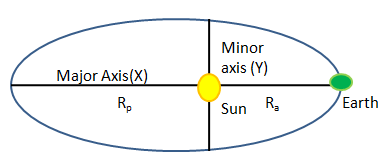
To find semi-major axis:
• We know that the longest diameter of the ellipse is called the major-axis. The half of the major axis is called the semi-major axis.
• We can find the semi-major axis by knowing the perihelion and aphelion distance.
• In the ellipse, the shortest distance from the centre of the ellipse is called perihelion. The farthest distance from the centre is called aphelion. In Greek, ‘Peri’ means close and ‘Apo’ means far. And ‘Helio’ means sun. Therefore here the ellipse is the orbit of the Earth around the sun.
• The sum of perihelion and the aphelion gives the value of the major axis as the sum defines the largest diameter. By just dividing the major axis, we can find semi-major axes.
• Lets take \[R\] is the average distance of the Earth from the sun. The perihelion value is taken as \[{R_p}\] and the aphelion value is taken as \[{R_a}\]
Therefore,
\[R = \dfrac{{{R_p} + {R_a}}}{2}\]
This \[R\]value gives the value of the semi-major axis.
To find the eccentricity:
• The value of eccentricity defines how much the ellipse is elongated. The value of eccentricity is denoted by ‘e’. The value of ‘e’ lies in between \[0\] and \[1\].
• The perihelion value is taken as \[{R_p}\] and the aphelion value is taken as \[{R_a}\]
\[ \Rightarrow {R_a} = 1 + e\]
\[ \Rightarrow {R_p} = 1 - e\]
Dividing these two values give,
\[\dfrac{{{R_a}}}{{{R_p}}} = \dfrac{{1 + e}}{{1 - e}}\]
\[ \Rightarrow {R_a}(1 - e) = {R_p}(1 + e)\]
\[ \Rightarrow {R_a} - {R_p} = \left( {{R_p} + {R_a}} \right)e\]
\[\therefore e = \dfrac{{{R_a} - {R_p}}}{{{R_p} + {R_a}}}\]
Hence the value of eccentricity can be found by perihelion and aphelion.
To find period:
• According to Kepler’s 3rd law, the square of the orbital time period is directly proportional to the cube of the average distance from the sun i.e. \[{T^2}\alpha {R^3}\]
\[\therefore \dfrac{{{T^2}}}{{{R^3}}} = C\]
\[ \Rightarrow T = \sqrt {C{R^3}} \]
• We already found the value of \[R\] by using perihelion and aphelion values. Now we can find the orbital time period by using the value of \[R\].
Note:
• Kepler’s 3rd law applies to orbiting bodies like the sun. The value of C only differs with respect to the average distance of the orbit.
• Earth’s average distance \[R\] is equal to 1AU.
• The Earth approaches its nearest point ‘perihelion’ with the sun in the month of January. It approaches its farthest point ‘aphelion’ in the month of July.
Complete step by step answer:
To find semi-major axis:
• We know that the longest diameter of the ellipse is called the major-axis. The half of the major axis is called the semi-major axis.
• We can find the semi-major axis by knowing the perihelion and aphelion distance.
• In the ellipse, the shortest distance from the centre of the ellipse is called perihelion. The farthest distance from the centre is called aphelion. In Greek, ‘Peri’ means close and ‘Apo’ means far. And ‘Helio’ means sun. Therefore here the ellipse is the orbit of the Earth around the sun.
• The sum of perihelion and the aphelion gives the value of the major axis as the sum defines the largest diameter. By just dividing the major axis, we can find semi-major axes.
• Lets take \[R\] is the average distance of the Earth from the sun. The perihelion value is taken as \[{R_p}\] and the aphelion value is taken as \[{R_a}\]
Therefore,
\[R = \dfrac{{{R_p} + {R_a}}}{2}\]
This \[R\]value gives the value of the semi-major axis.
To find the eccentricity:
• The value of eccentricity defines how much the ellipse is elongated. The value of eccentricity is denoted by ‘e’. The value of ‘e’ lies in between \[0\] and \[1\].
• The perihelion value is taken as \[{R_p}\] and the aphelion value is taken as \[{R_a}\]
\[ \Rightarrow {R_a} = 1 + e\]
\[ \Rightarrow {R_p} = 1 - e\]
Dividing these two values give,
\[\dfrac{{{R_a}}}{{{R_p}}} = \dfrac{{1 + e}}{{1 - e}}\]
\[ \Rightarrow {R_a}(1 - e) = {R_p}(1 + e)\]
\[ \Rightarrow {R_a} - {R_p} = \left( {{R_p} + {R_a}} \right)e\]
\[\therefore e = \dfrac{{{R_a} - {R_p}}}{{{R_p} + {R_a}}}\]
Hence the value of eccentricity can be found by perihelion and aphelion.
To find period:
• According to Kepler’s 3rd law, the square of the orbital time period is directly proportional to the cube of the average distance from the sun i.e. \[{T^2}\alpha {R^3}\]
\[\therefore \dfrac{{{T^2}}}{{{R^3}}} = C\]
\[ \Rightarrow T = \sqrt {C{R^3}} \]
• We already found the value of \[R\] by using perihelion and aphelion values. Now we can find the orbital time period by using the value of \[R\].
Note:
• Kepler’s 3rd law applies to orbiting bodies like the sun. The value of C only differs with respect to the average distance of the orbit.
• Earth’s average distance \[R\] is equal to 1AU.
• The Earth approaches its nearest point ‘perihelion’ with the sun in the month of January. It approaches its farthest point ‘aphelion’ in the month of July.
Recently Updated Pages
Master Class 10 English: Engaging Questions & Answers for Success

Master Class 10 Social Science: Engaging Questions & Answers for Success
Master Class 10 Computer Science: Engaging Questions & Answers for Success
Class 10 Question and Answer - Your Ultimate Solutions Guide
Master Class 10 General Knowledge: Engaging Questions & Answers for Success
Master Class 10 Maths: Engaging Questions & Answers for Success
Trending doubts
What is the full form of NDA a National Democratic class 10 social science CBSE
Explain the Treaty of Vienna of 1815 class 10 social science CBSE
Who Won 36 Oscar Awards? Record Holder Revealed
Bharatiya Janata Party was founded in the year A 1979 class 10 social science CBSE
What is the median of the first 10 natural numbers class 10 maths CBSE
Why is it 530 pm in india when it is 1200 afternoon class 10 social science CBSE