




How many optically active stereoisomers are possible for butane-2, 3-diol.
(A) 1
(B) 2
(C) 3
(D) 4
Answer
 Verified
609.9k+ views
Hint: In order to solve this question we need to have to the study stereoisomerism then will have to see all the possible structure of the butan-2, 3-diol then will study the stereoisomerism of the bautan-2, 3 diol.
Complete step by step solution:
For solving this the stereoisomerism so:
Generally defined, stereoisomers are isomers that have the same composition (that is, the same parts) but that differ in the orientation of those parts in space. There are two kinds of stereoisomers: enantiomers and diastereomers.
Now we will learning it one by one:
Enantiomers are a pair of molecules that exist in two forms that are mirror images of one another but cannot be superimposed one upon the other.
Diastereomers are defined as compounds which have the same molecular formula and sequence of bonded elements but which are non-superimposable, non-mirror images.
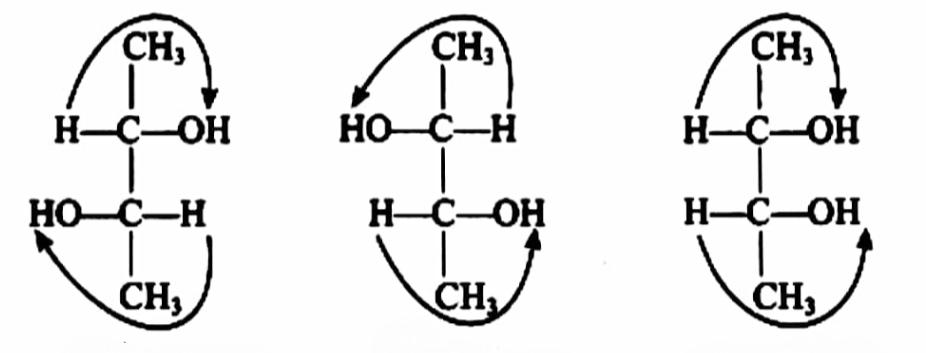
The number of optically active stereoisomers possible for 2,3−diol is 2. They are d,l isomers which are optically active. The meso- compound is optically inactive due to internal compensation.
So we can say that the correct option is B.
Note:
2,3-Butanediol is the organic compound with the formula $ {(C{H_3}CHOH)_2} $ . It is classified as a vic-diol (glycol). It exists as three stereoisomers, a chiral pair and the meso isomer. All are colorless liquids.
Complete step by step solution:
For solving this the stereoisomerism so:
Generally defined, stereoisomers are isomers that have the same composition (that is, the same parts) but that differ in the orientation of those parts in space. There are two kinds of stereoisomers: enantiomers and diastereomers.
Now we will learning it one by one:
Enantiomers are a pair of molecules that exist in two forms that are mirror images of one another but cannot be superimposed one upon the other.
Diastereomers are defined as compounds which have the same molecular formula and sequence of bonded elements but which are non-superimposable, non-mirror images.
The number of optically active stereoisomers possible for 2,3−diol is 2. They are d,l isomers which are optically active. The meso- compound is optically inactive due to internal compensation.
So we can say that the correct option is B.
Note:
2,3-Butanediol is the organic compound with the formula $ {(C{H_3}CHOH)_2} $ . It is classified as a vic-diol (glycol). It exists as three stereoisomers, a chiral pair and the meso isomer. All are colorless liquids.
Recently Updated Pages
Difference Between Prokaryotic Cells and Eukaryotic Cells

If x a + bt + ct2 where x is in meters and t is in class 11 physics CBSE
A car covers the first half distance between two places class 11 physics CBSE
The resultant of two vectors overrightarrow P and overrightarrow class 11 physics CBSE
Find the value of cos 135 class 11 maths CBSE
A mass M is held in place by an applied force F and class 11 physics CBSE
Trending doubts
One Metric ton is equal to kg A 10000 B 1000 C 100 class 11 physics CBSE
Simon Commission came to India in A 1927 B 1928 C 1929 class 11 social science CBSE
How are involuntary actions and reflex actions different class 11 biology CBSE
Derive an expression for maximum height and range of class 11 physics CBSE
What are polar and nonpolar solvents class 11 chemistry CBSE
Explain Rutherfords alpha ray scattering experiment class 11 chemistry CBSE