




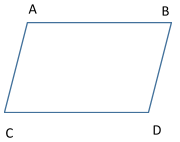
Opposite angles of quadrilateral $ABCD$ are equal. If $AB = 4cm$, determine $CD$.
A) $3$cm
B) $4$cm
C) $5$cm
D) $6$cm
Answer
 Verified
602.1k+ views
Hint: We are given a quadrilateral and also we are being mentioned that the opposite angles of quadrilateral are equal we have to find the length of one side as a length of one side is already given for this first we should know that if the opposite angles of a quadrilateral is equal then it must be a parallelogram.
A quadrilateral is a parallelogram if it’s opposite angles are equal or its opposite sides are equal or one pair of opposite sides are equal and parallel.
So by using this property we will find the sides of the quadrilateral given.
Complete step-by-step solution:
Step1: We are given a quadrilateral $ABCD$ in which $AB = 4cm$ and opp-
Site angles are given equal for this first we will draw a quadrilateral from
The figure it can be seen that $AB$ and $CD$ are the opposite sides.
Step2: As we know that the quadrilateral having opposite sides will
be a parallelogram because it is a property of quadrilateral that if its opposite angles are equal or its types are equal then it must be a parallelogram
As opposite angles are equal than opposite sides must also be equal. Using this property as $AB$ and $CD$ are the opposite sides. We can say $AB = CD$. Substituting the value of $AB$ we get
$CD = 4$cm.
Hence option (B) is the correct answer.
Note: In such types of questions students should remember the Properties of Quadrilaterals and various types of quadrilaterals. If know their property then by one specification they can easily find the type of quadrilateral on which question is based and then we can solve the further question based on the properties of that particular quadrilateral these questions are based on property don't require calculation just apply the property correctly
A quadrilateral is a parallelogram if it’s opposite angles are equal or its opposite sides are equal or one pair of opposite sides are equal and parallel.
So by using this property we will find the sides of the quadrilateral given.
Complete step-by-step solution:
Step1: We are given a quadrilateral $ABCD$ in which $AB = 4cm$ and opp-
Site angles are given equal for this first we will draw a quadrilateral from
The figure it can be seen that $AB$ and $CD$ are the opposite sides.
Step2: As we know that the quadrilateral having opposite sides will
be a parallelogram because it is a property of quadrilateral that if its opposite angles are equal or its types are equal then it must be a parallelogram
As opposite angles are equal than opposite sides must also be equal. Using this property as $AB$ and $CD$ are the opposite sides. We can say $AB = CD$. Substituting the value of $AB$ we get
$CD = 4$cm.
Hence option (B) is the correct answer.
Note: In such types of questions students should remember the Properties of Quadrilaterals and various types of quadrilaterals. If know their property then by one specification they can easily find the type of quadrilateral on which question is based and then we can solve the further question based on the properties of that particular quadrilateral these questions are based on property don't require calculation just apply the property correctly

Recently Updated Pages
Master Class 11 Social Science: Engaging Questions & Answers for Success

Master Class 11 Chemistry: Engaging Questions & Answers for Success
Master Class 12 Business Studies: Engaging Questions & Answers for Success
Master Class 12 Chemistry: Engaging Questions & Answers for Success
Master Class 12 Biology: Engaging Questions & Answers for Success
Class 12 Question and Answer - Your Ultimate Solutions Guide
Trending doubts
What is BLO What is the full form of BLO class 8 social science CBSE
Citizens of India can vote at the age of A 18 years class 8 social science CBSE
Right to vote is a AFundamental Right BFundamental class 8 social science CBSE
Give me the opposite gender of Duck class 8 english CBSE
Full form of STD, ISD and PCO
Explain land use pattern in India and why has the land class 8 social science CBSE