




What is an operon? How does an excess of tryptophan cause a switching off of the tryptophan operon?
Answer
 Verified
569.1k+ views
Hint: The operon is related to the process of ‘regulation of gene expression’ in organisms. This expression, when considered from the point of formation of a polypeptide, can be regulated at several levels. The operon model is mainly found in bacteria.
Complete answer:
The operon concept for gene regulation was first proposed by Francois Jacob and Jacques Monod. Operon is a coordinated group of genes such as structural gene, operator gene, promoter gene, regulator gene; and the coordinated functioning of all these genes regulate a particular metabolic pathway.
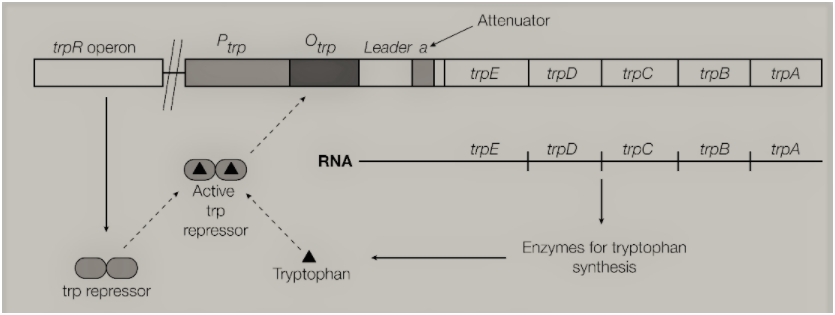
The tryptophan operon system is an example of a repressible operon system. The three enzymes that are needed for the synthesis of tryptophan are synthesized by 5 different genes (structural genes) in a coordinated manner. The addition of tryptophan above a specific level, however, stops and switches off this operon. Thus, this system is a feedback repressible system.
The five structural genes are trp A, trp B, trp C, trp D, and trp E.
The regulatory gene produces a repressor protein which is known as apo-repressor since it does not get bound to the operator gene directly. This allows the operon to remain in ‘switched on’ position.
Now, when tryptophan gradually gets added in the system, it gets bound to this apo-repressor and now this tryptophan-apo-repressor complex (tryptophan here is known as the co-repressor) forms the activated repressor which binds to the operator gene and thereby stops the production of tryptophan. Thus, the trp operon shifts to ‘switch off’ condition.
Note:
The operon system consists of genes some of which are always expressed and some of them are only expressed when the operon is in ‘switched on’ condition. Based on this, the genes are classified into two main types:
Constitutive genes: The genes that are constantly expressed in a cell.
Non-constitutive genes or luxury genes: The genes that are not always expressed in a cell and they are switched on and off depending on requirements.
Complete answer:
The operon concept for gene regulation was first proposed by Francois Jacob and Jacques Monod. Operon is a coordinated group of genes such as structural gene, operator gene, promoter gene, regulator gene; and the coordinated functioning of all these genes regulate a particular metabolic pathway.
The tryptophan operon system is an example of a repressible operon system. The three enzymes that are needed for the synthesis of tryptophan are synthesized by 5 different genes (structural genes) in a coordinated manner. The addition of tryptophan above a specific level, however, stops and switches off this operon. Thus, this system is a feedback repressible system.
The five structural genes are trp A, trp B, trp C, trp D, and trp E.
The regulatory gene produces a repressor protein which is known as apo-repressor since it does not get bound to the operator gene directly. This allows the operon to remain in ‘switched on’ position.
Now, when tryptophan gradually gets added in the system, it gets bound to this apo-repressor and now this tryptophan-apo-repressor complex (tryptophan here is known as the co-repressor) forms the activated repressor which binds to the operator gene and thereby stops the production of tryptophan. Thus, the trp operon shifts to ‘switch off’ condition.
Note:
The operon system consists of genes some of which are always expressed and some of them are only expressed when the operon is in ‘switched on’ condition. Based on this, the genes are classified into two main types:
Constitutive genes: The genes that are constantly expressed in a cell.
Non-constitutive genes or luxury genes: The genes that are not always expressed in a cell and they are switched on and off depending on requirements.
Recently Updated Pages
Which of the following graphs shows the variation of class 12 physics CBSE

Draw a labelled diagram of the human male reproductive class 12 biology CBSE
Describe the experiment to compare the emf of two cells class 12 physics CBSE
What is standard hydrogen electrode
What is conventional current and electric current class 12 physics CBSE
2Bromopentane is treated with an alcoholic KOH solution class 12 chemistry CBSE
Trending doubts
Draw a labelled sketch of the human eye class 12 physics CBSE
Which are the Top 10 Largest Countries of the World?
Differentiate between homogeneous and heterogeneous class 12 chemistry CBSE
Draw ray diagrams each showing i myopic eye and ii class 12 physics CBSE
Which is the correct genotypic ratio of mendel dihybrid class 12 biology CBSE
What is the Full Form of PVC, PET, HDPE, LDPE, PP and PS ?