




How open vascular bundles differ from closed vascular bundles?
Answer
 Verified
646.2k+ views
Hint: The major difference between open vascular bundles and closed vascular bundles is the layer which helps in the secondary growth of the plants. Secondary growth mostly takes place in the dicots plants, not in monocot plants.
Complete answer:
The main and very basic difference between open and closed vascular bundles is that of the strip of cambium.
-Open Vascular Bundles- In open vascular bundles, the cambium is present between the xylem and phloem and due to this, the xylem and phloem are not in direct contact with each other.
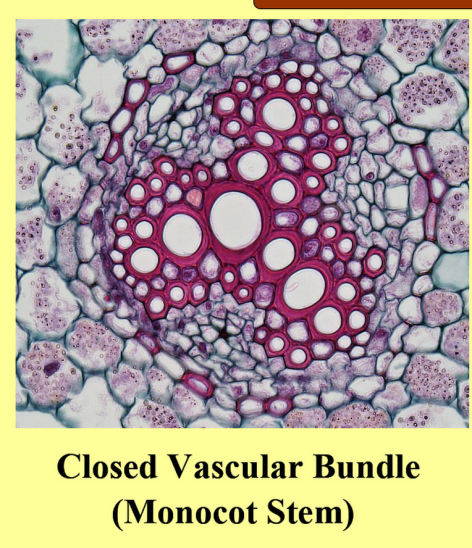
-Closed vascular bundles- In closed vascular bundles, the cambium is absent between xylem and phloem, and due to this, the xylem and phloem are in direct contact with each other.
Additional Information: A vascular bundle is a part of the transport system in vascular plants. The transport cells present in plant vascular tissue exist in two forms: xylem and phloem. These tissues play an important role in protection and support. The xylem typically lies adaxial with phloem which is positioned abaxial. When we consider a stem or root this suggests that the xylem is closer to the center of the stem or root while the phloem is closer to the outside. In a leaf, the adaxial surface of the leaf will usually be the top, with the abaxial surface the lower side.
Note: The term open in the open vascular bundle itself means that these types of plants are open for secondary growth i.e secondary growth will take place and in closed vascular bundles, close means that the plant is closed for secondary growth i.e secondary growth will not take place.
Complete answer:
The main and very basic difference between open and closed vascular bundles is that of the strip of cambium.
-Open Vascular Bundles- In open vascular bundles, the cambium is present between the xylem and phloem and due to this, the xylem and phloem are not in direct contact with each other.
-Closed vascular bundles- In closed vascular bundles, the cambium is absent between xylem and phloem, and due to this, the xylem and phloem are in direct contact with each other.
| S.NO | OPEN VASCULAR BUNDLE | CLOSED VASCULAR BUNDLE |
| 1 | It is capable of Secondary growth | It is not capable of Secondary growth |
| 2 | Cambium is present | Cambium is absent. |
| 3 | They are in dicotyledon plants. | They are in monocotyledon plants. |
| 4 | 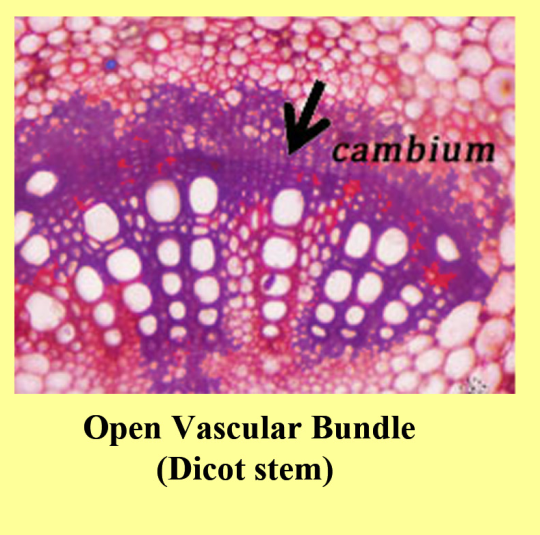
| 
|
Additional Information: A vascular bundle is a part of the transport system in vascular plants. The transport cells present in plant vascular tissue exist in two forms: xylem and phloem. These tissues play an important role in protection and support. The xylem typically lies adaxial with phloem which is positioned abaxial. When we consider a stem or root this suggests that the xylem is closer to the center of the stem or root while the phloem is closer to the outside. In a leaf, the adaxial surface of the leaf will usually be the top, with the abaxial surface the lower side.
Note: The term open in the open vascular bundle itself means that these types of plants are open for secondary growth i.e secondary growth will take place and in closed vascular bundles, close means that the plant is closed for secondary growth i.e secondary growth will not take place.
Recently Updated Pages
If x a + bt + ct2 where x is in meters and t is in class 11 physics CBSE

A car covers the first half distance between two places class 11 physics CBSE
The resultant of two vectors overrightarrow P and overrightarrow class 11 physics CBSE
Find the value of cos 135 class 11 maths CBSE
A mass M is held in place by an applied force F and class 11 physics CBSE
A solution of glucose in water is labelled as 10 dfracwv class 11 chemistry CBSE
Trending doubts
One Metric ton is equal to kg A 10000 B 1000 C 100 class 11 physics CBSE
Find the value of the expression given below sin 30circ class 11 maths CBSE
What do you mean by retardation What is its SI uni class 11 physics CBSE
Draw a diagram of nephron and explain its structur class 11 biology CBSE
10 examples of friction in our daily life
Difference between physical and chemical change class 11 chemistry CBSE