




How do one use Pascal’s triangle to expand the binomial ${{\left( d-5 \right)}^{6}}$?
Answer
 Verified
589.2k+ views
Hint: We first write the binomial expansion of ${{\left( d-5 \right)}^{6}}$. Then we explain Pascal's triangle and the use of it. We explain how the coefficients work. We also explain the use of the constant a and n in the general expansion of ${{\left( x+a \right)}^{n}}$. Then we find the coefficients of the equation ${{\left( d-5 \right)}^{6}}$ using Pascal’s triangle.
Complete step by step answer:
First, we write down the binomial expansion of the given equation ${{\left( d-5 \right)}^{6}}$, then we explain it with the help of Pascal’s triangle.
${{\left( d-5 \right)}^{6}}={{d}^{6}}-30{{d}^{5}}+375{{d}^{4}}-2500{{d}^{3}}+9375{{d}^{2}}-18750d+15625$.
Pascal’s triangle helps to find the coefficients for the expansion of the ${{\left( x+a \right)}^{n}}$, where n decides the number of times, we continue with the triangle expansion and the added value with x (for general case a) decides the multiplier. We multiply with ${{a}^{n}},a=0\left( 1 \right)n$ in a consecutive manner.
We first draw the triangle values till the ${{7}^{th}}$ row where it starts with 1 at the top.
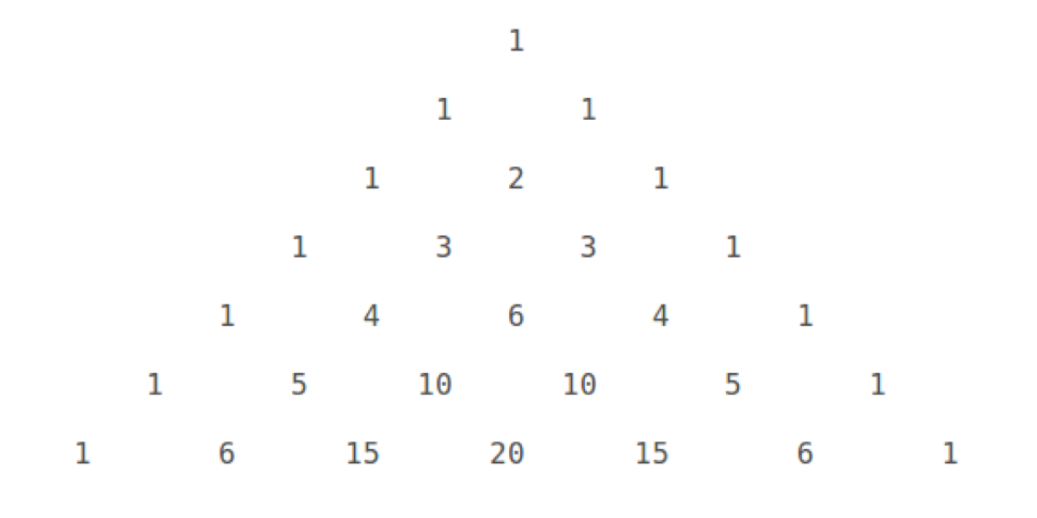
Every coefficient is the addition of the previous two coefficients on its top. These coefficients are made for the expansion of the term ${{\left( x+1 \right)}^{n}}$. For particular we took the value of $n=6$ and that’s why we took 6 rows after the first value of 1 at the top.
Now instead of a, we have to multiply with -5 as for the equation ${{\left( d-5 \right)}^{6}}$ we have $a=-5$.
The relative coefficients are 1, 6, 15, 20, 15, 6 ,1. We multiply them with ${{\left( -5 \right)}^{0}},{{\left( -5 \right)}^{1}},{{\left( -5 \right)}^{2}},{{\left( -5 \right)}^{3}},{{\left( -5 \right)}^{4}},{{\left( -5 \right)}^{5}},{{\left( -5 \right)}^{6}}$ respectively.
Therefore, the actual coefficients are
$\begin{align}
& {{\left( -5 \right)}^{0}}\times 1=1 \\
& {{\left( -5 \right)}^{1}}\times 6=-30 \\
& {{\left( -5 \right)}^{2}}\times 15=375 \\
& {{\left( -5 \right)}^{3}}\times 20=-2500 \\
& {{\left( -5 \right)}^{4}}\times 15=9375 \\
& {{\left( -5 \right)}^{5}}\times 6=-18750 \\
& {{\left( -5 \right)}^{6}}\times 1=15625 \\
\end{align}$
Therefore, the expansion is ${{\left( d-5 \right)}^{6}}={{d}^{6}}-30{{d}^{5}}+375{{d}^{4}}-2500{{d}^{3}}+9375{{d}^{2}}-18750d+15625$.
Note: In binomial expansion these coefficients are used in the form of combination where the expansion is ${{\left( x+a \right)}^{n}}={}^{n}{{C}_{0}}{{x}^{n}}{{a}^{0}}+{}^{n}{{C}_{1}}{{x}^{n-1}}{{a}^{1}}+...+{}^{n}{{C}_{r}}{{x}^{n-r}}{{a}^{r}}+...+{}^{n}{{C}_{n-1}}{{x}^{1}}{{a}^{n-1}}+{}^{n}{{C}_{n}}{{x}^{0}}{{a}^{n}}$.
The general coefficient value for ${{\left( r+1 \right)}^{th}}$ term is ${}^{n}{{C}_{r}}$ where ${}^{n}{{C}_{r}}=\dfrac{n!}{\left( n-r \right)!\times r!}$.
Complete step by step answer:
First, we write down the binomial expansion of the given equation ${{\left( d-5 \right)}^{6}}$, then we explain it with the help of Pascal’s triangle.
${{\left( d-5 \right)}^{6}}={{d}^{6}}-30{{d}^{5}}+375{{d}^{4}}-2500{{d}^{3}}+9375{{d}^{2}}-18750d+15625$.
Pascal’s triangle helps to find the coefficients for the expansion of the ${{\left( x+a \right)}^{n}}$, where n decides the number of times, we continue with the triangle expansion and the added value with x (for general case a) decides the multiplier. We multiply with ${{a}^{n}},a=0\left( 1 \right)n$ in a consecutive manner.
We first draw the triangle values till the ${{7}^{th}}$ row where it starts with 1 at the top.
Every coefficient is the addition of the previous two coefficients on its top. These coefficients are made for the expansion of the term ${{\left( x+1 \right)}^{n}}$. For particular we took the value of $n=6$ and that’s why we took 6 rows after the first value of 1 at the top.
Now instead of a, we have to multiply with -5 as for the equation ${{\left( d-5 \right)}^{6}}$ we have $a=-5$.
The relative coefficients are 1, 6, 15, 20, 15, 6 ,1. We multiply them with ${{\left( -5 \right)}^{0}},{{\left( -5 \right)}^{1}},{{\left( -5 \right)}^{2}},{{\left( -5 \right)}^{3}},{{\left( -5 \right)}^{4}},{{\left( -5 \right)}^{5}},{{\left( -5 \right)}^{6}}$ respectively.
Therefore, the actual coefficients are
$\begin{align}
& {{\left( -5 \right)}^{0}}\times 1=1 \\
& {{\left( -5 \right)}^{1}}\times 6=-30 \\
& {{\left( -5 \right)}^{2}}\times 15=375 \\
& {{\left( -5 \right)}^{3}}\times 20=-2500 \\
& {{\left( -5 \right)}^{4}}\times 15=9375 \\
& {{\left( -5 \right)}^{5}}\times 6=-18750 \\
& {{\left( -5 \right)}^{6}}\times 1=15625 \\
\end{align}$
Therefore, the expansion is ${{\left( d-5 \right)}^{6}}={{d}^{6}}-30{{d}^{5}}+375{{d}^{4}}-2500{{d}^{3}}+9375{{d}^{2}}-18750d+15625$.
Note: In binomial expansion these coefficients are used in the form of combination where the expansion is ${{\left( x+a \right)}^{n}}={}^{n}{{C}_{0}}{{x}^{n}}{{a}^{0}}+{}^{n}{{C}_{1}}{{x}^{n-1}}{{a}^{1}}+...+{}^{n}{{C}_{r}}{{x}^{n-r}}{{a}^{r}}+...+{}^{n}{{C}_{n-1}}{{x}^{1}}{{a}^{n-1}}+{}^{n}{{C}_{n}}{{x}^{0}}{{a}^{n}}$.
The general coefficient value for ${{\left( r+1 \right)}^{th}}$ term is ${}^{n}{{C}_{r}}$ where ${}^{n}{{C}_{r}}=\dfrac{n!}{\left( n-r \right)!\times r!}$.
Recently Updated Pages
Master Class 11 Social Science: Engaging Questions & Answers for Success

Master Class 11 English: Engaging Questions & Answers for Success
Master Class 11 Maths: Engaging Questions & Answers for Success
Master Class 11 Chemistry: Engaging Questions & Answers for Success
Master Class 11 Biology: Engaging Questions & Answers for Success
Master Class 11 Physics: Engaging Questions & Answers for Success
Trending doubts
One Metric ton is equal to kg A 10000 B 1000 C 100 class 11 physics CBSE
Difference Between Prokaryotic Cells and Eukaryotic Cells
Draw a diagram of a plant cell and label at least eight class 11 biology CBSE
Two of the body parts which do not appear in MRI are class 11 biology CBSE
Which gas is abundant in air class 11 chemistry CBSE
10 examples of friction in our daily life