




One side of a parallelogram is 8cm if the corresponding altitude is 6cm then its area is given by
a) $ 24 $ sq cm
b) $ 36 $ sq cm
c) $ 40 $ sq cm
d) $ 48 $ sq cm
Answer
 Verified
634.2k+ views
Hint: The question is from the concept of area of a parallelogram. A parallelogram is a geometric shape where two opposite sides are equal in length and are parallel to each other. The area of a parallelogram can be determined by various methods. In our case the base and altitude is given so we will be using the formula that deals with base and altitude to find the area of a parallelogram.
The area of a parallelogram with base $ b $ and height $ h $ is given by the formula:
$ A = b \times h $
Complete step by step solution:
Let’s first draw the parallelogram with the given side $ 8 $ cm and the corresponding altitude $ 6 $ cm.
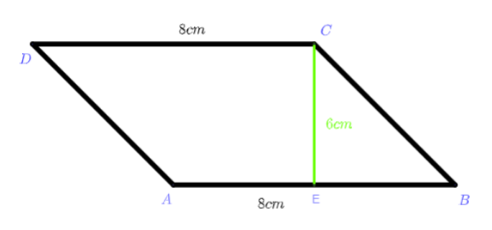
Here, we have side $ AB = CD = 8 $ cm and altitude $ CE = 6 $ cm.
So we have,
Base, $ b = 8 $ cm and height, $ h = 6 $ cm.
So area of parallelogram $ ABCD $ is:
$\Rightarrow A = 8 $ cm $ \times 6 $ cm $ = 48 $ sq. cm.
The area of the parallelogram is $ 48 $ sq. cm.
So, the correct answer is “Option D”.
Additional information:
The other ways to calculate the area of a parallelogram are:
1)If the length of two sides of a parallelogram is known and the angle between any two sides is known then by the application of trigonometry we have:
$ A = ab\sin x $ , where $ a,b $ are the length of two adjacent sides and $ x $ is the angle between them.
2)If the length of two diagonals are given $ {d_1},{d_2} $ and the angle between them is $ x $ ,
$ A = \dfrac{1}{2} \times {d_1} \times {d_2}\sin x $
Note: Notice that the unit of measurement of are is in sq. cm because the area is determined by multiplication of two quantities with the same unit of length. Omitting this unit is a common mistake, so take care of this while writing the solution.
The area of a parallelogram with base $ b $ and height $ h $ is given by the formula:
$ A = b \times h $
Complete step by step solution:
Let’s first draw the parallelogram with the given side $ 8 $ cm and the corresponding altitude $ 6 $ cm.
Here, we have side $ AB = CD = 8 $ cm and altitude $ CE = 6 $ cm.
So we have,
Base, $ b = 8 $ cm and height, $ h = 6 $ cm.
So area of parallelogram $ ABCD $ is:
$\Rightarrow A = 8 $ cm $ \times 6 $ cm $ = 48 $ sq. cm.
The area of the parallelogram is $ 48 $ sq. cm.
So, the correct answer is “Option D”.
Additional information:
The other ways to calculate the area of a parallelogram are:
1)If the length of two sides of a parallelogram is known and the angle between any two sides is known then by the application of trigonometry we have:
$ A = ab\sin x $ , where $ a,b $ are the length of two adjacent sides and $ x $ is the angle between them.
2)If the length of two diagonals are given $ {d_1},{d_2} $ and the angle between them is $ x $ ,
$ A = \dfrac{1}{2} \times {d_1} \times {d_2}\sin x $
Note: Notice that the unit of measurement of are is in sq. cm because the area is determined by multiplication of two quantities with the same unit of length. Omitting this unit is a common mistake, so take care of this while writing the solution.
Recently Updated Pages
Which will be the least stable resonating structure class 11 chemistry CBSE

Explain the structure of megasporangium class 12 biology CBSE
Differentiate between voluntary action and reflex class 10 biology CBSE
How many 5 digit telephone numbers can be construc-class-11-maths-CBSE
How do you find the angle of the resultant vector class 11 physics CBSE
Why is chloroform kept in dark coloured bottles class 12 chemistry CBSE
Trending doubts
How many sides does a circle have a 10 sides b 20 sides class 8 maths CBSE
What is BLO What is the full form of BLO class 8 social science CBSE
Citizens of India can vote at the age of A 18 years class 8 social science CBSE
Full form of STD, ISD and PCO
One cusec is equal to how many liters class 8 maths CBSE
10 slogans on organ donation class 8 english CBSE