




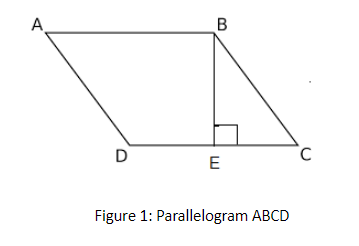
One side of a parallelogram is 18 cm and its distance from the opposite side is 8 cm. The area of the parallelogram is:
A) $48\mathop {{\rm{ }}cm}\nolimits^2 $
B) \[72\mathop {{\rm{ }}cm}\nolimits^2 \]
C) $100\mathop {{\rm{ }}cm}\nolimits^2 $
D) $144\mathop {{\rm{ }}cm}\nolimits^2 $
Answer
 Verified
596.1k+ views
Hint: The parallelogram is a quadrilateral whose opposite sides are parallel to each other. The angle between two adjacent sides of parallelogram is not equal to $90^\circ $ (i.e. $ \ne 90^\circ $)
Area of the parallelogram is equal to the multiplication of base and height.
Area of parallelogram = base $ \times $height
Base is the side of the parallelogram on which height is drawn. Height is the distance between the base side and the side opposite to it.
Complete step by step solution:
Step 1
Step 2
Length AB = 18 $cm$ (given)
Step 3
Length AB distance from its opposite side (i.e. side CD) is 8 $cm$. (given)
$ \Rightarrow $ Distance between sides AB and CD = 8 $cm$ …… (1)
Step 4
Distance between sides AB and CD is BE
$\therefore $ Height BE = 8 $cm$ (from (1))
Step 5
Area of parallelogram = base $ \times $height
\[\begin{array}{l}
= {\rm{ }}18{\rm{ }} \times {\rm{ }}8\\
= {\rm{ }}144{\rm{ }}\mathop {cm}\nolimits^2
\end{array}\]
The area of parallelogram is 144 $\mathop {cm}\nolimits^2 $. The correct option is (D).
Note:
The height always falls perpendicular to the side from the vertex it is measured. The opposite sides of a parallelogram are equal in length, but their diagonals are not equal.
Diagonals of a parallelogram bisect each other.
Length is represented in $units$ (example given: $cm$).
Area is represented in $sq.{\rm{ }}units$(example given: \[\mathop {cm}\nolimits^2 \])
Volume is represented in $cubic{\rm{ }}units$ (example given: \[\mathop {cm}\nolimits^3 \])
Area of the parallelogram is equal to the multiplication of base and height.
Area of parallelogram = base $ \times $height
Base is the side of the parallelogram on which height is drawn. Height is the distance between the base side and the side opposite to it.
Complete step by step solution:
Step 1
Step 2
Length AB = 18 $cm$ (given)
Step 3
Length AB distance from its opposite side (i.e. side CD) is 8 $cm$. (given)
$ \Rightarrow $ Distance between sides AB and CD = 8 $cm$ …… (1)
Step 4
Distance between sides AB and CD is BE
$\therefore $ Height BE = 8 $cm$ (from (1))
Step 5
Area of parallelogram = base $ \times $height
\[\begin{array}{l}
= {\rm{ }}18{\rm{ }} \times {\rm{ }}8\\
= {\rm{ }}144{\rm{ }}\mathop {cm}\nolimits^2
\end{array}\]
The area of parallelogram is 144 $\mathop {cm}\nolimits^2 $. The correct option is (D).
Note:
The height always falls perpendicular to the side from the vertex it is measured. The opposite sides of a parallelogram are equal in length, but their diagonals are not equal.
Diagonals of a parallelogram bisect each other.
Length is represented in $units$ (example given: $cm$).
Area is represented in $sq.{\rm{ }}units$(example given: \[\mathop {cm}\nolimits^2 \])
Volume is represented in $cubic{\rm{ }}units$ (example given: \[\mathop {cm}\nolimits^3 \])
Recently Updated Pages
Master Class 8 Social Science: Engaging Questions & Answers for Success

Master Class 8 English: Engaging Questions & Answers for Success
Class 8 Question and Answer - Your Ultimate Solutions Guide
Master Class 8 Maths: Engaging Questions & Answers for Success
Master Class 8 Science: Engaging Questions & Answers for Success
Master Class 9 General Knowledge: Engaging Questions & Answers for Success
Trending doubts
What are the 12 elements of nature class 8 chemistry CBSE
What is the difference between rai and mustard see class 8 biology CBSE
When people say No pun intended what does that mea class 8 english CBSE
Write a short biography of Dr APJ Abdul Kalam under class 8 english CBSE
Write a letter to the Municipal Commissioner to inform class 8 english CBSE
Compare the manure and fertilizer in maintaining the class 8 biology CBSE