




One of the Rectangular components of a vector of magnitude 50 units is 25 units. The angle it makes with this component is
(A) \[30^\circ \]
(B) \[60^\circ \]
(C) \[45^\circ \]
(D) \[37^\circ \]
Answer
 Verified
586.2k+ views
Hint:Vector is defined as the physical quantity which has magnitude as well as direction.So in this question we are going to resolve a vector into two components and some mathematical calculations we can arrive at the correct result.
Complete step by step answer:
Characteristics of vectors are as follows:
1) Vectors possess magnitude as well as direction.
2) They do not obey the ordinary laws of algebra.
3) Vector changes if either magnitude or direction changes.
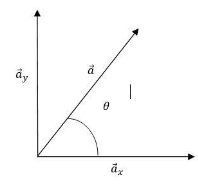
Any vector, $\overrightarrow a ,$can be resolved into two components. ${a_x}$is component parallel to the X-axis and ${a_y}$is component parallel to the Y-axis. Angle $\theta $gives the direction of the vector with respect to the axis.
Now, according to the question.
$\therefore \left| {\overrightarrow a } \right| = 50units$
And $\left| {\overrightarrow {{a_x}} } \right|25units$
From the figure above, we observe that, \[\cos \theta = \dfrac{{\left| {\overrightarrow {{a_x}} } \right|}}{{\left| {\overrightarrow a } \right|}}\]
By substituting the given values, we get
$ \Rightarrow \cos \theta = \dfrac{{25}}{{50}}$
$ \Rightarrow \cos \theta = \dfrac{1}{2}$
\[ \Rightarrow \theta = 60^\circ \]
Therefore, the correct answer is (B) \[60^\circ \]
Note:The concept of vector is very important. In some cases, direction matters as much as the length or distance. For example, say, you are driving a car with some acceleration. Then you apply a break and the car stops. Now, the car will not go from some velocity to zero velocity in an instant. The velocity will reduce gradually and become zero. That means, there is some acceleration which is opposite to the acceleration you were applying to drive the car. Now if we do not consider the fact that both the accelerations were in opposite directions, then we will never be able to explain why the car stopped.
Some examples of vector are, displacement, velocity, acceleration, force, Weight and moment.By Parallelogram law of vectors, the magnitude of resultant vector is given by,
$R = \sqrt {{P^2} + {Q^2} + 2PQ\cos \theta } $
And the direction is given by
$\tan \alpha = \dfrac{{Q\sin \theta }}{{P + \cos \theta }}$
Complete step by step answer:
Characteristics of vectors are as follows:
1) Vectors possess magnitude as well as direction.
2) They do not obey the ordinary laws of algebra.
3) Vector changes if either magnitude or direction changes.
Any vector, $\overrightarrow a ,$can be resolved into two components. ${a_x}$is component parallel to the X-axis and ${a_y}$is component parallel to the Y-axis. Angle $\theta $gives the direction of the vector with respect to the axis.
Now, according to the question.
$\therefore \left| {\overrightarrow a } \right| = 50units$
And $\left| {\overrightarrow {{a_x}} } \right|25units$
From the figure above, we observe that, \[\cos \theta = \dfrac{{\left| {\overrightarrow {{a_x}} } \right|}}{{\left| {\overrightarrow a } \right|}}\]
By substituting the given values, we get
$ \Rightarrow \cos \theta = \dfrac{{25}}{{50}}$
$ \Rightarrow \cos \theta = \dfrac{1}{2}$
\[ \Rightarrow \theta = 60^\circ \]
Therefore, the correct answer is (B) \[60^\circ \]
Note:The concept of vector is very important. In some cases, direction matters as much as the length or distance. For example, say, you are driving a car with some acceleration. Then you apply a break and the car stops. Now, the car will not go from some velocity to zero velocity in an instant. The velocity will reduce gradually and become zero. That means, there is some acceleration which is opposite to the acceleration you were applying to drive the car. Now if we do not consider the fact that both the accelerations were in opposite directions, then we will never be able to explain why the car stopped.
Some examples of vector are, displacement, velocity, acceleration, force, Weight and moment.By Parallelogram law of vectors, the magnitude of resultant vector is given by,
$R = \sqrt {{P^2} + {Q^2} + 2PQ\cos \theta } $
And the direction is given by
$\tan \alpha = \dfrac{{Q\sin \theta }}{{P + \cos \theta }}$
Recently Updated Pages
Master Class 11 Computer Science: Engaging Questions & Answers for Success

Master Class 11 Business Studies: Engaging Questions & Answers for Success
Master Class 11 Economics: Engaging Questions & Answers for Success
Master Class 11 English: Engaging Questions & Answers for Success
Master Class 11 Maths: Engaging Questions & Answers for Success
Master Class 11 Biology: Engaging Questions & Answers for Success
Trending doubts
One Metric ton is equal to kg A 10000 B 1000 C 100 class 11 physics CBSE
There are 720 permutations of the digits 1 2 3 4 5 class 11 maths CBSE
Discuss the various forms of bacteria class 11 biology CBSE
Draw a diagram of a plant cell and label at least eight class 11 biology CBSE
State the laws of reflection of light
Explain zero factorial class 11 maths CBSE