



One of the equal sides of an isosceles triangle is 13 cm and the perimeter is 50 cm. Find the area of the triangle in $c{m^2}.$
Answer
 Verified
649.8k+ views
Hint: To find the area of the triangle we need to gather information like height of the triangle base of the triangle and then we can put them directly into the formula to find the answer.
Complete step-by-step solution:
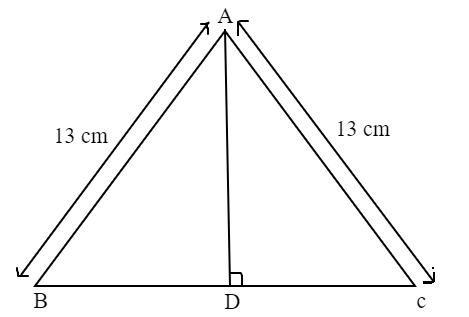
Let ABC be the triangle whose sides AB=AC because it is an isosceles triangle.
Therefore, AB=AC=13cm
It is given that the perimeter of the triangle is 50cm.
So, the third side of triangle is
BC=50-13-13=24cm
Since, AD is the perpendicular bisector of BC
$BD = DC = \dfrac{{24}}{2} = 12cm$
In right $\Delta ABD,$ using Pythagoras Theorem
$
A{B^2} = A{D^2} + B{D^2} \\
\Rightarrow {13^2} = A{D^2} + {12^2} \\
\Rightarrow 169 = {AD}^{2} + 144 \\
\Rightarrow {AD}^{2} = 25 \\
\Rightarrow AD = 5cm \\
$
Now, area of $\Delta ABC $
$
= \dfrac{1}{2} \times Base \times Altitude \\
= \dfrac{1}{2} \times BC \times AD \\
= \dfrac{1}{2} \times 24 \times 5 = 60 c{m^2} \\
$
Hence, the area of the triangle is $60 c{m^2}.$
Note: In order to solve this type of questions, remember the formula of area of the triangle and some properties and theorems of the triangle such as Pythagoras theorem. Also remember a line bisector divides the in line two equal parts and the line bisector is perpendicular to the line. Also when all sides of a triangle are known, the area of the triangle can also be found using Heron's formula.
Complete step-by-step solution:
Let ABC be the triangle whose sides AB=AC because it is an isosceles triangle.
Therefore, AB=AC=13cm
It is given that the perimeter of the triangle is 50cm.
So, the third side of triangle is
BC=50-13-13=24cm
Since, AD is the perpendicular bisector of BC
$BD = DC = \dfrac{{24}}{2} = 12cm$
In right $\Delta ABD,$ using Pythagoras Theorem
$
A{B^2} = A{D^2} + B{D^2} \\
\Rightarrow {13^2} = A{D^2} + {12^2} \\
\Rightarrow 169 = {AD}^{2} + 144 \\
\Rightarrow {AD}^{2} = 25 \\
\Rightarrow AD = 5cm \\
$
Now, area of $\Delta ABC $
$
= \dfrac{1}{2} \times Base \times Altitude \\
= \dfrac{1}{2} \times BC \times AD \\
= \dfrac{1}{2} \times 24 \times 5 = 60 c{m^2} \\
$
Hence, the area of the triangle is $60 c{m^2}.$
Note: In order to solve this type of questions, remember the formula of area of the triangle and some properties and theorems of the triangle such as Pythagoras theorem. Also remember a line bisector divides the in line two equal parts and the line bisector is perpendicular to the line. Also when all sides of a triangle are known, the area of the triangle can also be found using Heron's formula.
Recently Updated Pages
Master Class 9 General Knowledge: Engaging Questions & Answers for Success

Master Class 9 Maths: Engaging Questions & Answers for Success
Master Class 9 Science: Engaging Questions & Answers for Success
Master Class 9 English: Engaging Questions & Answers for Success
Master Class 9 Social Science: Engaging Questions & Answers for Success
Class 9 Question and Answer - Your Ultimate Solutions Guide
Trending doubts
Find the sum of series 1 + 2 + 3 + 4 + 5 + + 100 class 9 maths CBSE
Difference Between Plant Cell and Animal Cell
Fill the blanks with the suitable prepositions 1 The class 9 english CBSE
What is pollution? How many types of pollution? Define it
Name 10 Living and Non living things class 9 biology CBSE
What is the full form of pH?