




One kind of cake required 200g flour and 25g of fat, and another kind of cake required 100g of flour and 50g of fat. Find the maximum number of cakes which can be made from 5kg of flour and 1kg of fat assuming that there is no shortage of other ingredients used in making the cakes?
Answer
 Verified
624.9k+ views
Hint: We will form an equation according to the relation given like total flour = 5000g. So, the first equation will be \[200x+100y\le 5000\] and similarly, total fats available = 1000g, so, second equation will be $25x+50y\le 1000$ also the constraints \[x\ge 0,y\ge 0\] holds true. Then we will plot a graph and try to find the feasible region and then finally we will find the maximum number of cakes formed.
Complete step-by-step answer:
It is given in the question that one kind of cake requires 200g flour and 25g fat and another kind of cake requires 100g of flour and 500g of fat. Also Total flour available is 5kg and fat is 1Kg, then we have to find the maximum number of cakes which can be made. Let us assume that the number of the first type of cake will be x and Number of the second type of cake will be y. Thus, we get \[x\ge 0,y\ge 0\].
Now, we will put all the the given information in tabular form as following –
Let the total number of cake formed will be Z, then from table we get $Z=x+y$ and \[200x+100y\le 5000\] which is equal to $2x+y\le 50....(i)$ also, $25x+50y\le 1000$ which is equal to $x+2y\le 40.....(ii)$ and also \[x\ge 0,y\ge 0.....(iii)\]. Now, we will plot the graph according to the obtained equation.
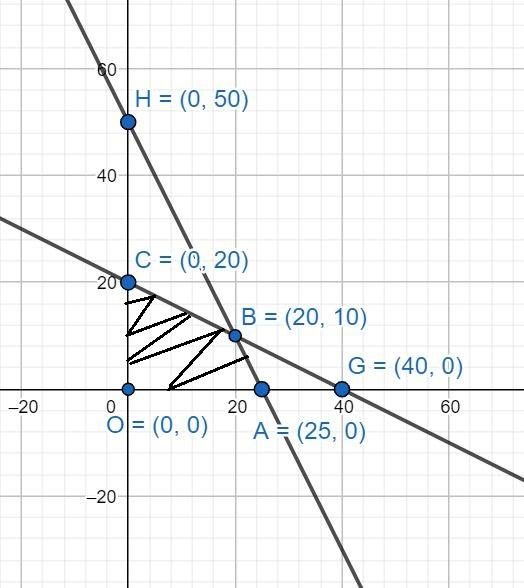
The corner points of feasible region ACBO are A(25,0), B(20,10), C(0,20) and O(0,0). Now, we can calculate the value of $Z=x+y$ by putting the value of corner points
Therefore, the maximum numbers of cakes that can be made are 30 assuming 20 of one kind and 10 of other kinds.
Note: Usually students do not plot graphs to solve linear inequality problems which create lots of problems for them many times. Also this results in the formation of wrong answers because without plotting graphs we can’t decide the feasible region and because of this many times students take wrong points or many times they may skip points. Thus, it is recommended to plot graphs in linear inequality questions.
Complete step-by-step answer:
It is given in the question that one kind of cake requires 200g flour and 25g fat and another kind of cake requires 100g of flour and 500g of fat. Also Total flour available is 5kg and fat is 1Kg, then we have to find the maximum number of cakes which can be made. Let us assume that the number of the first type of cake will be x and Number of the second type of cake will be y. Thus, we get \[x\ge 0,y\ge 0\].
Now, we will put all the the given information in tabular form as following –
| FLOUR(g) | FAT(g) | |
| Cakes of first kind(x) | 200 | 25 |
| Cakes of second kind(y) | 100 | 50 |
| Total available | 5000 | 1000 |
Let the total number of cake formed will be Z, then from table we get $Z=x+y$ and \[200x+100y\le 5000\] which is equal to $2x+y\le 50....(i)$ also, $25x+50y\le 1000$ which is equal to $x+2y\le 40.....(ii)$ and also \[x\ge 0,y\ge 0.....(iii)\]. Now, we will plot the graph according to the obtained equation.
The corner points of feasible region ACBO are A(25,0), B(20,10), C(0,20) and O(0,0). Now, we can calculate the value of $Z=x+y$ by putting the value of corner points
| Corner Point | $Z=x+y$ |
| A(25,0) | $Z=25+0=25$ |
| B(20,10) | $Z=20+10=30$ |
| C(0,20) | $Z=0+20=20$ |
| D(0,0) | $Z=0+0=0$ |
Therefore, the maximum numbers of cakes that can be made are 30 assuming 20 of one kind and 10 of other kinds.
Note: Usually students do not plot graphs to solve linear inequality problems which create lots of problems for them many times. Also this results in the formation of wrong answers because without plotting graphs we can’t decide the feasible region and because of this many times students take wrong points or many times they may skip points. Thus, it is recommended to plot graphs in linear inequality questions.
Recently Updated Pages
Three beakers labelled as A B and C each containing 25 mL of water were taken A small amount of NaOH anhydrous CuSO4 and NaCl were added to the beakers A B and C respectively It was observed that there was an increase in the temperature of the solutions contained in beakers A and B whereas in case of beaker C the temperature of the solution falls Which one of the following statements isarecorrect i In beakers A and B exothermic process has occurred ii In beakers A and B endothermic process has occurred iii In beaker C exothermic process has occurred iv In beaker C endothermic process has occurred

Master Class 10 Social Science: Engaging Questions & Answers for Success
Master Class 10 Science: Engaging Questions & Answers for Success
Master Class 10 Maths: Engaging Questions & Answers for Success
Master Class 10 General Knowledge: Engaging Questions & Answers for Success
Master Class 10 Computer Science: Engaging Questions & Answers for Success
Three beakers labelled as A B and C each containing 25 mL of water were taken A small amount of NaOH anhydrous CuSO4 and NaCl were added to the beakers A B and C respectively It was observed that there was an increase in the temperature of the solutions contained in beakers A and B whereas in case of beaker C the temperature of the solution falls Which one of the following statements isarecorrect i In beakers A and B exothermic process has occurred ii In beakers A and B endothermic process has occurred iii In beaker C exothermic process has occurred iv In beaker C endothermic process has occurred
Master Class 10 Social Science: Engaging Questions & Answers for Success
Master Class 10 Science: Engaging Questions & Answers for Success
Trending doubts
Explain the Treaty of Vienna of 1815 class 10 social science CBSE
In cricket, what is the term for a bowler taking five wickets in an innings?
Who Won 36 Oscar Awards? Record Holder Revealed
What is the median of the first 10 natural numbers class 10 maths CBSE
Why is it 530 pm in india when it is 1200 afternoon class 10 social science CBSE
What is deficiency disease class 10 biology CBSE