




One half of a convex lens is covered with black paper. Will this lens produce a complete image of the object? Explain your observations.
Answer
 Verified
649.5k+ views
Hint: To form an image, a point on any object needs only two rays. We have to check whether two rays from each point of the object passes through half of the lens which is not covered.
Complete step by step solution:
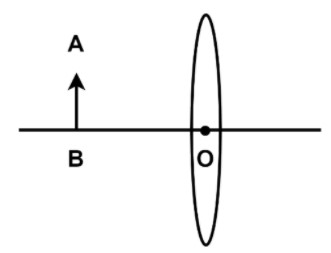
Here, the bottom half of the lens is covered. Consider an object AB is placed in front of the convex lens. We have to first check whether two rays from A can pass through the uncovered part of the lens. The ray from point A parallel to the principal axis easily passes through the lens, as the upper half is not covered.
Another ray from point A, which is almost close to the first can also pass through the lens. Hence the image of point A is formed. If it is possible to make the rays from point A of the object to pass through the lens, then the rays from the other points of the object A can easily pass through the lens.
Hence, the convex lens can produce the complete image of the object.
Note: As one half of the lens is covered the number of rays involved in the image formation reduces. This implies the image formed is of lesser intensity.
Complete step by step solution:
Here, the bottom half of the lens is covered. Consider an object AB is placed in front of the convex lens. We have to first check whether two rays from A can pass through the uncovered part of the lens. The ray from point A parallel to the principal axis easily passes through the lens, as the upper half is not covered.
Another ray from point A, which is almost close to the first can also pass through the lens. Hence the image of point A is formed. If it is possible to make the rays from point A of the object to pass through the lens, then the rays from the other points of the object A can easily pass through the lens.
Hence, the convex lens can produce the complete image of the object.
Note: As one half of the lens is covered the number of rays involved in the image formation reduces. This implies the image formed is of lesser intensity.
Recently Updated Pages
Master Class 12 Economics: Engaging Questions & Answers for Success

Master Class 12 Social Science: Engaging Questions & Answers for Success
Master Class 12 English: Engaging Questions & Answers for Success
Master Class 12 Maths: Engaging Questions & Answers for Success
Master Class 12 Physics: Engaging Questions & Answers for Success
Master Class 12 Biology: Engaging Questions & Answers for Success
Trending doubts
The common name of Rheo leaf is A Oyster plant B Boat class 9 biology CBSE
Difference Between Plant Cell and Animal Cell
Fill the blanks with the suitable prepositions 1 The class 9 english CBSE
What is the full form of pH?
Any five important events between the years 1930 to class 9 social science CBSE
On an outline map of India show its neighbouring c class 9 social science CBSE