




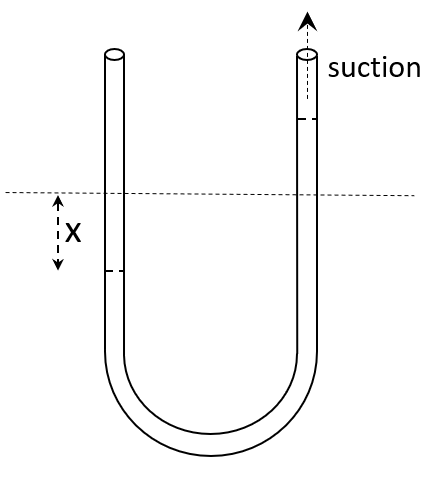
One end of a U-tube of uniform bore (area $A$) containing mercury is connected to a suction pump. Because of its level of liquid of density $\rho $ falls in one limb. When the pump is removed, the restoring force in the other limb is:
A. $2x\rho Ag$
B. $x\rho g$
C. $A\rho g$
D. $x\rho Ag$
Answer
 Verified
608.1k+ views
Hint: Restoring force is the total force required to bring back the fluid to the original arrangement. Since there are two limbs the total force is equal to two times the weight of fluid displaced in one limb. Substitute the density and area of the tube to calculate the weight of the fluid.
Complete answer:
In the above diagram, we have been provided the final arrangement of the fluid when the suction pressure is applied at one end of the tube. The dotted line shows the original level of fluid, before the suction was applied. Therefore total height of column of fluid on the right limb with respect to the level of fluid in left limb in new arrangement = $2x$ (Note that if you displace unit length fluid from one level in one limb, then equal unit length of fluid will rise above the same level in other limb, considering the cross sectional area of both the limbs are constant). Weight of this column of fluid, given that the density of the fluid is, $\rho $ and area of the tube, $A$ = density $\times$ volume $\times$ acceleration due to gravity, $g$ = $\rho \times 2xA \times g = 2x\rho Ag$. (Since mass = density $\times$ volume)
Therefore to bring the arrangement back to original, the restoring force should be equal to the weight of the fluid and thus comparing the choices given in the problem above with the last result, we can say that option A is correct.
Note: Restoring force is the difference in weights of fluid before and after the suction is applied. Before the suction pressure, the level of fluid was the same and thus weight of the fluid is zero. When the suction pressure is applied, the weight of fluid causing the level difference is twice the fluid dropped in one limb.
Complete answer:
In the above diagram, we have been provided the final arrangement of the fluid when the suction pressure is applied at one end of the tube. The dotted line shows the original level of fluid, before the suction was applied. Therefore total height of column of fluid on the right limb with respect to the level of fluid in left limb in new arrangement = $2x$ (Note that if you displace unit length fluid from one level in one limb, then equal unit length of fluid will rise above the same level in other limb, considering the cross sectional area of both the limbs are constant). Weight of this column of fluid, given that the density of the fluid is, $\rho $ and area of the tube, $A$ = density $\times$ volume $\times$ acceleration due to gravity, $g$ = $\rho \times 2xA \times g = 2x\rho Ag$. (Since mass = density $\times$ volume)
Therefore to bring the arrangement back to original, the restoring force should be equal to the weight of the fluid and thus comparing the choices given in the problem above with the last result, we can say that option A is correct.
Note: Restoring force is the difference in weights of fluid before and after the suction is applied. Before the suction pressure, the level of fluid was the same and thus weight of the fluid is zero. When the suction pressure is applied, the weight of fluid causing the level difference is twice the fluid dropped in one limb.
Recently Updated Pages
Basicity of sulphurous acid and sulphuric acid are

Master Class 11 Business Studies: Engaging Questions & Answers for Success
Master Class 11 Computer Science: Engaging Questions & Answers for Success
Master Class 11 Economics: Engaging Questions & Answers for Success
Master Class 11 Social Science: Engaging Questions & Answers for Success
Master Class 11 English: Engaging Questions & Answers for Success
Trending doubts
One Metric ton is equal to kg A 10000 B 1000 C 100 class 11 physics CBSE
Explain zero factorial class 11 maths CBSE
State and prove Bernoullis theorem class 11 physics CBSE
What steps did the French revolutionaries take to create class 11 social science CBSE
The transition element that has lowest enthalpy of class 11 chemistry CBSE
Can anyone list 10 advantages and disadvantages of friction