




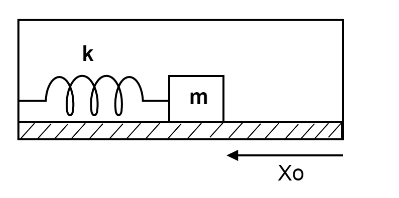
One end of a spring of force constant $k$ is fixed to a vertical wall and another to a body of mass $m$ resting on a smooth horizontal surface. There is another wall at the distance ${x_0}$ from the body. The spring is then compressed by $3{x_0}$ and released.The time taken to strike the wall from the instant of release is ? (given ${\sin ^{ - 1}}\left( {\dfrac{1}{3}} \right) = \left( {\dfrac{\pi }{9}} \right)$)
A. \[\dfrac{\pi }{6}\sqrt {\dfrac{m}{k}} \]
B. \[\dfrac{{2\pi }}{3}\sqrt {\dfrac{m}{k}} \]
C. \[\dfrac{\pi }{4}\sqrt {\dfrac{m}{k}} \]
D. \[\dfrac{{11\pi }}{9}\sqrt {\dfrac{m}{k}} \]
Answer
 Verified
509.7k+ views
Hint:In this question, we have to calculate the time taken by the mass to strike from the instant of release. This can be achieved by using the concept of displacement of a body from mean position and time needed to cover the distance from compressed position to mean position.
Complete step by step answer:
The total amplitude of the motion is $A = 2{x_0}$. The time needed to cover from compressed position to mean position is $\dfrac{T}{4}$, where $T$ is the total time required to do the motion.
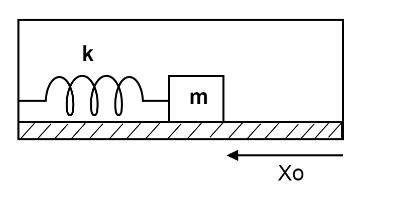
Now, the displacement from the mean position to ${x_0}$ , time taken t will be given as
$y = A\sin wt$
$\Rightarrow {x_0} = 2{x_0}\sin wt$
But $w = \dfrac{{2\pi }}{T}$, So,
$\Rightarrow {x_0} = 2{x_0}\sin \dfrac{{2\pi }}{T}t$
solving for the value of $t$, we get $t = \dfrac{T}{{12}} - - - - - - (1)$
Thus, Time taken to hit the wall is $\dfrac{T}{{12}} + \dfrac{T}{4} = \dfrac{T}{3} - - - - - - (2)$
Now, If mass $m$ is suspended from the spring of force constant $K$ , time period is given as
$T = 2\pi \sqrt {\dfrac{m}{k}} $
So, Time taken to hit the wall is $\dfrac{T}{3} = \dfrac{{2\pi }}{3}\sqrt {\dfrac{m}{k}} $.
Hence, option B is correct.
Note: The particle performing SHM starting from mean position is given by $x = a\sin wt$. The period of SHM does not depend on amplitude or energy of the particle. When the spring is compressed by $3{x_0}$ , the total path of the particle is divided into four equal parts of time $\dfrac{T}{4}$.
Complete step by step answer:
The total amplitude of the motion is $A = 2{x_0}$. The time needed to cover from compressed position to mean position is $\dfrac{T}{4}$, where $T$ is the total time required to do the motion.
Now, the displacement from the mean position to ${x_0}$ , time taken t will be given as
$y = A\sin wt$
$\Rightarrow {x_0} = 2{x_0}\sin wt$
But $w = \dfrac{{2\pi }}{T}$, So,
$\Rightarrow {x_0} = 2{x_0}\sin \dfrac{{2\pi }}{T}t$
solving for the value of $t$, we get $t = \dfrac{T}{{12}} - - - - - - (1)$
Thus, Time taken to hit the wall is $\dfrac{T}{{12}} + \dfrac{T}{4} = \dfrac{T}{3} - - - - - - (2)$
Now, If mass $m$ is suspended from the spring of force constant $K$ , time period is given as
$T = 2\pi \sqrt {\dfrac{m}{k}} $
So, Time taken to hit the wall is $\dfrac{T}{3} = \dfrac{{2\pi }}{3}\sqrt {\dfrac{m}{k}} $.
Hence, option B is correct.
Note: The particle performing SHM starting from mean position is given by $x = a\sin wt$. The period of SHM does not depend on amplitude or energy of the particle. When the spring is compressed by $3{x_0}$ , the total path of the particle is divided into four equal parts of time $\dfrac{T}{4}$.
Recently Updated Pages
Master Class 11 Computer Science: Engaging Questions & Answers for Success

Master Class 11 Business Studies: Engaging Questions & Answers for Success
Master Class 11 Economics: Engaging Questions & Answers for Success
Master Class 11 English: Engaging Questions & Answers for Success
Master Class 11 Maths: Engaging Questions & Answers for Success
Master Class 11 Biology: Engaging Questions & Answers for Success
Trending doubts
One Metric ton is equal to kg A 10000 B 1000 C 100 class 11 physics CBSE
There are 720 permutations of the digits 1 2 3 4 5 class 11 maths CBSE
Discuss the various forms of bacteria class 11 biology CBSE
Draw a diagram of a plant cell and label at least eight class 11 biology CBSE
State the laws of reflection of light
Explain zero factorial class 11 maths CBSE