




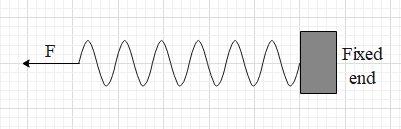
One end of a spring is kept while the other end is stretched by a force as shown in the diagram.
(i) Copy the diagram and mark on it the direction of the restoring force on the free end.
(ii) Name one instrument which works on the above principle.
Answer
 Verified
603k+ views
Hint: A spring has a tendency to resist any change in its natural length. Therefore, in order to regain its original length, it applies an internal force that resists the applied force. This force is called restoring force.
Complete step by step answer:
(i) In the question, it is told that one of the springs is fixed and the other end is stretched to some extent. Now, we are supposed to find the direction of the restoring force on the free end.
Let us first understand what restoring force is.
Restoring force of a material is an internal force caused due to the property of the material. In this case, the material is a spring. When a force is applied on a spring, we know that the length of spring changes. It either expands or contracts depending on the direction of the applied force (i.e. whether it is a pulling force or a pushing force).
However, a spring has a tendency to resist any change in its natural length. Therefore, in order to regain its original length, it applies an internal force that resists the applied force. This force is called restoring force. That is why when we stretch a spring and leave it, it comes back to its original length.
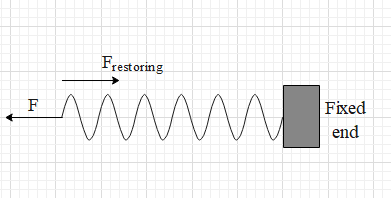
In this case, the spring is being stretched by applying a force towards the left, as shown. Now, to come back to its original length, the spring has to exert a restoring force in the opposite direction of the applied force. Therefore, the direction of the restoring force will be towards right, as shown below.
(ii) Spring balance is the instrument that works on the above principle to measure masses of objects.
Note:
The restoring force depends on the change in length of the spring (x) as $F=-kx$, where k is the spring constant.
The negative sign in the equation indicates that the direction of the restoring force is opposite to the direction of the change is length.
When a force is applied on a spring, we know that the length of spring changes.
Complete step by step answer:
(i) In the question, it is told that one of the springs is fixed and the other end is stretched to some extent. Now, we are supposed to find the direction of the restoring force on the free end.
Let us first understand what restoring force is.
Restoring force of a material is an internal force caused due to the property of the material. In this case, the material is a spring. When a force is applied on a spring, we know that the length of spring changes. It either expands or contracts depending on the direction of the applied force (i.e. whether it is a pulling force or a pushing force).
However, a spring has a tendency to resist any change in its natural length. Therefore, in order to regain its original length, it applies an internal force that resists the applied force. This force is called restoring force. That is why when we stretch a spring and leave it, it comes back to its original length.
In this case, the spring is being stretched by applying a force towards the left, as shown. Now, to come back to its original length, the spring has to exert a restoring force in the opposite direction of the applied force. Therefore, the direction of the restoring force will be towards right, as shown below.
(ii) Spring balance is the instrument that works on the above principle to measure masses of objects.
Note:
The restoring force depends on the change in length of the spring (x) as $F=-kx$, where k is the spring constant.
The negative sign in the equation indicates that the direction of the restoring force is opposite to the direction of the change is length.
When a force is applied on a spring, we know that the length of spring changes.
Recently Updated Pages
Master Class 12 Economics: Engaging Questions & Answers for Success

Master Class 12 English: Engaging Questions & Answers for Success
Master Class 12 Social Science: Engaging Questions & Answers for Success
Master Class 12 Maths: Engaging Questions & Answers for Success
Master Class 12 Physics: Engaging Questions & Answers for Success
Master Class 11 Social Science: Engaging Questions & Answers for Success
Trending doubts
One Metric ton is equal to kg A 10000 B 1000 C 100 class 11 physics CBSE
Difference Between Prokaryotic Cells and Eukaryotic Cells
Find the value of the expression given below sin 30circ class 11 maths CBSE
Two of the body parts which do not appear in MRI are class 11 biology CBSE
Draw a diagram of nephron and explain its structur class 11 biology CBSE
10 examples of friction in our daily life