




When one end of a magnet is placed near a compass, the pointer (n-pole) of the compass turns and points at the magnet because
A) The pointer points at any end of the magnet
B) The end near a compass is a N-pole
C) The end near a compass is a S-pole
D) A magnet always attracts the pointer of a compass
Answer
 Verified
605.4k+ views
Hint: The needle of a magnetic compass can be considered to be a magnet having two poles, the south pole and the north pole. The pointer in the needle is the north pole of this magnet. Also, like poles of a magnet repel while unlike poles attract each other.
Complete answer:
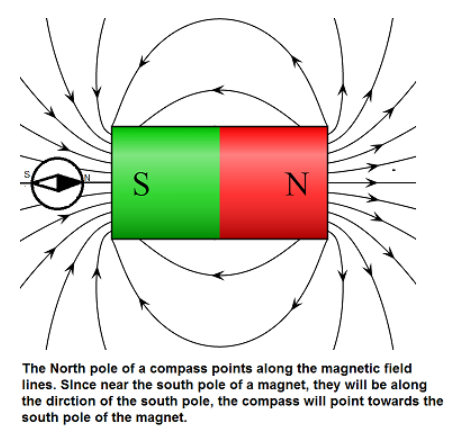
The needle inside a compass is equivalent to a magnet with two poles, with the pointer being the north pole and the opposite end being the south pole. Since, like poles of a magnet repel each other and unlike poles attract, if the pointer (N-pole) of the compass turns and points at the end of a magnet when it is brought near, this would mean that the end of the magnet is the south pole. This is because the south pole of the magnet would attract the north pole of the compass needle and make it point towards it.
Hence, the end near the compass would be the South pole of the magnet.
Therefore, the correct option is C) The end near a compass is a S-pole.
Note:
Students must be thinking that if the pointer of a compass needle is the north pole and like poles repel then why does a compass point towards the north pole of the earth. This is because actually the magnetic field of the earth can be approximated as a bar magnet with the south pole near the geographical north pole and the magnetic north pole near the geographical south pole. Hence, the compass actually points towards the south pole of the Earth’s hypothetical bar magnet and since the geographical north pole is near the magnetic south pole, therefore it is said that the pointer of a compass needle points towards the geographical north pole of the earth.
Complete answer:
The needle inside a compass is equivalent to a magnet with two poles, with the pointer being the north pole and the opposite end being the south pole. Since, like poles of a magnet repel each other and unlike poles attract, if the pointer (N-pole) of the compass turns and points at the end of a magnet when it is brought near, this would mean that the end of the magnet is the south pole. This is because the south pole of the magnet would attract the north pole of the compass needle and make it point towards it.
Hence, the end near the compass would be the South pole of the magnet.
Therefore, the correct option is C) The end near a compass is a S-pole.
Note:
Students must be thinking that if the pointer of a compass needle is the north pole and like poles repel then why does a compass point towards the north pole of the earth. This is because actually the magnetic field of the earth can be approximated as a bar magnet with the south pole near the geographical north pole and the magnetic north pole near the geographical south pole. Hence, the compass actually points towards the south pole of the Earth’s hypothetical bar magnet and since the geographical north pole is near the magnetic south pole, therefore it is said that the pointer of a compass needle points towards the geographical north pole of the earth.
Recently Updated Pages
Master Class 11 Economics: Engaging Questions & Answers for Success

Master Class 11 English: Engaging Questions & Answers for Success
Master Class 11 Maths: Engaging Questions & Answers for Success
Class 11 Question and Answer - Your Ultimate Solutions Guide
Master Class 11 Social Science: Engaging Questions & Answers for Success
Master Class 11 Business Studies: Engaging Questions & Answers for Success
Trending doubts
There are 720 permutations of the digits 1 2 3 4 5 class 11 maths CBSE
State and prove Bernoullis theorem class 11 physics CBSE
Draw a diagram of a plant cell and label at least eight class 11 biology CBSE
Discuss the various forms of bacteria class 11 biology CBSE
People have conflicting developmental goals Support class 11 social science CBSE
Proton was discovered by A Thomson B Rutherford C Chadwick class 11 chemistry CBSE