




On which side of the human heart is low in oxygen?
(a)Left ventricle
(b)Right ventricle
(c)Left atrium
(d)Right atrium
Answer
 Verified
569.7k+ views
Hint: In humans, double blood circulation is seen, that is blood flows twice through the heart to complete one circulation. In the first circulation oxygenated blood from the heart flows to the body and back to the heart whereas in the second circulation deoxygenated blood from the heart flows to the lungs and back to the heart.
Complete Answer:
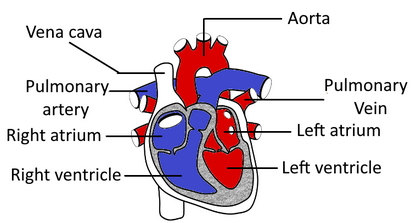
The structure of the heart consists of two upper auricles known as the right and left auricles and two lower ventricles are known as the right and left ventricles. Deoxygenated blood coming from the body is poured into the right auricle which is passed to the right ventricle and then pumped to the lungs where it becomes oxygenated. This oxygenated blood is sent back to the left side of the heart where the left auricle receives it and passes it to the left ventricle. Thus, the side of the heart which is low in oxygen is the right auricle or atrium.
Additional information:
Let us look at the structure of the heart in detail.
-Heart is an organ situated in the thoracic cavity, in between the lungs and it is a mesodermally derived organ.
-It is protected by a double-walled membranous bag pericardium which has the pericardial fluid in between them.
-It consists of four chambers out of which there are 2 smaller auricles and 2 ventricles.
-The auricles are separated by a thin muscular wall known as the interatrial septum whereas the ventricles are separated by the interventricular septum.
-The auricle and ventricle present on the same side is also separated by the atrioventricular septum.
So, the correct option is ‘Right atrium’.
Note:
-There is an opening present on the atrioventricular septum on each side guarded by a valve.
-The valve present between the right atrium and right ventricle is made up of three cusps and is known as the tricuspid valve.
-Whereas the valve between the left atrium and left ventricle is made up of two cusps and is known as the bicuspid or mitral valve.
Complete Answer:
The structure of the heart consists of two upper auricles known as the right and left auricles and two lower ventricles are known as the right and left ventricles. Deoxygenated blood coming from the body is poured into the right auricle which is passed to the right ventricle and then pumped to the lungs where it becomes oxygenated. This oxygenated blood is sent back to the left side of the heart where the left auricle receives it and passes it to the left ventricle. Thus, the side of the heart which is low in oxygen is the right auricle or atrium.
Additional information:
Let us look at the structure of the heart in detail.
-Heart is an organ situated in the thoracic cavity, in between the lungs and it is a mesodermally derived organ.
-It is protected by a double-walled membranous bag pericardium which has the pericardial fluid in between them.
-It consists of four chambers out of which there are 2 smaller auricles and 2 ventricles.
-The auricles are separated by a thin muscular wall known as the interatrial septum whereas the ventricles are separated by the interventricular septum.
-The auricle and ventricle present on the same side is also separated by the atrioventricular septum.
So, the correct option is ‘Right atrium’.
Note:
-There is an opening present on the atrioventricular septum on each side guarded by a valve.
-The valve present between the right atrium and right ventricle is made up of three cusps and is known as the tricuspid valve.
-Whereas the valve between the left atrium and left ventricle is made up of two cusps and is known as the bicuspid or mitral valve.
Recently Updated Pages
Master Class 11 Computer Science: Engaging Questions & Answers for Success

Master Class 11 Business Studies: Engaging Questions & Answers for Success
Master Class 11 Economics: Engaging Questions & Answers for Success
Master Class 11 English: Engaging Questions & Answers for Success
Master Class 11 Maths: Engaging Questions & Answers for Success
Master Class 11 Biology: Engaging Questions & Answers for Success
Trending doubts
One Metric ton is equal to kg A 10000 B 1000 C 100 class 11 physics CBSE
There are 720 permutations of the digits 1 2 3 4 5 class 11 maths CBSE
Discuss the various forms of bacteria class 11 biology CBSE
Draw a diagram of a plant cell and label at least eight class 11 biology CBSE
State the laws of reflection of light
10 examples of friction in our daily life