




On the basis of Huygens wave theory, prove Snell's law of refraction of light.
Answer
 Verified
654.9k+ views
Hint: The ray diagram needs to be drawn according to the need to prove the snell’s law of refraction from the Huygens wave theory, after drawing the diagram we have to figure out two triangles in the diagram that is by figuring one in both sides of the surface, remember that the triangles should be chosen in such a way that it should satisfy the snell’s law.
Complete step-by-step answer:
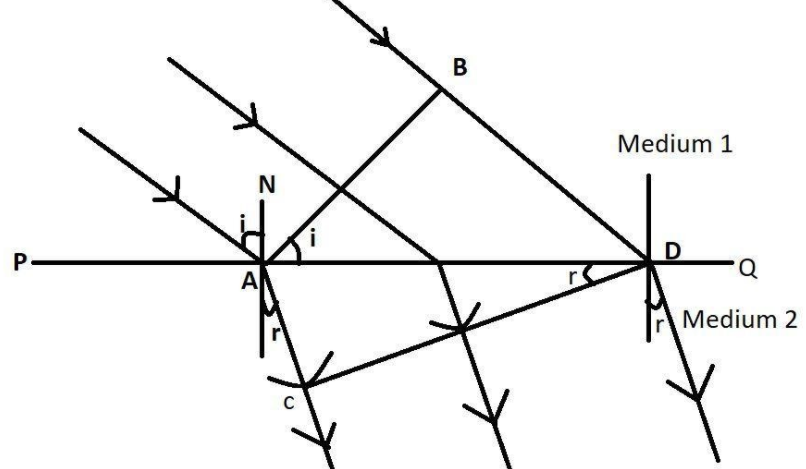
Laws of Refraction: Consider a plane wavefront AB incident on a surface PQ separating two mediums (1) and (2). The medium (1) is rarer, having refractive index $\mathrm{n}_{1}$, in which the light travels with a velocity $\mathrm{c}_{1}$. The medium (2) is denser, having refractive index $\mathrm{n}_{2}$, in which the light travels with a velocity $\mathrm{c}_{2}$.
At time $t=0,$ the incident wave front AB touches the boundary separating two mediums at A. The secondary wavelets from point B advance forward with a velocity $c_{1},$ and after time $t$ seconds
touches at D, thus covering a distance $B D=c_{1} t .$ In the same time interval of $t$ seconds, the secondary wavelets from $\mathrm{A},$ advance forward in the second and an envelope is drawn to obtain a new refracted wavefront as CD.
Consider triangle BAD and ACD,
$\sin i=\sin (a m g \leq B A D)=\dfrac{B D}{A D}=\dfrac{c_{1} t}{A D}$
$\sin r=\sin (\angle A D C)=\dfrac{A C}{A D}=\dfrac{c_{2} t}{A D}$
$\Rightarrow \dfrac{\sin i}{\sin r}=\dfrac{c_{1} t}{c_{2} t}=\dfrac{c_{1}}{c_{2}}$
$\Rightarrow \dfrac{\sin i}{\sin r}=\dfrac{c_{1}}{c_{2}}=$ constant.
This constant is known as the refractive index of the second medium with respect to the first medium. And it is a fixed value.
$\dfrac{c_{1}}{c_{2}}=\dfrac{n_{2}}{n_{1}}$
$\therefore \dfrac{\sin i}{\sin r}=\dfrac{c_{1}}{c_{2}}=\dfrac{n_{2}}{n_{1}}=1 n_{2}$
This is known as the Snell's law.
Note: The constant will always remain the same for a pair of two mediums that are unchanged, The value of the refractive index never changes. Snell’s law stated that for a pair of two mediums the refractive index always remains the same.
Complete step-by-step answer:
Laws of Refraction: Consider a plane wavefront AB incident on a surface PQ separating two mediums (1) and (2). The medium (1) is rarer, having refractive index $\mathrm{n}_{1}$, in which the light travels with a velocity $\mathrm{c}_{1}$. The medium (2) is denser, having refractive index $\mathrm{n}_{2}$, in which the light travels with a velocity $\mathrm{c}_{2}$.
At time $t=0,$ the incident wave front AB touches the boundary separating two mediums at A. The secondary wavelets from point B advance forward with a velocity $c_{1},$ and after time $t$ seconds
touches at D, thus covering a distance $B D=c_{1} t .$ In the same time interval of $t$ seconds, the secondary wavelets from $\mathrm{A},$ advance forward in the second and an envelope is drawn to obtain a new refracted wavefront as CD.
Consider triangle BAD and ACD,
$\sin i=\sin (a m g \leq B A D)=\dfrac{B D}{A D}=\dfrac{c_{1} t}{A D}$
$\sin r=\sin (\angle A D C)=\dfrac{A C}{A D}=\dfrac{c_{2} t}{A D}$
$\Rightarrow \dfrac{\sin i}{\sin r}=\dfrac{c_{1} t}{c_{2} t}=\dfrac{c_{1}}{c_{2}}$
$\Rightarrow \dfrac{\sin i}{\sin r}=\dfrac{c_{1}}{c_{2}}=$ constant.
This constant is known as the refractive index of the second medium with respect to the first medium. And it is a fixed value.
$\dfrac{c_{1}}{c_{2}}=\dfrac{n_{2}}{n_{1}}$
$\therefore \dfrac{\sin i}{\sin r}=\dfrac{c_{1}}{c_{2}}=\dfrac{n_{2}}{n_{1}}=1 n_{2}$
This is known as the Snell's law.
Note: The constant will always remain the same for a pair of two mediums that are unchanged, The value of the refractive index never changes. Snell’s law stated that for a pair of two mediums the refractive index always remains the same.
Recently Updated Pages
Explain the Treaty of Vienna of 1815 class 10 social science CBSE

A Paragraph on Pollution in about 100-150 Words
What is BLO What is the full form of BLO class 8 social science CBSE
10 examples of friction in our daily life
Draw a diagram of nephron and explain its structur class 11 biology CBSE
Write structures of the following compounds i 2 Chloro3methylpentane class 11 chemistry CBSE
Trending doubts
Which is the Lowest Point of Earth?
1 GB equals how many MB?
Identify the plural form of the word child from the class 10 english CBSE
Choose the feminine form of the given noun Fox AFoxess class 10 english CBSE
What is overloading class 10 physics CBSE
Define 1 ohm 1 volt and 1 ampere briefly class 10 physics CBSE