




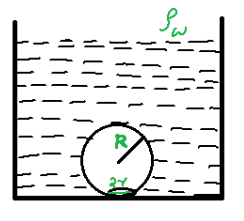
On heating water, bubbles being formed at the bottom of the vessel detach and rise. Take the bubbles to be spheres of radius R and make circular contact of radius r with the bottom of the vessel. If r < < R, the surface tension of water is T. Value of r just before the bubble detach is, (${{\rho }_{w}}$ is the density of water)
Answer
 Verified
605.4k+ views
Hint: The water bubble at the bottom of the vessel experiences mainly two forces. One is the force due to buoyancy and the other one is the force due to surface tension of the water bubble with the vessel.
Complete step by step answer:
So we are given a vessel and in it, there is a bubble of radius R. The bubble is attached to the bottom of the vessel and the circular contact has a radius r. So when the bubble is about to detach from the bottom of the vessel the buoyancy will equal or greater than the surface tension of the bubble.
So the buoyant force acting on the bubble is given by,
${{\text{F}}_{\text{b}}}={{\text{ }\!\!\rho\!\!\text{ }}_{\text{w}}}\text{Vg}$…equation (1)
Where,
${{\text{ }\!\!\rho\!\!\text{ }}_{\text{w}}}$ is the density of water.
V is the volume of the bubble.
g is the acceleration due to gravity.
The force due to surface tension is given,
${{\text{F}}_{\text{s}}}=\text{Tl}$…… equation (2)
Where, T is the surface tension
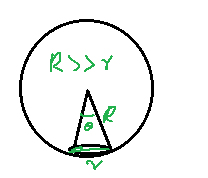
l is the length of the bubble in contact, which is given by $\text{l}=\left( 2\pi r \right)\sin \theta $.
So the bubble is about to detach when these forces are equal.
${{\text{F}}_{\text{b}}}={{\text{F}}_{\text{s}}}$
From equation (1) and (2), we can write,
${{\text{ }\!\!\rho\!\!\text{ }}_{\text{w}}}\text{Vg}=\text{Tl}$
Substituting $V=\dfrac{4}{3}\pi {{R}^{3}}$ and $\sin \theta =\dfrac{r}{R}$, in the above equation, we get
${{\text{ }\!\!\rho\!\!\text{ }}_{\text{w}}}\left( \dfrac{4}{3}\pi {{R}^{3}} \right)\text{g}=\text{T}\left( \dfrac{r}{R}\left( 2\pi r \right) \right)$
$\therefore \text{ r}={{R}^{2}}\sqrt{\dfrac{2{{\rho }_{w}}g}{3T}}$
So the value of r at the time when the bubble is just about to detach from the bottom is given by $\text{ r}={{R}^{2}}\sqrt{\dfrac{2{{\rho }_{w}}g}{3T}}$
Note: Surface tension is the tendency of liquid surfaces to shrink into the minimum surface area possible. Surface tension is measured in force per unit length. Its SI unit is a newton per meter but the C.G.S unit of dyne per centimetre is also used.
Buoyancy or upthrust is an upward force exerted by a fluid that opposes the weight of a partially or fully immersed object.
Complete step by step answer:
So we are given a vessel and in it, there is a bubble of radius R. The bubble is attached to the bottom of the vessel and the circular contact has a radius r. So when the bubble is about to detach from the bottom of the vessel the buoyancy will equal or greater than the surface tension of the bubble.
So the buoyant force acting on the bubble is given by,
${{\text{F}}_{\text{b}}}={{\text{ }\!\!\rho\!\!\text{ }}_{\text{w}}}\text{Vg}$…equation (1)
Where,
${{\text{ }\!\!\rho\!\!\text{ }}_{\text{w}}}$ is the density of water.
V is the volume of the bubble.
g is the acceleration due to gravity.
The force due to surface tension is given,
${{\text{F}}_{\text{s}}}=\text{Tl}$…… equation (2)
Where, T is the surface tension
l is the length of the bubble in contact, which is given by $\text{l}=\left( 2\pi r \right)\sin \theta $.
So the bubble is about to detach when these forces are equal.
${{\text{F}}_{\text{b}}}={{\text{F}}_{\text{s}}}$
From equation (1) and (2), we can write,
${{\text{ }\!\!\rho\!\!\text{ }}_{\text{w}}}\text{Vg}=\text{Tl}$
Substituting $V=\dfrac{4}{3}\pi {{R}^{3}}$ and $\sin \theta =\dfrac{r}{R}$, in the above equation, we get
${{\text{ }\!\!\rho\!\!\text{ }}_{\text{w}}}\left( \dfrac{4}{3}\pi {{R}^{3}} \right)\text{g}=\text{T}\left( \dfrac{r}{R}\left( 2\pi r \right) \right)$
$\therefore \text{ r}={{R}^{2}}\sqrt{\dfrac{2{{\rho }_{w}}g}{3T}}$
So the value of r at the time when the bubble is just about to detach from the bottom is given by $\text{ r}={{R}^{2}}\sqrt{\dfrac{2{{\rho }_{w}}g}{3T}}$
Note: Surface tension is the tendency of liquid surfaces to shrink into the minimum surface area possible. Surface tension is measured in force per unit length. Its SI unit is a newton per meter but the C.G.S unit of dyne per centimetre is also used.
Buoyancy or upthrust is an upward force exerted by a fluid that opposes the weight of a partially or fully immersed object.
Recently Updated Pages
Master Class 11 Computer Science: Engaging Questions & Answers for Success

Master Class 11 Business Studies: Engaging Questions & Answers for Success
Master Class 11 Economics: Engaging Questions & Answers for Success
Master Class 11 English: Engaging Questions & Answers for Success
Master Class 11 Maths: Engaging Questions & Answers for Success
Master Class 11 Biology: Engaging Questions & Answers for Success
Trending doubts
One Metric ton is equal to kg A 10000 B 1000 C 100 class 11 physics CBSE
There are 720 permutations of the digits 1 2 3 4 5 class 11 maths CBSE
Discuss the various forms of bacteria class 11 biology CBSE
Draw a diagram of a plant cell and label at least eight class 11 biology CBSE
State the laws of reflection of light
10 examples of friction in our daily life