



 Watch Video



On an open ground a motorist follows a track that turns to his left by an angle of $60^\circ $ after every 500m. Starting from a given turn, specify the displacement of the motorist at the third, sixth and eight turn. Compare the magnitude of displacement with the total path length covered by the motorist in each case.
Answer
 Verified
573.6k+ views
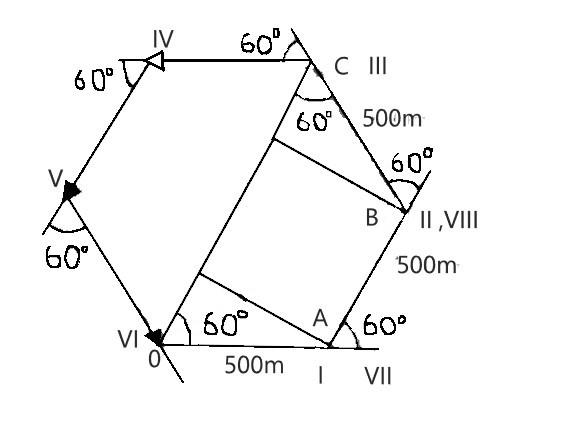
Hint: Displacement as defined as the difference between the initial and the final position between the two points and distance is defined as the amount of length covered by the person in reach of a particular place. Here, imagine a motorcyclist taking $60^\circ $turn on the left after travelling a distance of 500m and draw a diagram. (It would be a hexagon)
Complete step by step solution:
Step 1:
See the above diagram, in this diagram the magnitude of length at the 3rd turn:
$\left| {OA + AB + BC} \right| = \left| {OC} \right|$ ;
Put the value of the length in the above relation
$ \Rightarrow 500\cos 60^\circ + 500 + 500\cos 60^\circ $ ;
$ \Rightarrow 500 \times \dfrac{1}{2} + 500 + 500 \times \dfrac{1}{2}$;
Dot the necessary calculation:
$ \Rightarrow 250 + 500 + 250$;
$ \Rightarrow \left| {OA + AB + BC} \right| = \left| {OC} \right| = 1000m$;
The above value is displacement of the motorcyclist at the 3rd turn for the displacement:
\[{\text{Distance = }}500 + 500 + 500 = 1500m\]; (At 3rd turn)
Now, the ratio between the displacement and distance is:
$\dfrac{{{\text{Displacement}}}}{{{\text{Distance}}}} = \dfrac{{1000}}{{1500}} = \dfrac{2}{3}$ ;
Step 2:
At 6th turn: The initial position is same as the final position so the displacement and distance will be:
${\text{Displacement}} = 0$;
${\text{Distance}} = 6 \times 500 = 3000m$;
Now, the ratio between them is:
$\dfrac{{{\text{Displacement}}}}{{{\text{Distance}}}} = \dfrac{0}{{3000}} = 0$;
Step 3:
At the 8th turn the displacement and the distance would be:
${\text{Displacement}} = 500\cos 60^\circ $;
Multiply and divide by “2” on the LHS:
${\text{Displacement}} = 2\left( {500} \right)\left( {\dfrac{{\cos 60^\circ }}{2}} \right)$;
$ \Rightarrow {\text{Displacement}} = \left( {1000} \right)\left( {\cos 30^\circ } \right)$;
$ \Rightarrow {\text{Displacement}} = \left( {1000} \right)\left( {\dfrac{{\sqrt 3 }}{2}} \right)$;
Do the necessary calculation:
$ \Rightarrow {\text{Displacement}} = \left( {500\sqrt 3 } \right)m$
${\text{Distance}} = 8 \times 500 = 4000m$;
The ratio between the two would be:
$\dfrac{{{\text{Displacement}}}}{{{\text{Distance}}}} = \dfrac{{500\sqrt 3 }}{{4000}} = \dfrac{{\sqrt 3 }}{8}m$;
Final Answer: The displacement at the third, sixth and eight turn of the motorcyclist is 1000m,0m and $\left( {500\sqrt 3 } \right)m$.
Note: Here, the question is not that more complex than it appears to be. We need to resolve the angle and add them together to get to the asked turn. Distance is a vector quantity so we need to resolve the angle just add the distances together.
Complete step by step solution:
Step 1:
See the above diagram, in this diagram the magnitude of length at the 3rd turn:
$\left| {OA + AB + BC} \right| = \left| {OC} \right|$ ;
Put the value of the length in the above relation
$ \Rightarrow 500\cos 60^\circ + 500 + 500\cos 60^\circ $ ;
$ \Rightarrow 500 \times \dfrac{1}{2} + 500 + 500 \times \dfrac{1}{2}$;
Dot the necessary calculation:
$ \Rightarrow 250 + 500 + 250$;
$ \Rightarrow \left| {OA + AB + BC} \right| = \left| {OC} \right| = 1000m$;
The above value is displacement of the motorcyclist at the 3rd turn for the displacement:
\[{\text{Distance = }}500 + 500 + 500 = 1500m\]; (At 3rd turn)
Now, the ratio between the displacement and distance is:
$\dfrac{{{\text{Displacement}}}}{{{\text{Distance}}}} = \dfrac{{1000}}{{1500}} = \dfrac{2}{3}$ ;
Step 2:
At 6th turn: The initial position is same as the final position so the displacement and distance will be:
${\text{Displacement}} = 0$;
${\text{Distance}} = 6 \times 500 = 3000m$;
Now, the ratio between them is:
$\dfrac{{{\text{Displacement}}}}{{{\text{Distance}}}} = \dfrac{0}{{3000}} = 0$;
Step 3:
At the 8th turn the displacement and the distance would be:
${\text{Displacement}} = 500\cos 60^\circ $;
Multiply and divide by “2” on the LHS:
${\text{Displacement}} = 2\left( {500} \right)\left( {\dfrac{{\cos 60^\circ }}{2}} \right)$;
$ \Rightarrow {\text{Displacement}} = \left( {1000} \right)\left( {\cos 30^\circ } \right)$;
$ \Rightarrow {\text{Displacement}} = \left( {1000} \right)\left( {\dfrac{{\sqrt 3 }}{2}} \right)$;
Do the necessary calculation:
$ \Rightarrow {\text{Displacement}} = \left( {500\sqrt 3 } \right)m$
${\text{Distance}} = 8 \times 500 = 4000m$;
The ratio between the two would be:
$\dfrac{{{\text{Displacement}}}}{{{\text{Distance}}}} = \dfrac{{500\sqrt 3 }}{{4000}} = \dfrac{{\sqrt 3 }}{8}m$;
Final Answer: The displacement at the third, sixth and eight turn of the motorcyclist is 1000m,0m and $\left( {500\sqrt 3 } \right)m$.
Note: Here, the question is not that more complex than it appears to be. We need to resolve the angle and add them together to get to the asked turn. Distance is a vector quantity so we need to resolve the angle just add the distances together.
Watch videos on
On an open ground a motorist follows a track that turns to his left by an angle of $60^\circ $ after every 500m. Starting from a given turn, specify the displacement of the motorist at the third, sixth and eight turn. Compare the magnitude of displacement with the total path length covered by the motorist in each case.
Motion in a Plane class 11 Physics - NCERT EXERCISE 3.10 | Physics NCERT | Gaurav Tiwari
Subscribe
 Share
Share likes
20.7K Views
2 years ago
Recently Updated Pages
Master Class 11 Computer Science: Engaging Questions & Answers for Success

Master Class 11 Business Studies: Engaging Questions & Answers for Success
Master Class 11 Economics: Engaging Questions & Answers for Success
Master Class 11 English: Engaging Questions & Answers for Success
Master Class 11 Maths: Engaging Questions & Answers for Success
Master Class 11 Biology: Engaging Questions & Answers for Success
Trending doubts
One Metric ton is equal to kg A 10000 B 1000 C 100 class 11 physics CBSE
There are 720 permutations of the digits 1 2 3 4 5 class 11 maths CBSE
Discuss the various forms of bacteria class 11 biology CBSE
Draw a diagram of a plant cell and label at least eight class 11 biology CBSE
State the laws of reflection of light
Explain zero factorial class 11 maths CBSE