




On a straight line passing through the foot of the tower, two points C and D are at distances of 4 m and 16 m from the foot respectively. If the angles of elevation from C and D of the top of the tower are complementary, then find the height of the tower.
Answer
 Verified
623.4k+ views
Hint: Use the formula for tangent of an angle,
\[\tan \theta =\dfrac{Opposite\,side}{Adjacent\,side}\]
Use properties of complementary angles. Complementary angles are angles that sum up to \[{{90}^{\circ }}\]. Let, A and B be two angles, they are said to be complementary angles of each other if$A+B={{90}^{\circ }}$.
Use the trigonometric formula, \[\cot \theta =\dfrac{1}{\tan \theta }\]
Draw diagrams for ease of understanding the question.
Complete step by step answer:
We are given, two points C and D are at distances of 4 m and 16 m from the foot respectively. We are also given that the angles of elevation from C and D of the top of the tower are complementary.
We are asked to find the height of the tower.
Taking AB to be the tower mentioned in the question (with a height $h$ ),
We can represent the scenario as,
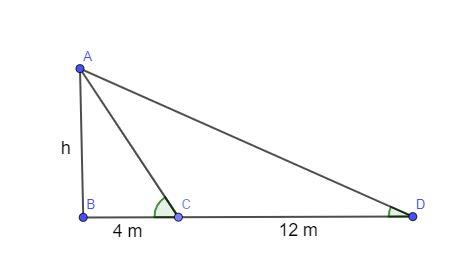
Here, \[\angle C\]and \[\angle D\] are complementary angles.
Hence,
\[\angle C={{90}^{\circ }}-\angle D\ and\,\angle D={{90}^{\circ }}-\angle C\]
From\[\Delta ABC\],
We know that \[\tan \theta =\dfrac{Opposite\,side}{Adjacent\,side}\]
\[\therefore \tan C=\dfrac{h}{4}\,...............(1)\]
From \[\Delta ABD\],
We know that \[\tan \theta =\dfrac{Opposite\,side}{Adjacent\,side}\]
\[\tan D=\tan ({{90}^{\circ }}-C)=\dfrac{h}{12+4}\]
\[\cot C=\dfrac{h}{16}..............(2)\]
We know the trigonometric equation,
\[\cot \theta =\dfrac{1}{\tan \theta }\]
Hence, using this trigonometric equation, equation (2) becomes,
\[\tan C=\dfrac{16}{h}..............(3)\]
On equating equation (1) and (2), we obtain,
\[\begin{align}
& \dfrac{16}{h}=\dfrac{h}{4} \\
& \\
\end{align}\]
On cross-multiplying,
\[\begin{align}
& {{h}^{2}}=64 \\
& \\
\end{align}\]
On taking square root of both the side,
\[h=\pm 8\]
Since, measurement of lengths cannot be a negative value, we reject the value of \[h=-8\].
\[\therefore h=8m\]
Hence, the height of the tower is 8m.
Note:
The same question could have been asked keeping the distance of points from the foot of the perpendicular as unknowns and to find those distances (Height would be given in this case). Nevertheless, the method would remain the same.
You have to keep in mind the difference between angle of elevation and angle of depression. Do not confuse it with each other.
\[\tan \theta =\dfrac{Opposite\,side}{Adjacent\,side}\]
Use properties of complementary angles. Complementary angles are angles that sum up to \[{{90}^{\circ }}\]. Let, A and B be two angles, they are said to be complementary angles of each other if$A+B={{90}^{\circ }}$.
Use the trigonometric formula, \[\cot \theta =\dfrac{1}{\tan \theta }\]
Draw diagrams for ease of understanding the question.
Complete step by step answer:
We are given, two points C and D are at distances of 4 m and 16 m from the foot respectively. We are also given that the angles of elevation from C and D of the top of the tower are complementary.
We are asked to find the height of the tower.
Taking AB to be the tower mentioned in the question (with a height $h$ ),
We can represent the scenario as,
Here, \[\angle C\]and \[\angle D\] are complementary angles.
Hence,
\[\angle C={{90}^{\circ }}-\angle D\ and\,\angle D={{90}^{\circ }}-\angle C\]
From\[\Delta ABC\],
We know that \[\tan \theta =\dfrac{Opposite\,side}{Adjacent\,side}\]
\[\therefore \tan C=\dfrac{h}{4}\,...............(1)\]
From \[\Delta ABD\],
We know that \[\tan \theta =\dfrac{Opposite\,side}{Adjacent\,side}\]
\[\tan D=\tan ({{90}^{\circ }}-C)=\dfrac{h}{12+4}\]
\[\cot C=\dfrac{h}{16}..............(2)\]
We know the trigonometric equation,
\[\cot \theta =\dfrac{1}{\tan \theta }\]
Hence, using this trigonometric equation, equation (2) becomes,
\[\tan C=\dfrac{16}{h}..............(3)\]
On equating equation (1) and (2), we obtain,
\[\begin{align}
& \dfrac{16}{h}=\dfrac{h}{4} \\
& \\
\end{align}\]
On cross-multiplying,
\[\begin{align}
& {{h}^{2}}=64 \\
& \\
\end{align}\]
On taking square root of both the side,
\[h=\pm 8\]
Since, measurement of lengths cannot be a negative value, we reject the value of \[h=-8\].
\[\therefore h=8m\]
Hence, the height of the tower is 8m.
Note:
The same question could have been asked keeping the distance of points from the foot of the perpendicular as unknowns and to find those distances (Height would be given in this case). Nevertheless, the method would remain the same.
You have to keep in mind the difference between angle of elevation and angle of depression. Do not confuse it with each other.
Recently Updated Pages
A Paragraph on Pollution in about 100-150 Words

What is BLO What is the full form of BLO class 8 social science CBSE
10 examples of friction in our daily life
Draw a diagram of nephron and explain its structur class 11 biology CBSE
Write structures of the following compounds i 2 Chloro3methylpentane class 11 chemistry CBSE
XIX+XXX A 49 B 51 C 55 D 44 class 5 maths CBSE
Trending doubts
Explain the Treaty of Vienna of 1815 class 10 social science CBSE
1 GB equals how many MB?
10 examples of evaporation in daily life with explanations
What is the full form of POSCO class 10 social science CBSE
Which is the hottest planet in the Solar system A Earth class 10 social science CBSE
Name any four life processes in living things class 10 biology CBSE