



On a square cardboard sheet of area \[784{\text{ c}}{{\text{m}}^2}\] , four congruent circular plates of maximum size are placed such that each circular plate touches the two plates and each side of the square sheet is tangent to two circular plates. Find the area of the square sheet not covered by the circular plates.
(A) \[154{\text{ c}}{{\text{m}}^2}\]
(B) \[168{\text{ c}}{{\text{m}}^2}\]
(C) \[{\text{616 c}}{{\text{m}}^2}\]
(D) \[{\text{284 c}}{{\text{m}}^2}\]
Answer
 Verified
539.4k+ views
Hint: To find the area of the square sheet not covered by the circular plates, we will first find the total area of the given square sheet and then the area of the given congruent plates. Subtracting the area of all four congruent circular plates from the area of the square sheet will give the area of the square sheet not covered by the circular plates.
Complete step-by-step solution:
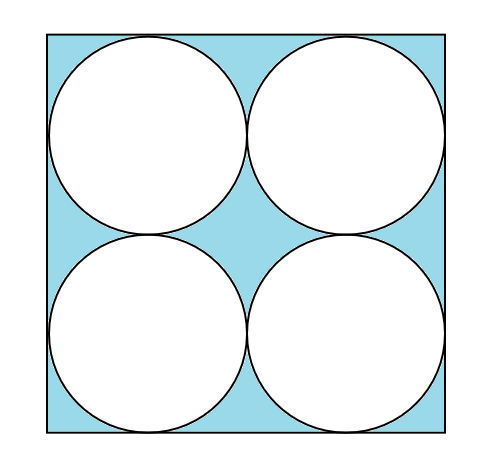
Let the length of each side be \[a\] and since all the circles are congruent, the radius of each circle be \[r\].
Given that the area of the square sheet is \[784{\text{ c}}{{\text{m}}^2}\].
Also, we know that for a square, \[area = {\left( {side} \right)^2}\]
Therefore, on comparing we can find the length of side as
\[area = {\left( {side} \right)^2}\]
\[ \Rightarrow 784{\text{ c}}{{\text{m}}^2} = {\left( {side} \right)^2}\]
On solving,
\[ \Rightarrow {(28{\text{ cm)}}^2} = {\left( {side} \right)^2}\]
\[ \Rightarrow 28{\text{ cm}} = side\]
\[\therefore {\text{size of given square}} = 28{\text{ cm}}\]
Now, since each circular plate touches two other plates and each side of the square sheet is tangent to two circular plates
Diameter of each circular plate is given by
\[{\text{Diameter of each plate}} = \dfrac{{28}}{2}{\text{ cm}}\]
\[\therefore {\text{Diameter of each plate}} = 14{\text{ cm}}\]
So, \[\therefore {\text{Radius of each plate}} = 7{\text{ cm}}\]
Now, \[{\text{area of one circular plate}} = \pi {r^2}\]
Putting the value of \[r\] ,
\[{\text{Area of one circular plate}} = \pi {\left( 7 \right)^2}{\text{ }}\]
\[{\text{Area of four circular plates}} = 4 \times \pi {\left( 7 \right)^2}{\text{ }}\]
\[ = 616{\text{ c}}{{\text{m}}^2}\]
\[{\text{Area of square not covered by plates}} = {\text{area of square}} - {\text{area of four circular plates}}\]
\[ = \left( {784 - 616} \right){\text{ c}}{{\text{m}}^2}\]
\[ = 168{\text{ c}}{{\text{m}}^2}\]
Therefore, the area of the square sheet not covered by the circular plates is \[168{\text{ c}}{{\text{m}}^2}\].
Hence, option (B) \[168{\text{ c}}{{\text{m}}^2}\] is correct.
Note: Since the circles are congruent and are placed such that each circular plate touches the two plates and each side of the square sheet is tangent to two circular plates and as we also know that two circles are congruent if they have the same size so all the circles will have the same radius.
Complete step-by-step solution:
Let the length of each side be \[a\] and since all the circles are congruent, the radius of each circle be \[r\].
Given that the area of the square sheet is \[784{\text{ c}}{{\text{m}}^2}\].
Also, we know that for a square, \[area = {\left( {side} \right)^2}\]
Therefore, on comparing we can find the length of side as
\[area = {\left( {side} \right)^2}\]
\[ \Rightarrow 784{\text{ c}}{{\text{m}}^2} = {\left( {side} \right)^2}\]
On solving,
\[ \Rightarrow {(28{\text{ cm)}}^2} = {\left( {side} \right)^2}\]
\[ \Rightarrow 28{\text{ cm}} = side\]
\[\therefore {\text{size of given square}} = 28{\text{ cm}}\]
Now, since each circular plate touches two other plates and each side of the square sheet is tangent to two circular plates
Diameter of each circular plate is given by
\[{\text{Diameter of each plate}} = \dfrac{{28}}{2}{\text{ cm}}\]
\[\therefore {\text{Diameter of each plate}} = 14{\text{ cm}}\]
So, \[\therefore {\text{Radius of each plate}} = 7{\text{ cm}}\]
Now, \[{\text{area of one circular plate}} = \pi {r^2}\]
Putting the value of \[r\] ,
\[{\text{Area of one circular plate}} = \pi {\left( 7 \right)^2}{\text{ }}\]
\[{\text{Area of four circular plates}} = 4 \times \pi {\left( 7 \right)^2}{\text{ }}\]
\[ = 616{\text{ c}}{{\text{m}}^2}\]
\[{\text{Area of square not covered by plates}} = {\text{area of square}} - {\text{area of four circular plates}}\]
\[ = \left( {784 - 616} \right){\text{ c}}{{\text{m}}^2}\]
\[ = 168{\text{ c}}{{\text{m}}^2}\]
Therefore, the area of the square sheet not covered by the circular plates is \[168{\text{ c}}{{\text{m}}^2}\].
Hence, option (B) \[168{\text{ c}}{{\text{m}}^2}\] is correct.
Note: Since the circles are congruent and are placed such that each circular plate touches the two plates and each side of the square sheet is tangent to two circular plates and as we also know that two circles are congruent if they have the same size so all the circles will have the same radius.
Recently Updated Pages
Master Class 9 General Knowledge: Engaging Questions & Answers for Success

Master Class 9 Maths: Engaging Questions & Answers for Success
Master Class 9 Science: Engaging Questions & Answers for Success
Master Class 9 English: Engaging Questions & Answers for Success
Master Class 9 Social Science: Engaging Questions & Answers for Success
Class 9 Question and Answer - Your Ultimate Solutions Guide
Trending doubts