




Ohmic conductors:
(A). Obey Ohm’s law
(B). Do not obey Ohm’s law
(C). Sometimes obey Ohm’s law
(D). None of these
Answer
 Verified
647.4k+ views
Hint: Define Ohm’s law. Ohm’s law gives us the relation between the voltage, resistance and current in any DC electrical circuit. Obtain the electrical components which follow Ohm’s law and which don’t. Define how they work if they don’t follow Ohm’s law.
Complete step by step answer:
Ohm’s law can be defined as, at a constant temperature the electrical current flowing through a conductor is directly proportional to the potential difference applied across the conductor and inversely proportional to the resistance.
If V is the potential difference and I is the current flowing, then
$\begin{align}
& V\propto I \\
& V=IR \\
\end{align}$
Where R is the proportionality constant called the resistance of the conductor.
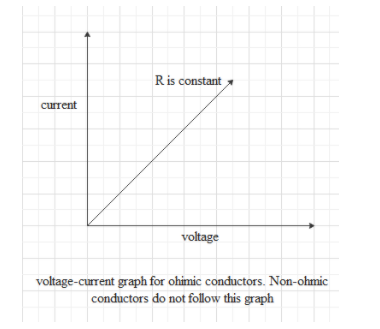
The conductors which obey ohm's law have a constant resistance when we vary the voltage across them or if we increase the current flowing through them. These types of conductors are called ohmic conductors.
In some conductors the resistance varies as we change the temperature. They do not obey ohm’s law. These types of conductors are called non-ohmic conductors.
So, ohmic conductors obey Ohm’s law.
The correct option is (A).
Additional information:
Mostly we use ohmic conductors but non ohmic conductors also have many applications in our day to day life. In a light bulb even if the voltage is increased, the current through the filament still remains constant. This is because the voltage increases the temperature of the filament increases which increases the resistance of the filament. So, the temperature will remain constant and it doesn’t follow Ohm’s law.
Note: In an ohmic conductor the graph between the voltage and the current flowing will be a straight line because they obey the ohm’s law. If we consider a non-ohmic conductor the graph between the voltage and current flowing will not be straight line. So, we can differentiate between types of conductors on the basis of this voltage-current graph.
Complete step by step answer:
Ohm’s law can be defined as, at a constant temperature the electrical current flowing through a conductor is directly proportional to the potential difference applied across the conductor and inversely proportional to the resistance.
If V is the potential difference and I is the current flowing, then
$\begin{align}
& V\propto I \\
& V=IR \\
\end{align}$
Where R is the proportionality constant called the resistance of the conductor.
The conductors which obey ohm's law have a constant resistance when we vary the voltage across them or if we increase the current flowing through them. These types of conductors are called ohmic conductors.
In some conductors the resistance varies as we change the temperature. They do not obey ohm’s law. These types of conductors are called non-ohmic conductors.
So, ohmic conductors obey Ohm’s law.
The correct option is (A).
Additional information:
Mostly we use ohmic conductors but non ohmic conductors also have many applications in our day to day life. In a light bulb even if the voltage is increased, the current through the filament still remains constant. This is because the voltage increases the temperature of the filament increases which increases the resistance of the filament. So, the temperature will remain constant and it doesn’t follow Ohm’s law.
Note: In an ohmic conductor the graph between the voltage and the current flowing will be a straight line because they obey the ohm’s law. If we consider a non-ohmic conductor the graph between the voltage and current flowing will not be straight line. So, we can differentiate between types of conductors on the basis of this voltage-current graph.
Recently Updated Pages
Basicity of sulphurous acid and sulphuric acid are

Master Class 12 Economics: Engaging Questions & Answers for Success
Master Class 12 Biology: Engaging Questions & Answers for Success
Master Class 11 English: Engaging Questions & Answers for Success
Master Class 11 Physics: Engaging Questions & Answers for Success
Master Class 11 Computer Science: Engaging Questions & Answers for Success
Trending doubts
Draw a labelled sketch of the human eye class 12 physics CBSE
The chemical formula of tear gas is A CO Cl 2 B C 10 class 12 chemistry CBSE
Draw ray diagrams each showing i myopic eye and ii class 12 physics CBSE
Which are the Top 10 Largest Countries of the World?
Differentiate between homogeneous and heterogeneous class 12 chemistry CBSE
Which is the correct genotypic ratio of mendel dihybrid class 12 biology CBSE