




Offsprings produced from a marriage have only O and A blood groups. The possible genotypes of the parents would be
A. ${I^A}{I^A}$ and ${I^A}{I^O}$
B. ${I^A}{I^A}$ and ${I^O}{I^O}$
C. ${I^O}{I^O}$ and ${I^O}{I^O}$
D. ${I^A}{I^O}$ and ${I^O}{I^O}$
Answer
 Verified
574.8k+ views
Hint: Here ${I^A}$, ${I^B}$, and ${I^O}$ are the alleles that are responsible for the blood groups in humans. Out of these, alleles A and B are codominant and allele O is recessive. This means that a child can have O blood group only when he/she inherits Io from both parents. Since allele A is dominant over allele O, for a child to have A blood group, he/she needs to inherit only one copy of ${I^A}$.
Complete answer:
Now let us see how this works.
When a person with ${I^A}{I^O}$ is crossed with another person having ${I^O}{I^O}$, we get the following outcomes:
- ${I^A}{I^O}$
- ${I^A}{I^O}$
- ${I^O}{I^O}$
- ${I^O}{I^O}$
The offsprings that have ${I^A}{I^O}$ will have the blood group A, whereas those having ${I^O}{I^O}$ will have blood group O.
Let us understand this with the help of a diagram:
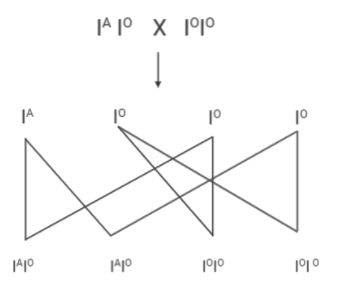
So, from the cross, we can conclude that there is a 50% chance for both blood groups A and O.
Hence, the correct answer is option (D).
Additional information:
By understanding how the blood group is determined, we can conclude the following:
- If the parents have ${I^A}{I^A}$ and ${I^O}{I^O}$, then all offspring would have blood group A.
- If the parents have ${I^A}{I^A}$ and ${I^O}{I^O}$, then all offspring would have blood group A.
- If the parents have ${I^O}{I^O}$ and ${I^O}{I^O}$, then all offspring would have blood group O.
Note: There are 4 blood groups – A, B, AB, and O.
It is important to know the blood group of an individual as transfusion between 2 incompatible groups can lead to complications. A person with O blood group is a Universal Donor and a person with blood group AB is a Universal Recipient.
Complete answer:
Now let us see how this works.
When a person with ${I^A}{I^O}$ is crossed with another person having ${I^O}{I^O}$, we get the following outcomes:
- ${I^A}{I^O}$
- ${I^A}{I^O}$
- ${I^O}{I^O}$
- ${I^O}{I^O}$
The offsprings that have ${I^A}{I^O}$ will have the blood group A, whereas those having ${I^O}{I^O}$ will have blood group O.
Let us understand this with the help of a diagram:
So, from the cross, we can conclude that there is a 50% chance for both blood groups A and O.
Hence, the correct answer is option (D).
Additional information:
By understanding how the blood group is determined, we can conclude the following:
- If the parents have ${I^A}{I^A}$ and ${I^O}{I^O}$, then all offspring would have blood group A.
- If the parents have ${I^A}{I^A}$ and ${I^O}{I^O}$, then all offspring would have blood group A.
- If the parents have ${I^O}{I^O}$ and ${I^O}{I^O}$, then all offspring would have blood group O.
Note: There are 4 blood groups – A, B, AB, and O.
It is important to know the blood group of an individual as transfusion between 2 incompatible groups can lead to complications. A person with O blood group is a Universal Donor and a person with blood group AB is a Universal Recipient.
Recently Updated Pages
Master Class 11 Computer Science: Engaging Questions & Answers for Success

Master Class 11 Business Studies: Engaging Questions & Answers for Success
Master Class 11 Economics: Engaging Questions & Answers for Success
Master Class 11 English: Engaging Questions & Answers for Success
Master Class 11 Maths: Engaging Questions & Answers for Success
Master Class 11 Biology: Engaging Questions & Answers for Success
Trending doubts
One Metric ton is equal to kg A 10000 B 1000 C 100 class 11 physics CBSE
There are 720 permutations of the digits 1 2 3 4 5 class 11 maths CBSE
Discuss the various forms of bacteria class 11 biology CBSE
Draw a diagram of a plant cell and label at least eight class 11 biology CBSE
State the laws of reflection of light
Explain zero factorial class 11 maths CBSE