




Of the number of three athletic teams in a school, 21 are in the basketball team, 26 in hockey team, 29 in the football team. 14 play hockey and basketball, 15 play hockey and football, 12 play football and basketball and 8 play all the games. The total number of members is
A) 42
B) 43
C) 45
D) None of these
Answer
 Verified
579.9k+ views
Hint:
Here, we will use the concept of applications on the cardinality of the set. A set is defined as the collection of well defined objects. Cardinality of a set is defined as the number of elements in a set. We will substitute the given values in the formula of union of sets and simplify it to get the total number of members.
Formula Used:
If we are given three finite set, then the total number is given by the formula \[n\left( {A \cup B \cup C} \right) = n\left( A \right) + n\left( B \right) + n\left( C \right) - n\left( {A \cap B} \right) - n\left( {B \cap C} \right) - n\left( {A \cap C} \right) + n\left( {A \cap B \cap C} \right)\]
Complete Step by Step Solution:
Let B be the set of members in an athletic team who play Basketball, H be the set of members in an athletic team who play Hockey, F be the set of members in an athletic team who play football.
Number of members in a basketball team \[n\left( B \right) = 21\]
Number of members in a Hockey team \[n\left( H \right) = 26\]
Number of members in a football team \[n\left( F \right) = 29\]
Number of members who play both hockey and basketball \[n\left( {H \cap B} \right) = 14\]
Number of members who play both hockey and football \[n\left( {H \cap F} \right) = 15\]
Number of members who play both basketball and football \[n\left( {B \cap F} \right) = 12\]
Number of members who play all the three games \[n\left( {B \cap H \cap F} \right) = 8\]
If we are given three finite set, then the total number is given by the formula \[n\left( {A \cup B \cup C} \right) = n\left( A \right) + n\left( B \right) + n\left( C \right) - n\left( {A \cap B} \right) - n\left( {B \cap C} \right) - n\left( {A \cap C} \right) + n\left( {A \cap B \cap C} \right)\]
Now, substituting the terms , we get
\[ \Rightarrow n\left( {B \cup H \cup F} \right) = n\left( B \right) + n\left( H \right) + n\left( F \right) - n\left( {H \cap B} \right) - n\left( {H \cap F} \right) - n\left( {B \cap F} \right) + n\left( {B \cap H \cap F} \right)\]
Now, substituting the values, we get
\[ \Rightarrow n\left( {B \cup H \cup F} \right) = 21 + 26 + 29 - 14 - 15 - 12 + 8\]
By simplifying the equation, we get
\[ \Rightarrow n\left( {B \cup H \cup F} \right) = 84 - 41\]
\[ \Rightarrow n\left( {B \cup H \cup F} \right) = 43\]
Therefore, the total number of members is 43.
Thus, option (B) is the correct answer.
Note:
We can also solve the problem on set by using venn diagrams. Venn diagram is a method to represent the relationships between the finite sets. A finite set is defined as the set which is countable.
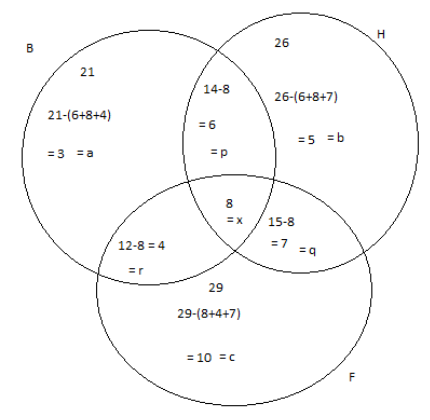
From the venn diagram, we get
The total number of members in an athletic team \[ = a + b + c + p + q + r + x\]
Substituting the values in the above equation, we get
\[ \Rightarrow \] The total number of members in an athletic team \[ = 3 + 5 + 10 + 6 + 4 + 7 + 8\]
Adding the term, we get
\[ \Rightarrow \] The total number of members in an athletic team \[ = 43\]
Here, we will use the concept of applications on the cardinality of the set. A set is defined as the collection of well defined objects. Cardinality of a set is defined as the number of elements in a set. We will substitute the given values in the formula of union of sets and simplify it to get the total number of members.
Formula Used:
If we are given three finite set, then the total number is given by the formula \[n\left( {A \cup B \cup C} \right) = n\left( A \right) + n\left( B \right) + n\left( C \right) - n\left( {A \cap B} \right) - n\left( {B \cap C} \right) - n\left( {A \cap C} \right) + n\left( {A \cap B \cap C} \right)\]
Complete Step by Step Solution:
Let B be the set of members in an athletic team who play Basketball, H be the set of members in an athletic team who play Hockey, F be the set of members in an athletic team who play football.
Number of members in a basketball team \[n\left( B \right) = 21\]
Number of members in a Hockey team \[n\left( H \right) = 26\]
Number of members in a football team \[n\left( F \right) = 29\]
Number of members who play both hockey and basketball \[n\left( {H \cap B} \right) = 14\]
Number of members who play both hockey and football \[n\left( {H \cap F} \right) = 15\]
Number of members who play both basketball and football \[n\left( {B \cap F} \right) = 12\]
Number of members who play all the three games \[n\left( {B \cap H \cap F} \right) = 8\]
If we are given three finite set, then the total number is given by the formula \[n\left( {A \cup B \cup C} \right) = n\left( A \right) + n\left( B \right) + n\left( C \right) - n\left( {A \cap B} \right) - n\left( {B \cap C} \right) - n\left( {A \cap C} \right) + n\left( {A \cap B \cap C} \right)\]
Now, substituting the terms , we get
\[ \Rightarrow n\left( {B \cup H \cup F} \right) = n\left( B \right) + n\left( H \right) + n\left( F \right) - n\left( {H \cap B} \right) - n\left( {H \cap F} \right) - n\left( {B \cap F} \right) + n\left( {B \cap H \cap F} \right)\]
Now, substituting the values, we get
\[ \Rightarrow n\left( {B \cup H \cup F} \right) = 21 + 26 + 29 - 14 - 15 - 12 + 8\]
By simplifying the equation, we get
\[ \Rightarrow n\left( {B \cup H \cup F} \right) = 84 - 41\]
\[ \Rightarrow n\left( {B \cup H \cup F} \right) = 43\]
Therefore, the total number of members is 43.
Thus, option (B) is the correct answer.
Note:
We can also solve the problem on set by using venn diagrams. Venn diagram is a method to represent the relationships between the finite sets. A finite set is defined as the set which is countable.
From the venn diagram, we get
The total number of members in an athletic team \[ = a + b + c + p + q + r + x\]
Substituting the values in the above equation, we get
\[ \Rightarrow \] The total number of members in an athletic team \[ = 3 + 5 + 10 + 6 + 4 + 7 + 8\]
Adding the term, we get
\[ \Rightarrow \] The total number of members in an athletic team \[ = 43\]
Recently Updated Pages
Master Class 11 Social Science: Engaging Questions & Answers for Success

Master Class 11 Physics: Engaging Questions & Answers for Success
Master Class 11 Maths: Engaging Questions & Answers for Success
Master Class 11 Economics: Engaging Questions & Answers for Success
Master Class 11 Computer Science: Engaging Questions & Answers for Success
Master Class 11 Chemistry: Engaging Questions & Answers for Success
Trending doubts
One Metric ton is equal to kg A 10000 B 1000 C 100 class 11 physics CBSE
There are 720 permutations of the digits 1 2 3 4 5 class 11 maths CBSE
1 Quintal is equal to a 110 kg b 10 kg c 100kg d 1000 class 11 physics CBSE
State and prove Bernoullis theorem class 11 physics CBSE
Difference Between Prokaryotic Cells and Eukaryotic Cells
Discuss the various forms of bacteria class 11 biology CBSE