




Of the 200 students in college T majoring in 1 or more of the sciences, 130 are majoring in Chemistry and 150 are majoring in Biology. If at least 30 students are not majoring in either chemistry or biology, then the number of students majoring in both chemistry and biology could be any number from:
A) 2020 to 50
B) 40 to 70
C) 50 to 130
D) 110 to 130
E) 110 to 150
Answer
 Verified
595.2k+ views
Hint:
We will find the solution by representing the students for each subject using a Venn diagram. Venn diagram is a diagram which shows the relationship between two components or objects using a circle. It shows the similarity and the difference between two sets.
Complete step by step solution:
We will first draw the Venn diagram.
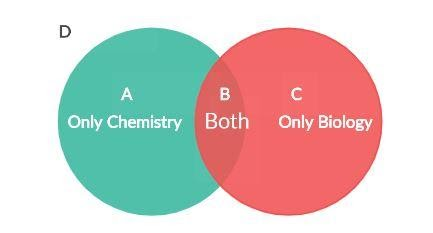
We can see that the green circle on the left represents the students majoring in Chemistry; the pink circle on the right represents the students majoring in Biology and the shaded portion in between represents the students majoring in both Chemistry and Biology.
A represents the students that are majoring in only Chemistry, C represents the students that are majoring in only Biology, B represents the students majoring in both Chemistry and Biology and D represents the students majoring in neither Chemistry nor Biology.
We can infer from the figure that the number of total students (T) in the college is:
\[T = {\rm{Chem}} + {\rm{Bio}} - {\rm{B}} + {\rm{D}}\]
Where variable Chem represents the number of students majoring in Chemistry, variable Bio represents the number of students majoring in Bio, B is the number of students represented by region B and D is the number of students represented by region D.
\[\begin{array}{c}200 = 130 + 150 - {\rm{B}} + {\rm{D}}\\{\rm{200}} = 280 - {\rm{B}} + {\rm{D}}\\{\rm{B}} - 80 = {\rm{D}}\end{array}\]
We know that at least 30 students are majoring in neither Chemistry nor Biology. So,
\[\begin{array}{l}{\rm{ D}} \ge 30\\ \Rightarrow {\rm{B}} - 80 \ge 30\\ \Rightarrow {\rm{ B}} \ge 110\end{array}\]
The number of students that are majoring in both Chemistry and Biology cannot be greater than the number of students majoring in Chemistry. So,
\[{\rm{B}} \le {\rm{130}}\]
Therefore, we can conclude,
\[110 \le {\rm{B}} \le 130\]
Hence, option D is the correct option.
Note:
We can make a mistake where we might assume the total number of students (T) as:
\[T = {\rm{Chem}} + {\rm{Bio}} + {\rm{N}}\].
We should note that in this case the number of students represented by region B has been counted twice. So, we must subtract B once on the right-hand side. We should avoid this double counting.
We will find the solution by representing the students for each subject using a Venn diagram. Venn diagram is a diagram which shows the relationship between two components or objects using a circle. It shows the similarity and the difference between two sets.
Complete step by step solution:
We will first draw the Venn diagram.
We can see that the green circle on the left represents the students majoring in Chemistry; the pink circle on the right represents the students majoring in Biology and the shaded portion in between represents the students majoring in both Chemistry and Biology.
A represents the students that are majoring in only Chemistry, C represents the students that are majoring in only Biology, B represents the students majoring in both Chemistry and Biology and D represents the students majoring in neither Chemistry nor Biology.
We can infer from the figure that the number of total students (T) in the college is:
\[T = {\rm{Chem}} + {\rm{Bio}} - {\rm{B}} + {\rm{D}}\]
Where variable Chem represents the number of students majoring in Chemistry, variable Bio represents the number of students majoring in Bio, B is the number of students represented by region B and D is the number of students represented by region D.
\[\begin{array}{c}200 = 130 + 150 - {\rm{B}} + {\rm{D}}\\{\rm{200}} = 280 - {\rm{B}} + {\rm{D}}\\{\rm{B}} - 80 = {\rm{D}}\end{array}\]
We know that at least 30 students are majoring in neither Chemistry nor Biology. So,
\[\begin{array}{l}{\rm{ D}} \ge 30\\ \Rightarrow {\rm{B}} - 80 \ge 30\\ \Rightarrow {\rm{ B}} \ge 110\end{array}\]
The number of students that are majoring in both Chemistry and Biology cannot be greater than the number of students majoring in Chemistry. So,
\[{\rm{B}} \le {\rm{130}}\]
Therefore, we can conclude,
\[110 \le {\rm{B}} \le 130\]
Hence, option D is the correct option.
Note:
We can make a mistake where we might assume the total number of students (T) as:
\[T = {\rm{Chem}} + {\rm{Bio}} + {\rm{N}}\].
We should note that in this case the number of students represented by region B has been counted twice. So, we must subtract B once on the right-hand side. We should avoid this double counting.
Recently Updated Pages
Three beakers labelled as A B and C each containing 25 mL of water were taken A small amount of NaOH anhydrous CuSO4 and NaCl were added to the beakers A B and C respectively It was observed that there was an increase in the temperature of the solutions contained in beakers A and B whereas in case of beaker C the temperature of the solution falls Which one of the following statements isarecorrect i In beakers A and B exothermic process has occurred ii In beakers A and B endothermic process has occurred iii In beaker C exothermic process has occurred iv In beaker C endothermic process has occurred

Master Class 11 Social Science: Engaging Questions & Answers for Success
Master Class 11 Physics: Engaging Questions & Answers for Success
Master Class 11 Maths: Engaging Questions & Answers for Success
Master Class 11 Economics: Engaging Questions & Answers for Success
Master Class 11 Computer Science: Engaging Questions & Answers for Success
Three beakers labelled as A B and C each containing 25 mL of water were taken A small amount of NaOH anhydrous CuSO4 and NaCl were added to the beakers A B and C respectively It was observed that there was an increase in the temperature of the solutions contained in beakers A and B whereas in case of beaker C the temperature of the solution falls Which one of the following statements isarecorrect i In beakers A and B exothermic process has occurred ii In beakers A and B endothermic process has occurred iii In beaker C exothermic process has occurred iv In beaker C endothermic process has occurred
Master Class 11 Social Science: Engaging Questions & Answers for Success
Master Class 11 Physics: Engaging Questions & Answers for Success
Trending doubts
One Metric ton is equal to kg A 10000 B 1000 C 100 class 11 physics CBSE
There are 720 permutations of the digits 1 2 3 4 5 class 11 maths CBSE
State and prove Bernoullis theorem class 11 physics CBSE
Draw a diagram of a plant cell and label at least eight class 11 biology CBSE
Difference Between Prokaryotic Cells and Eukaryotic Cells
1 Quintal is equal to a 110 kg b 10 kg c 100kg d 1000 class 11 physics CBSE