




Obtain an expression for the momentum of a gas transferred to the walls of a container gas in time $\Delta t$.
Answer
 Verified
573.9k+ views
Hint: Since we are asked to find the expression for momentum transferred on all the walls of the gas container, we should consider the average velocity of all of its components. We could recall the expression for pressure exerted on the walls from which we could get the force exerted. Then by using Newton’s second law, we will directly get the momentum transferred on to the walls.
Formula used:
Pressure exerted on the walls,
$P=\dfrac{1}{3}\dfrac{Nm}{V}{{\overline{v}}^{2}}$
Complete step by step solution:
In the question we are asked to find the expression for the momentum of a gas that is being transferred on the walls of a container gas in the time interval $\Delta t$.
When a molecule of mass m and velocity v collides with the wall of a container, it gets rebound and the momentum will be transferred to the wall. The change in momentum before and after gives us the momentum that is transferred to the wall. We know that momentum of a body is given by the product of its mass and velocity.
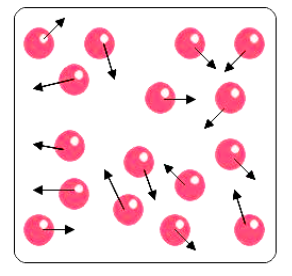
Let us recall the expression for pressure exerted on the walls of the container of volume V that has N
molecules and the average velocity of molecules due to its components in all directions,$\dfrac{1}{3}m{{\overline{v}}^{2}}$ will be,
$P=\dfrac{1}{3}\dfrac{Nm}{V}{{\overline{v}}^{2}}$
But,
$P=\dfrac{F}{A}$
$\Rightarrow F=P\times A=\dfrac{1}{3}\dfrac{Nm}{V}{{\overline{v}}^{2}}A$
Now by Newton’s second law we know that force exerted on the walls of the gas container will be the time rate of momentum transferred on to the walls, that is,
$F=\dfrac{\Delta p}{\Delta t}$
$\Rightarrow \Delta p=F\Delta t$
$\therefore \Delta p=\dfrac{1}{3}\dfrac{Nm}{V}{{\overline{v}}^{2}}A\Delta t$
Hence, we get the expression for the momentum of a gas transferred to the walls of a container gas in time$\Delta t$as,
$\Delta p=\dfrac{1}{3}\dfrac{Nm}{V}{{\overline{v}}^{2}}A\Delta t$
Note:
For a single molecule of gas,
Momentum before impact,
${{p}_{1}}=mv$
Magnitude of momentum after impact will be the same but the direction of the velocity changes after colliding with the wall and hence,
Momentum after impact
${{p}_{2}}=-mv$
Therefore, the change in momentum,
$\Delta p=mv-\left( -mv \right)=2mv$
Hence $\Delta p=2mv$ is the amount of momentum transferred on to the wall by a single molecule.
Formula used:
Pressure exerted on the walls,
$P=\dfrac{1}{3}\dfrac{Nm}{V}{{\overline{v}}^{2}}$
Complete step by step solution:
In the question we are asked to find the expression for the momentum of a gas that is being transferred on the walls of a container gas in the time interval $\Delta t$.
When a molecule of mass m and velocity v collides with the wall of a container, it gets rebound and the momentum will be transferred to the wall. The change in momentum before and after gives us the momentum that is transferred to the wall. We know that momentum of a body is given by the product of its mass and velocity.
Let us recall the expression for pressure exerted on the walls of the container of volume V that has N
molecules and the average velocity of molecules due to its components in all directions,$\dfrac{1}{3}m{{\overline{v}}^{2}}$ will be,
$P=\dfrac{1}{3}\dfrac{Nm}{V}{{\overline{v}}^{2}}$
But,
$P=\dfrac{F}{A}$
$\Rightarrow F=P\times A=\dfrac{1}{3}\dfrac{Nm}{V}{{\overline{v}}^{2}}A$
Now by Newton’s second law we know that force exerted on the walls of the gas container will be the time rate of momentum transferred on to the walls, that is,
$F=\dfrac{\Delta p}{\Delta t}$
$\Rightarrow \Delta p=F\Delta t$
$\therefore \Delta p=\dfrac{1}{3}\dfrac{Nm}{V}{{\overline{v}}^{2}}A\Delta t$
Hence, we get the expression for the momentum of a gas transferred to the walls of a container gas in time$\Delta t$as,
$\Delta p=\dfrac{1}{3}\dfrac{Nm}{V}{{\overline{v}}^{2}}A\Delta t$
Note:
For a single molecule of gas,
Momentum before impact,
${{p}_{1}}=mv$
Magnitude of momentum after impact will be the same but the direction of the velocity changes after colliding with the wall and hence,
Momentum after impact
${{p}_{2}}=-mv$
Therefore, the change in momentum,
$\Delta p=mv-\left( -mv \right)=2mv$
Hence $\Delta p=2mv$ is the amount of momentum transferred on to the wall by a single molecule.
Recently Updated Pages
Master Class 11 Computer Science: Engaging Questions & Answers for Success

Master Class 11 Business Studies: Engaging Questions & Answers for Success
Master Class 11 Economics: Engaging Questions & Answers for Success
Master Class 11 English: Engaging Questions & Answers for Success
Master Class 11 Maths: Engaging Questions & Answers for Success
Master Class 11 Biology: Engaging Questions & Answers for Success
Trending doubts
One Metric ton is equal to kg A 10000 B 1000 C 100 class 11 physics CBSE
There are 720 permutations of the digits 1 2 3 4 5 class 11 maths CBSE
Discuss the various forms of bacteria class 11 biology CBSE
Draw a diagram of a plant cell and label at least eight class 11 biology CBSE
State the laws of reflection of light
10 examples of friction in our daily life