




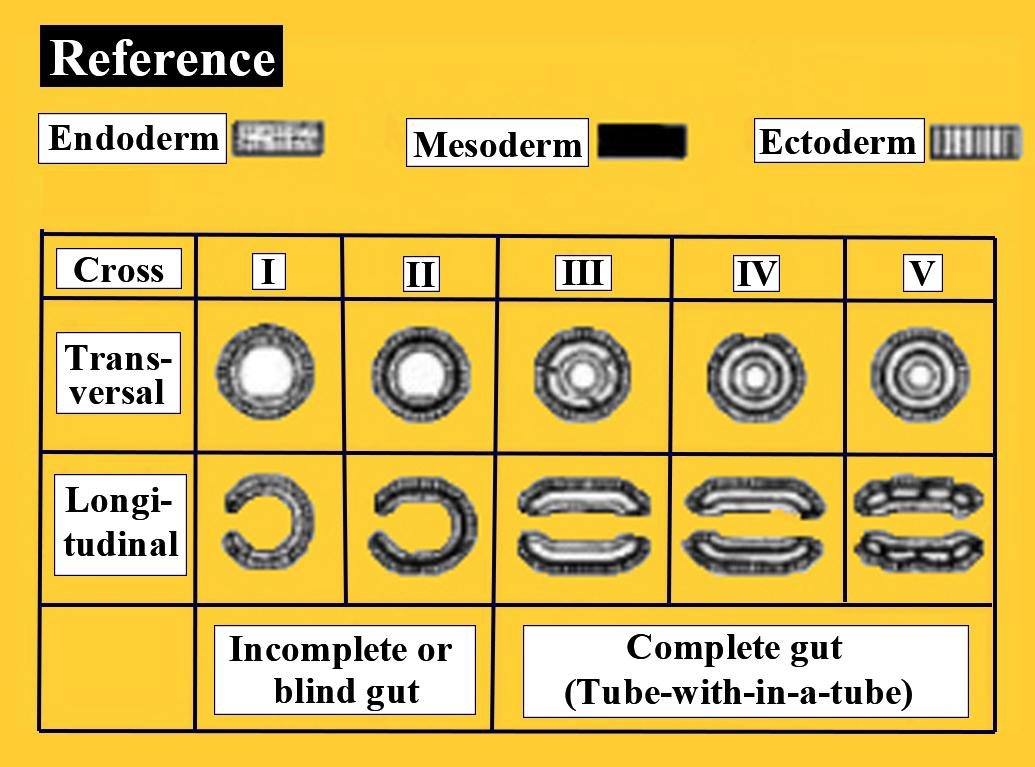
Observe the following diagrams of invertebrates embryos illustrating the characteristics of the body plan. Select the correct sequence which corresponds to the Phyla represented with l, ll,lll, lV, and V.
(a) (i) Cnidaria,(ii) Platyhelminthes, (iii) Annelida, (iv) Nematoda, (v) Arthropoda
(b) (i) Cnidaria, (ii) Platyhelminthes, (iii) Nematoda, (iv) Arthropoda, (v) Annelida
(c) (I) Nematoda, (ii) Arthropoda, (iii) Platyhelminthes, (iv) Cnidaria, (v) Annelida
(d) (i) Annelida, (ii) Cnidaria, (iii) Arthropoda, (iv) Platyhelminthes, (v) Nematoda.
Answer
 Verified
588.9k+ views
Hint: In the question image it is given that incomplete or blind gut is present in the embryos of some phylum, also providing the hint of embryos bearing complete gut. With the help of these provided points, we have to conclude about the correct sequence of the phylum
Complete step by step answer:
In the provided image the embryo of animal (I) bears two germinal layers, namely ectoderm, and mesoderm. It means that this animal is diploblastic, but it is either a poriferan or a cnidarian. The embryos of all the other three animals have three germinal layers, the ectoderm, the mesoderm, and the endoderm. It means that these animals are triploblastic. These animals can be from Phylum Platyhelminthes to Phylum Mollusca.
In both the embryos of animal (I) and animal (II) there is no coelom or coelom is absent. The embryo of animal (Ill) bears pseudocoelom, whereas the embryo of animal (IV) and animal (V) bears a true coelom.
The coelom is a cavity that is filled with fluid and forms the main body cavity of animals. The coelom is formed by the splitting of the mesoderm. Therefore, we can say that the embryos of animal (I) and animal (II) can be of Poriferans, Cnidarians, Ctenophores, or Platyhelminthes. The embryo of animal (III) is of Nemathelminthes or Nematoda, whereas the embryos of animal (IV) and animal (V) can be of Annelids, Arthropods, or Mollusks. The embryo of animal (V) shows internal divisions or internal segmentation in the body. Thus we can conclude that the embryo in the image (V) belongs to the phylum Annelida. The incomplete or blind gut occurs in Cnidarians and Platyhelminthes. Therefore, we can conclude finally that, embryo in the image (I) belongs to Cnidaria, the embryo in the image (II) belongs to Platyhelminthes, the embryo in the image (III) belongs to Nematoda, embryo in the image (IV) belongs to Arthropoda, and embryo in the image (V) belongs to Annelida.
So, the correct answer is,’(i) Cnidaria, (ii) Platyhelminthes, (iii) Nematoda, (iv) Arthropoda, and (v) Annelida.
Note:
- The diploblastic embryo bears two germinal layers whereas the triploblastic embryo bears three germinal layers.
- The coelom is a cavity that is filled with fluid and forms the main body cavity of animals and it is formed by the splitting of the mesoderm.
Complete step by step answer:
In the provided image the embryo of animal (I) bears two germinal layers, namely ectoderm, and mesoderm. It means that this animal is diploblastic, but it is either a poriferan or a cnidarian. The embryos of all the other three animals have three germinal layers, the ectoderm, the mesoderm, and the endoderm. It means that these animals are triploblastic. These animals can be from Phylum Platyhelminthes to Phylum Mollusca.
In both the embryos of animal (I) and animal (II) there is no coelom or coelom is absent. The embryo of animal (Ill) bears pseudocoelom, whereas the embryo of animal (IV) and animal (V) bears a true coelom.
The coelom is a cavity that is filled with fluid and forms the main body cavity of animals. The coelom is formed by the splitting of the mesoderm. Therefore, we can say that the embryos of animal (I) and animal (II) can be of Poriferans, Cnidarians, Ctenophores, or Platyhelminthes. The embryo of animal (III) is of Nemathelminthes or Nematoda, whereas the embryos of animal (IV) and animal (V) can be of Annelids, Arthropods, or Mollusks. The embryo of animal (V) shows internal divisions or internal segmentation in the body. Thus we can conclude that the embryo in the image (V) belongs to the phylum Annelida. The incomplete or blind gut occurs in Cnidarians and Platyhelminthes. Therefore, we can conclude finally that, embryo in the image (I) belongs to Cnidaria, the embryo in the image (II) belongs to Platyhelminthes, the embryo in the image (III) belongs to Nematoda, embryo in the image (IV) belongs to Arthropoda, and embryo in the image (V) belongs to Annelida.
So, the correct answer is,’(i) Cnidaria, (ii) Platyhelminthes, (iii) Nematoda, (iv) Arthropoda, and (v) Annelida.
Note:
- The diploblastic embryo bears two germinal layers whereas the triploblastic embryo bears three germinal layers.
- The coelom is a cavity that is filled with fluid and forms the main body cavity of animals and it is formed by the splitting of the mesoderm.
Recently Updated Pages
Basicity of sulphurous acid and sulphuric acid are

Master Class 11 Business Studies: Engaging Questions & Answers for Success
Master Class 11 Computer Science: Engaging Questions & Answers for Success
Master Class 11 Economics: Engaging Questions & Answers for Success
Master Class 11 Social Science: Engaging Questions & Answers for Success
Master Class 11 English: Engaging Questions & Answers for Success
Trending doubts
One Metric ton is equal to kg A 10000 B 1000 C 100 class 11 physics CBSE
State and prove Bernoullis theorem class 11 physics CBSE
Actinoid contraction is more than lanthanoid contraction class 11 chemistry CBSE
The transition element that has lowest enthalpy of class 11 chemistry CBSE
Can anyone list 10 advantages and disadvantages of friction
State the laws of reflection of light