




Observe the figure:
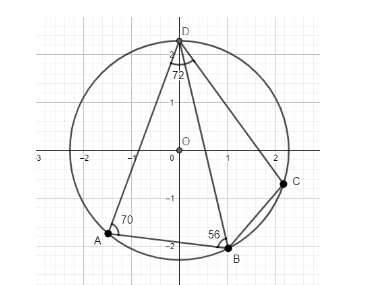
Which of the following is true?
(a) $ \angle $ BDC = 18°; $ \angle $ BCD = 110°; $ \angle $ CBD = 52°
(b) $ \angle $ BDC = 18°; $ \angle $ BCD = 110°; $ \angle $ CBD = 54°
(c) $ \angle $ BDC = 18°; $ \angle $ BCD = 120°; $ \angle $ CBD = 52°
(d) $ \angle $ BDC = 10°; $ \angle $ BCD = 110°; $ \angle $ CBD = 52°
Answer
 Verified
626.4k+ views
Hint: We will solve this question by option verification method and use the concept that the sum of the internal angles of a triangle is 108°. We will find the angles given in the figure. With the help of the given angles, we will find one of the angles of triangle BCD. As soon as we find one angle of triangle BCD, we will see from the options which of the given options satisfy the sum of the internal angles of a triangle concept.
Complete step-by-step answer:
From the given figure, we make the following observations:
$ \angle $ BAD = 70°……(1)
$ \angle $ ABD = 56°……(2)
$ \angle $ ADC = 72°……(3)
We also make note that points ABD form a triangle. Similarly, BCD also make a triangle.
Now, $ \angle $ ADC can also be written as the sum of $ \angle $ ADB and $ \angle $ BDC.
$ \Rightarrow $ $ \angle $ ADC = $ \angle $ ADB + $ \angle $ BDC……(4)
We also know that the sum of the internal angles of a triangle is 180°.
So, in triangle ABD, $ \angle $ ABD + $ \angle $ ADB + $ \angle $ BAD = 180°
From (1) and (2), $ \angle $ BAD = 70° and $ \angle $ ABD = 56°.
$ \Rightarrow $ 56° + $ \angle $ ADB + 70° = 180°
$ \Rightarrow $ $ \angle $ ADB = 54°
From (4) and (3), we know that $ \angle $ ADC = $ \angle $ ADB + $ \angle $ BDC and $ \angle $ ADC = 72°
$ \Rightarrow $ $ \angle $ ADC = $ \angle $ ADB + $ \angle $ BDC
$ \Rightarrow $ 72° = 54° + $ \angle $ BDC
$ \Rightarrow $ $ \angle $ BDC = 18°
Thus, we can rule out option (d).
Now, in triangle BDC, $ \angle $ BDC + $ \angle $ BCD + $ \angle $ CBD = 180°
$ \Rightarrow $ 18° + $ \angle $ BCD + $ \angle $ CBD = 180°
$ \Rightarrow $ $ \angle $ BCD + $ \angle $ CBD = 162°
From the options, we can see that option (a) satisfies this condition as in option (a), $ \angle $ BCD = 110°; $ \angle $ CBD = 52°, so 110° + 52° = 162°.
So, the correct answer is “Option A”.
Note: This is one method to use the concepts of sum of the internal angles of a triangle. Another principal is that the sum of the internal angles of a quadrilateral inscribed in a circle is 360°. In the figure, ABCD forms a quadrilateral. Even then, we have to use option verification as there will be two unknowns.
Complete step-by-step answer:
From the given figure, we make the following observations:
$ \angle $ BAD = 70°……(1)
$ \angle $ ABD = 56°……(2)
$ \angle $ ADC = 72°……(3)
We also make note that points ABD form a triangle. Similarly, BCD also make a triangle.
Now, $ \angle $ ADC can also be written as the sum of $ \angle $ ADB and $ \angle $ BDC.
$ \Rightarrow $ $ \angle $ ADC = $ \angle $ ADB + $ \angle $ BDC……(4)
We also know that the sum of the internal angles of a triangle is 180°.
So, in triangle ABD, $ \angle $ ABD + $ \angle $ ADB + $ \angle $ BAD = 180°
From (1) and (2), $ \angle $ BAD = 70° and $ \angle $ ABD = 56°.
$ \Rightarrow $ 56° + $ \angle $ ADB + 70° = 180°
$ \Rightarrow $ $ \angle $ ADB = 54°
From (4) and (3), we know that $ \angle $ ADC = $ \angle $ ADB + $ \angle $ BDC and $ \angle $ ADC = 72°
$ \Rightarrow $ $ \angle $ ADC = $ \angle $ ADB + $ \angle $ BDC
$ \Rightarrow $ 72° = 54° + $ \angle $ BDC
$ \Rightarrow $ $ \angle $ BDC = 18°
Thus, we can rule out option (d).
Now, in triangle BDC, $ \angle $ BDC + $ \angle $ BCD + $ \angle $ CBD = 180°
$ \Rightarrow $ 18° + $ \angle $ BCD + $ \angle $ CBD = 180°
$ \Rightarrow $ $ \angle $ BCD + $ \angle $ CBD = 162°
From the options, we can see that option (a) satisfies this condition as in option (a), $ \angle $ BCD = 110°; $ \angle $ CBD = 52°, so 110° + 52° = 162°.
So, the correct answer is “Option A”.
Note: This is one method to use the concepts of sum of the internal angles of a triangle. Another principal is that the sum of the internal angles of a quadrilateral inscribed in a circle is 360°. In the figure, ABCD forms a quadrilateral. Even then, we have to use option verification as there will be two unknowns.

Recently Updated Pages
Master Class 8 English: Engaging Questions & Answers for Success

Master Class 8 Science: Engaging Questions & Answers for Success
Master Class 8 Maths: Engaging Questions & Answers for Success
Class 8 Question and Answer - Your Ultimate Solutions Guide
Master Class 8 Social Science: Engaging Questions & Answers for Success
Master Class 12 Economics: Engaging Questions & Answers for Success
Trending doubts
What is BLO What is the full form of BLO class 8 social science CBSE
Which Indian state shares the longest international class 8 social science CBSE
Citizens of India can vote at the age of A 18 years class 8 social science CBSE
Right to vote is a AFundamental Right BFundamental class 8 social science CBSE
Full form of STD, ISD and PCO
What is the area formula of an obtuse triangle class 8 maths CBSE