




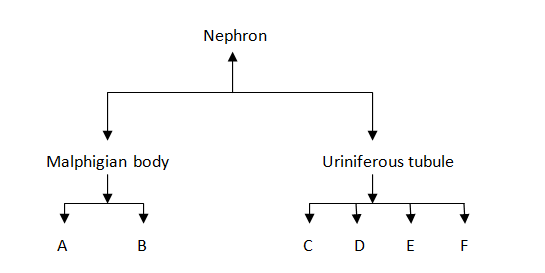
Observe the chart depicting the structure of a nephron.
(i) Mention the structures A to F
(ii) Explain the main function of a nephron.
Answer
 Verified
606.9k+ views
Hint: The renal corpuscle and the renal tubule consist of the nephron. For filtration, excretion and resorption, the nephron is responsible. It filters out small plasma molecules, reabsorbs much of the water and some of the molecules selectively, and even secrete some secretory compounds into the filtrate.
Complete answer:
A. Glomerulus - The blood from the afferent arteriole joins and travels into the efferent arteriole.
B. Capsule Bowman's
C. Convoluted Tubule Proximal
D. Henle Loop
E. Distal Tubule Convoluted
F. The Apparatus of the Juxtaglomerular (JGA)
The basic purpose of the nephron is to pump the blood and extract excess substances for different biochemical processes while maintaining important substances. The nephron may also affect the pH (acid-base balance) of the blood in the process, stabilize blood pressure, maintain the volume of blood and monitor the amount of electrolytes in the fluids of the body.
With regard to each component, the roles of the nephron can be discussed:
Bowman's Capsule - The incoming fluid from the glomerular capillaries is extracted.
Proximal Convoluted Tubule- Reabsorbing salt, potassium, water, glucose and amino acids (removed from the tubules). Acids and bases are secreted into the proximal tubule, such as bile salts, oxalate along with uric acid.
Henle's loop- In the descending limb and the thin portion of the ascending limb, water is mostly reabsorbed.
The thick section of the ascending limb deliberately reabsorbs sodium, calcium, chloride, magnesium and potassium.
Distal convoluted tubule- It regulates the blood supply of the nephron to which it corresponds through the glomerular capillaries and glomerular filtration. Reabsorption of sodium, potassium and chloride. Reabsorption of sodium, potassium and chloride. Secretion of hydrogen ions.
Note: Kidneys play an important role in osmoregulation by controlling the volume of water reabsorbed from glomerular filtrate in renal tubules, which is mediated by hormones such as antidiuretic hormone (ADH), aldosterone, and angiotensin II, the kidneys play a very significant role in human osmoregulation.
Complete answer:
A. Glomerulus - The blood from the afferent arteriole joins and travels into the efferent arteriole.
B. Capsule Bowman's
C. Convoluted Tubule Proximal
D. Henle Loop
E. Distal Tubule Convoluted
F. The Apparatus of the Juxtaglomerular (JGA)
The basic purpose of the nephron is to pump the blood and extract excess substances for different biochemical processes while maintaining important substances. The nephron may also affect the pH (acid-base balance) of the blood in the process, stabilize blood pressure, maintain the volume of blood and monitor the amount of electrolytes in the fluids of the body.
With regard to each component, the roles of the nephron can be discussed:
Bowman's Capsule - The incoming fluid from the glomerular capillaries is extracted.
Proximal Convoluted Tubule- Reabsorbing salt, potassium, water, glucose and amino acids (removed from the tubules). Acids and bases are secreted into the proximal tubule, such as bile salts, oxalate along with uric acid.
Henle's loop- In the descending limb and the thin portion of the ascending limb, water is mostly reabsorbed.
The thick section of the ascending limb deliberately reabsorbs sodium, calcium, chloride, magnesium and potassium.
Distal convoluted tubule- It regulates the blood supply of the nephron to which it corresponds through the glomerular capillaries and glomerular filtration. Reabsorption of sodium, potassium and chloride. Reabsorption of sodium, potassium and chloride. Secretion of hydrogen ions.
Note: Kidneys play an important role in osmoregulation by controlling the volume of water reabsorbed from glomerular filtrate in renal tubules, which is mediated by hormones such as antidiuretic hormone (ADH), aldosterone, and angiotensin II, the kidneys play a very significant role in human osmoregulation.
Recently Updated Pages
Master Class 11 English: Engaging Questions & Answers for Success

Master Class 11 Physics: Engaging Questions & Answers for Success
Master Class 11 Computer Science: Engaging Questions & Answers for Success
Master Class 11 Chemistry: Engaging Questions & Answers for Success
Master Class 11 Social Science: Engaging Questions & Answers for Success
Master Class 11 Accountancy: Engaging Questions & Answers for Success
Trending doubts
Draw a diagram of a plant cell and label at least eight class 11 biology CBSE
Proton was discovered by A Thomson B Rutherford C Chadwick class 11 chemistry CBSE
What is the purity of pure gold in carat class 11 chemistry CBSE
Can anyone list 10 advantages and disadvantages of friction
Lysosomes are known as suicidal bags of cell why class 11 biology CBSE
Derive the equation of motion by the calculus method class 11 physics CBSE