




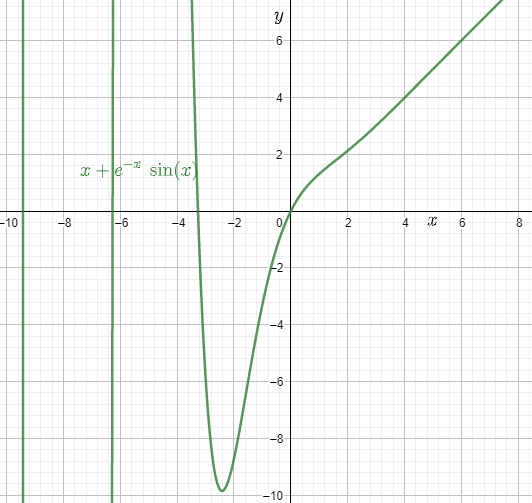
What is the oblique asymptote to the curve $y=x+{{e}^{-x}}\sin x$ is
A. $y=x+\dfrac{\pi }{2}$.
B. $y=x+\dfrac{2}{\pi }$.
C. $y=x+e$.
D. $y=x$.
Answer
 Verified
525.6k+ views
Hint: For this problem we need to find the oblique asymptote of the given function. If $y=mx+c$ is an oblique asymptote for the function or curve $y=f\left( x \right)$, then $m=\displaystyle \lim_{x \to -\infty }\left( \dfrac{y}{x} \right)$, $c=\displaystyle \lim_{x \to \infty }\left( y-mx \right)$. So, we will first assume that the equation $y=mx+c$ is the required equation of the oblique asymptote for the given curve. Now we will calculate the value of $m$ by using the formula $m=\displaystyle \lim_{x \to -\infty }\left( \dfrac{y}{x} \right)$ and some basic mathematical operations. After that we will use the calculated value of $m$ in calculation of $c$ by using the formula $c=\displaystyle \lim_{x \to \infty }\left( y-mx \right)$. After having the both values of $m$ and $c$, we will substitute them in the assumed equation which is $y=mx+c$ to get the required result.
Complete step-by-step solution:
Given curve or function is $y=x+{{e}^{-x}}\sin x$.
Let us assume that the equation of required oblique asymptote is given by $y=mx+c$.
If $y=mx+c$ is the oblique asymptote of the curve $y=x+{{e}^{-x}}\sin x$, then we can write the values of $m$ and $c$ as
$m=\displaystyle \lim_{x \to -\infty }\left( \dfrac{y}{x} \right)$, $c=\displaystyle \lim_{x \to \infty }\left( y-mx \right)$.
Considering the equation $m=\displaystyle \lim_{x \to -\infty }\left( \dfrac{y}{x} \right)$ and substituting the value $y=x+{{e}^{-x}}\sin x$, then we will get
$m=\displaystyle \lim_{x \to -\infty }\left( \dfrac{x+{{e}^{-x}}\sin x}{x} \right)$
Simplifying the above equation by using basic mathematical operations and limit formulas, then we will get
$\begin{align}
& m=\displaystyle \lim_{x \to -\infty }\left( \dfrac{x}{x}+\dfrac{{{e}^{-x}}\sin x}{x} \right) \\
& \Rightarrow m=\displaystyle \lim_{x \to -\infty }\left( 1+\dfrac{{{e}^{-x}}\sin x}{x} \right) \\
& \Rightarrow m=1+\displaystyle \lim_{x \to -\infty }\left( \dfrac{{{e}^{-x}}\sin x}{x} \right) \\
& \Rightarrow m=1+0 \\
& \Rightarrow m=1 \\
\end{align}$
We have the value of $m$ as $m=1$.
Now considering the equation $c=\displaystyle \lim_{x \to \infty }\left( y-mx \right)$, substituting the values $y=x+{{e}^{-x}}\sin x$, $m=1$, then we will have
$c=\displaystyle \lim_{x \to \infty }\left( x+{{e}^{-x}}\sin x-1\times x \right)$
Simplifying the above equation by using basic mathematical operations and limit formulas, then we will get
$\begin{align}
& c=\displaystyle \lim_{x \to \infty }\left( x+{{e}^{-x}}\sin x-x \right) \\
& \Rightarrow c=\displaystyle \lim_{x \to \infty }\left( {{e}^{-x}}\sin x \right) \\
& \Rightarrow c=0 \\
\end{align}$
From the above equation we have the value of $c$ as $c=0$.
Substituting the values $m=1$, $c=0$ in the assumed equation of oblique asymptote which is $y=mx+c$, then we will get
$\begin{align}
& y=1\left( x \right)+0 \\
& \Rightarrow y=x \\
\end{align}$
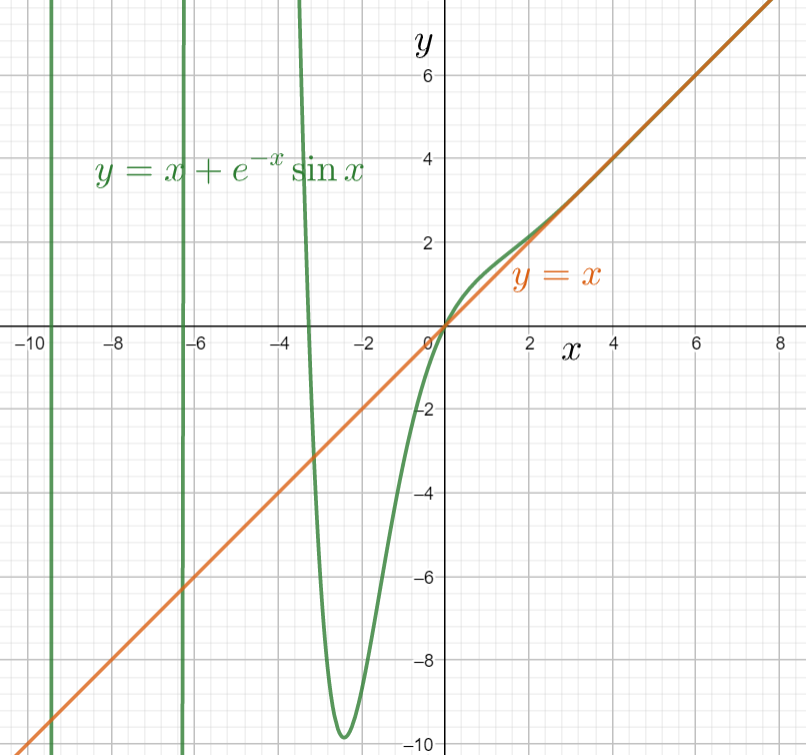
Hence option – D is the correct answer.
The graph of the both the equations is given by
Note: For this type of problems, we regularly use the concept of limits. So, we will use the formulas of limits at every step. Some of the limit formulas which we will use regularly are given below
$\displaystyle \lim_{x \to a}x=a$
$\displaystyle \lim_{x \to a}\left( px+q \right)=pa+q$
$\displaystyle \lim_{x \to a}{{x}^{n}}={{a}^{n}}$.
Complete step-by-step solution:
Given curve or function is $y=x+{{e}^{-x}}\sin x$.
Let us assume that the equation of required oblique asymptote is given by $y=mx+c$.
If $y=mx+c$ is the oblique asymptote of the curve $y=x+{{e}^{-x}}\sin x$, then we can write the values of $m$ and $c$ as
$m=\displaystyle \lim_{x \to -\infty }\left( \dfrac{y}{x} \right)$, $c=\displaystyle \lim_{x \to \infty }\left( y-mx \right)$.
Considering the equation $m=\displaystyle \lim_{x \to -\infty }\left( \dfrac{y}{x} \right)$ and substituting the value $y=x+{{e}^{-x}}\sin x$, then we will get
$m=\displaystyle \lim_{x \to -\infty }\left( \dfrac{x+{{e}^{-x}}\sin x}{x} \right)$
Simplifying the above equation by using basic mathematical operations and limit formulas, then we will get
$\begin{align}
& m=\displaystyle \lim_{x \to -\infty }\left( \dfrac{x}{x}+\dfrac{{{e}^{-x}}\sin x}{x} \right) \\
& \Rightarrow m=\displaystyle \lim_{x \to -\infty }\left( 1+\dfrac{{{e}^{-x}}\sin x}{x} \right) \\
& \Rightarrow m=1+\displaystyle \lim_{x \to -\infty }\left( \dfrac{{{e}^{-x}}\sin x}{x} \right) \\
& \Rightarrow m=1+0 \\
& \Rightarrow m=1 \\
\end{align}$
We have the value of $m$ as $m=1$.
Now considering the equation $c=\displaystyle \lim_{x \to \infty }\left( y-mx \right)$, substituting the values $y=x+{{e}^{-x}}\sin x$, $m=1$, then we will have
$c=\displaystyle \lim_{x \to \infty }\left( x+{{e}^{-x}}\sin x-1\times x \right)$
Simplifying the above equation by using basic mathematical operations and limit formulas, then we will get
$\begin{align}
& c=\displaystyle \lim_{x \to \infty }\left( x+{{e}^{-x}}\sin x-x \right) \\
& \Rightarrow c=\displaystyle \lim_{x \to \infty }\left( {{e}^{-x}}\sin x \right) \\
& \Rightarrow c=0 \\
\end{align}$
From the above equation we have the value of $c$ as $c=0$.
Substituting the values $m=1$, $c=0$ in the assumed equation of oblique asymptote which is $y=mx+c$, then we will get
$\begin{align}
& y=1\left( x \right)+0 \\
& \Rightarrow y=x \\
\end{align}$
Hence option – D is the correct answer.
The graph of the both the equations is given by
Note: For this type of problems, we regularly use the concept of limits. So, we will use the formulas of limits at every step. Some of the limit formulas which we will use regularly are given below
$\displaystyle \lim_{x \to a}x=a$
$\displaystyle \lim_{x \to a}\left( px+q \right)=pa+q$
$\displaystyle \lim_{x \to a}{{x}^{n}}={{a}^{n}}$.
Recently Updated Pages
Master Class 11 Social Science: Engaging Questions & Answers for Success

Master Class 11 Chemistry: Engaging Questions & Answers for Success
Master Class 12 Business Studies: Engaging Questions & Answers for Success
Master Class 12 Chemistry: Engaging Questions & Answers for Success
Master Class 12 Biology: Engaging Questions & Answers for Success
Class 12 Question and Answer - Your Ultimate Solutions Guide
Trending doubts
One Metric ton is equal to kg A 10000 B 1000 C 100 class 11 physics CBSE
Difference Between Prokaryotic Cells and Eukaryotic Cells
How many of the following diseases can be studied with class 11 biology CBSE
Two of the body parts which do not appear in MRI are class 11 biology CBSE
Which of the following enzymes is used for carboxylation class 11 biology CBSE
Explain zero factorial class 11 maths CBSE