




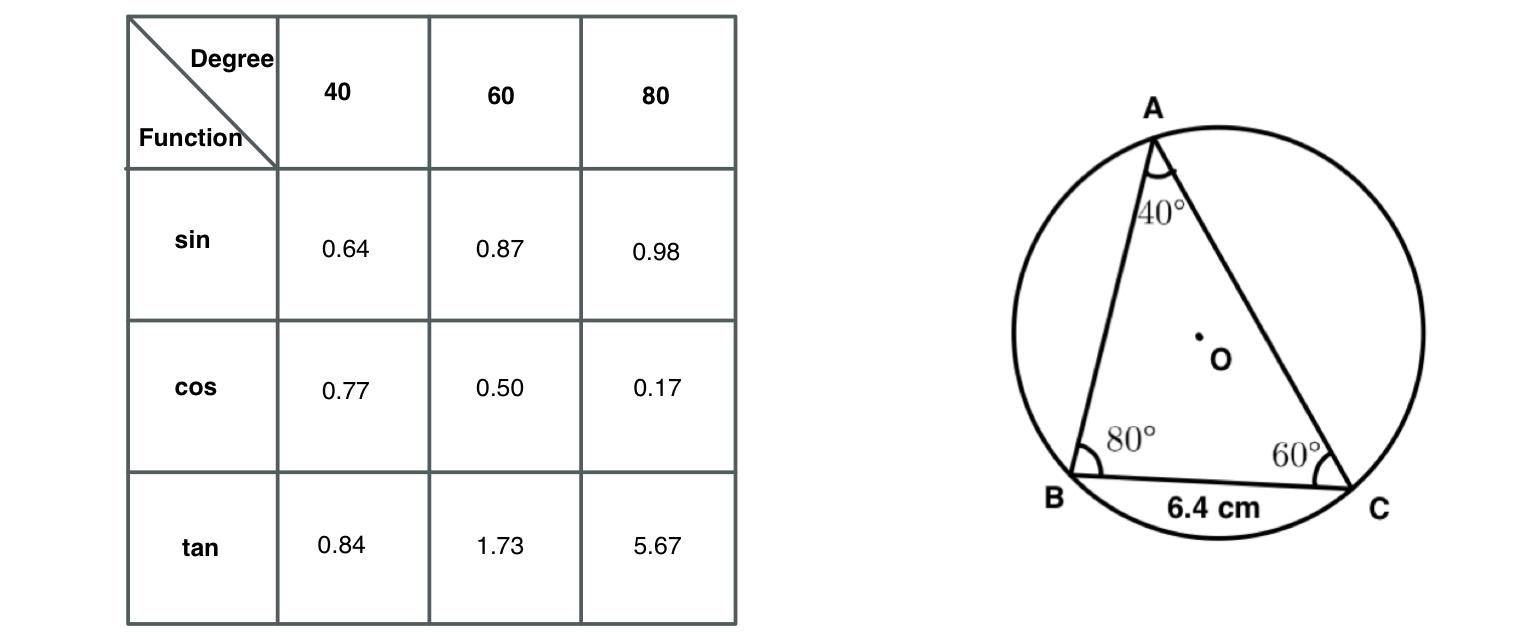
‘O’ is the centre of the circumcircle of $$\triangle ABC$$, where $$\angle A=40^{\circ},\ \angle B=80^{\circ},\ \angle C=60^{\circ},\ BC=6.4\ cm$$
a. What is the diameter of the circle?
b. What is the length of the other sides?
Answer
 Verified
636.6k+ views
Hint: In this question it is given that ‘O’ is the centre of the circumcircle of $$\triangle ABC$$, where $$\angle A=40^{\circ},\ \angle B=80^{\circ},\ \angle C=60^{\circ},\ BC=6.4\ cm$$. We have to find the diameter and the length of each side. So to find the solution we need to know that if a, b, c be the opposite sides of the angles $$\angle A,\ \angle B,\ \angle C$$ of a $$\triangle ABC$$,
Then, $$\dfrac{a}{\sin A} =\dfrac{b}{\sin B} =\dfrac{c}{\sin C} =2R$$.....(1)
Where R is the radius of the circumcircle.
So by using the above formula we are able to find the solution.
Complete step-by-step answer:
Here it is given that
$$\triangle ABC$$, where $$\angle A=40^{\circ},\ \angle B=80^{\circ},\ \angle C=60^{\circ},\ BC=6.4\ cm$$
Now let us consider the side BC=a cm, CA=b cm and AB=c cm, and the radius of the circumcircle is R cm.
Therefore, by the formula (1) we can write,
$$\dfrac{a}{\sin A} =\dfrac{b}{\sin B} =\dfrac{c}{\sin C} =2R$$
$$\Rightarrow \dfrac{6.4}{\sin 40^{\circ}} =\dfrac{b}{\sin 80^{\circ}} =\dfrac{c}{\sin 60^{\circ}} =2R$$
$$\Rightarrow \dfrac{6.4}{0.64} =\dfrac{b}{0.98} =\dfrac{c}{0.87} =2R$$
$$\Rightarrow \dfrac{6.4\times 100}{0.64\times 100} =\dfrac{b}{0.98} =\dfrac{c}{0.87} =2R$$
$$\Rightarrow \dfrac{640}{64} =\dfrac{b}{0.98} =\dfrac{c}{0.87} =2R$$
$$\Rightarrow 10=\dfrac{b}{0.98} =\dfrac{c}{0.87} =2R$$........(2)
Now taking first and the fourth from the equation (2), we get,
$$10=2R$$
$$\Rightarrow 2R=10$$
$$\Rightarrow R=\dfrac{10}{2}$$
$$\Rightarrow R=5$$
So we get the radius of the circumcircle is 5 cm.
Therefore the diameter =2R=$$2\times 5$$=10 cm
Now taking first and second from equation (2),
$$\dfrac{b}{0.98} =10$$
$$\Rightarrow b=10\times 0.98$$
$$\Rightarrow b=9.8$$
Taking first and third from the equation (2), we get,
$$\dfrac{c}{0.87} =10$$
$$\Rightarrow c=10\times 0.87$$
$$\Rightarrow c=8.7$$
Therefore the length of the other sides are 9.8 cm and 8.7 cm.
Note: While solving this type of question you need to know that in geometry, the circumscribed circle or circumcircle of a polygon is a circle that passes through all the vertices of the polygon. The center of this circle is called the circumcenter and its radius is called the circumradius although not every polygon has a circumscribed circle. A polygon that does have one is called a cyclic polygon.
Then, $$\dfrac{a}{\sin A} =\dfrac{b}{\sin B} =\dfrac{c}{\sin C} =2R$$.....(1)
Where R is the radius of the circumcircle.
So by using the above formula we are able to find the solution.
Complete step-by-step answer:
Here it is given that
$$\triangle ABC$$, where $$\angle A=40^{\circ},\ \angle B=80^{\circ},\ \angle C=60^{\circ},\ BC=6.4\ cm$$
Now let us consider the side BC=a cm, CA=b cm and AB=c cm, and the radius of the circumcircle is R cm.
Therefore, by the formula (1) we can write,
$$\dfrac{a}{\sin A} =\dfrac{b}{\sin B} =\dfrac{c}{\sin C} =2R$$
$$\Rightarrow \dfrac{6.4}{\sin 40^{\circ}} =\dfrac{b}{\sin 80^{\circ}} =\dfrac{c}{\sin 60^{\circ}} =2R$$
$$\Rightarrow \dfrac{6.4}{0.64} =\dfrac{b}{0.98} =\dfrac{c}{0.87} =2R$$
$$\Rightarrow \dfrac{6.4\times 100}{0.64\times 100} =\dfrac{b}{0.98} =\dfrac{c}{0.87} =2R$$
$$\Rightarrow \dfrac{640}{64} =\dfrac{b}{0.98} =\dfrac{c}{0.87} =2R$$
$$\Rightarrow 10=\dfrac{b}{0.98} =\dfrac{c}{0.87} =2R$$........(2)
Now taking first and the fourth from the equation (2), we get,
$$10=2R$$
$$\Rightarrow 2R=10$$
$$\Rightarrow R=\dfrac{10}{2}$$
$$\Rightarrow R=5$$
So we get the radius of the circumcircle is 5 cm.
Therefore the diameter =2R=$$2\times 5$$=10 cm
Now taking first and second from equation (2),
$$\dfrac{b}{0.98} =10$$
$$\Rightarrow b=10\times 0.98$$
$$\Rightarrow b=9.8$$
Taking first and third from the equation (2), we get,
$$\dfrac{c}{0.87} =10$$
$$\Rightarrow c=10\times 0.87$$
$$\Rightarrow c=8.7$$
Therefore the length of the other sides are 9.8 cm and 8.7 cm.
Note: While solving this type of question you need to know that in geometry, the circumscribed circle or circumcircle of a polygon is a circle that passes through all the vertices of the polygon. The center of this circle is called the circumcenter and its radius is called the circumradius although not every polygon has a circumscribed circle. A polygon that does have one is called a cyclic polygon.
Recently Updated Pages
Master Class 11 English: Engaging Questions & Answers for Success

Master Class 11 Social Science: Engaging Questions & Answers for Success
Master Class 11 Maths: Engaging Questions & Answers for Success
Master Class 11 Biology: Engaging Questions & Answers for Success
Master Class 11 Physics: Engaging Questions & Answers for Success
Master Class 11 Chemistry: Engaging Questions & Answers for Success
Trending doubts
One Metric ton is equal to kg A 10000 B 1000 C 100 class 11 physics CBSE
Difference Between Prokaryotic Cells and Eukaryotic Cells
Find the value of the expression given below sin 30circ class 11 maths CBSE
1 ton equals to A 100 kg B 1000 kg C 10 kg D 10000 class 11 physics CBSE
Two of the body parts which do not appear in MRI are class 11 biology CBSE
What are hard magnetic materials class 11 physics CBSE