




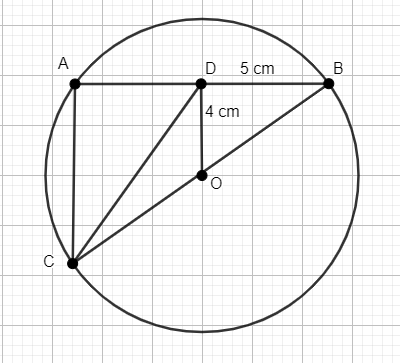
O is the centre of the circle. BC is the diameter of the circle. OD is perpendicular to AB. If OD = 4 cm and BD = 5 cm then find the value of CD.
Answer
 Verified
630.3k+ views
Hint: To solve the question, we have to apply the Pythagorean theorem to calculate the unknown values of sides of given triangles. To solve further, apply the properties of an angle in semicircle and the properties of perpendicular bisectors for the given diagram to obtain the required values.
Complete step-by-step answer:
We know that by Pythagorean theorem, we get, in a right-angle triangle XYZ \[X{{Z}^{2}}=\text{ X}{{\text{Y}}^{2}}+Y{{Z}^{2}}\] where XZ is hypotenuse and XY, YZ are two adjacent sides of the given right-angle triangle.
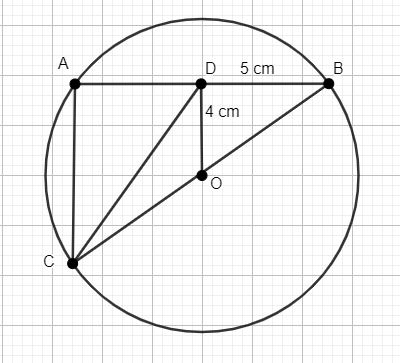
By applying the above theorem for \[\Delta ODB\], we get
\[O{{B}^{2}}=\text{ O}{{\text{D}}^{2}}+B{{D}^{2}}\]
By substituting the given value in above equation, we get
\[\begin{align}
& O{{B}^{2}}=\text{ }{{\text{4}}^{2}}+{{5}^{2}} \\
& O{{B}^{2}}=16+25 \\
& O{{B}^{2}}=41 \\
& \Rightarrow OB=\sqrt{41}cm \\
\end{align}\]
We know OC = OB since OC, OB are the radius of the given circle. Thus, we get
\[OC=\sqrt{41}cm\]
We know \[BC=OC+OB=2OB=2\sqrt{41}cm\]
Given that OB is perpendicular to AB, this implies that D is the mid-point of AB since the perpendicular drawn from the centre of a circle to its any chord always bisects the chord.
Thus, we get BD = AD = 5 cm
We know AB = AD + BD = 5 + 5 = 10 cm
We know the angle in a semicircle is always \[{{90}^{0}}\]. Thus, we get \[\angle CAB={{90}^{0}}\]
By applying the Pythagorean theorem for \[\Delta ABC\], we get
\[B{{C}^{2}}=\text{ A}{{\text{B}}^{2}}+A{{C}^{2}}\]
By substituting the given value in above equation, we get
\[\begin{align}
& {{\left( 2\sqrt{41} \right)}^{2}}=\text{ 1}{{\text{0}}^{2}}+A{{C}^{2}} \\
& 4\times 41=100+A{{C}^{2}} \\
& 164=100+A{{C}^{2}} \\
& A{{C}^{2}}=164-100 \\
& A{{C}^{2}}=64 \\
& AC=\sqrt{64}=\sqrt{{{8}^{2}}} \\
& \Rightarrow AC=8cm \\
\end{align}\]
By applying the Pythagorean theorem for \[\Delta DAC\], we get
\[C{{D}^{2}}=\text{ A}{{\text{D}}^{2}}+A{{C}^{2}}\]
By substituting the given value in above equation, we get
\[\begin{align}
& C{{D}^{2}}=\text{ }{{\text{5}}^{2}}+{{8}^{2}} \\
& C{{D}^{2}}=\text{ }25+64 \\
& C{{D}^{2}}=\text{ }89 \\
& \Rightarrow CD=\sqrt{89}cm \\
\end{align}\]
Thus, the measurement of CD is equal to \[\sqrt{89}cm\]
Note: The possibility of mistake can be, not applying the Pythagorean theorem to calculate the unknown values of sides of given triangles. The other possible mistake can be, not applying the properties of an angle in semicircle and the properties of perpendicular bisectors.
Complete step-by-step answer:
We know that by Pythagorean theorem, we get, in a right-angle triangle XYZ \[X{{Z}^{2}}=\text{ X}{{\text{Y}}^{2}}+Y{{Z}^{2}}\] where XZ is hypotenuse and XY, YZ are two adjacent sides of the given right-angle triangle.
By applying the above theorem for \[\Delta ODB\], we get
\[O{{B}^{2}}=\text{ O}{{\text{D}}^{2}}+B{{D}^{2}}\]
By substituting the given value in above equation, we get
\[\begin{align}
& O{{B}^{2}}=\text{ }{{\text{4}}^{2}}+{{5}^{2}} \\
& O{{B}^{2}}=16+25 \\
& O{{B}^{2}}=41 \\
& \Rightarrow OB=\sqrt{41}cm \\
\end{align}\]
We know OC = OB since OC, OB are the radius of the given circle. Thus, we get
\[OC=\sqrt{41}cm\]
We know \[BC=OC+OB=2OB=2\sqrt{41}cm\]
Given that OB is perpendicular to AB, this implies that D is the mid-point of AB since the perpendicular drawn from the centre of a circle to its any chord always bisects the chord.
Thus, we get BD = AD = 5 cm
We know AB = AD + BD = 5 + 5 = 10 cm
We know the angle in a semicircle is always \[{{90}^{0}}\]. Thus, we get \[\angle CAB={{90}^{0}}\]
By applying the Pythagorean theorem for \[\Delta ABC\], we get
\[B{{C}^{2}}=\text{ A}{{\text{B}}^{2}}+A{{C}^{2}}\]
By substituting the given value in above equation, we get
\[\begin{align}
& {{\left( 2\sqrt{41} \right)}^{2}}=\text{ 1}{{\text{0}}^{2}}+A{{C}^{2}} \\
& 4\times 41=100+A{{C}^{2}} \\
& 164=100+A{{C}^{2}} \\
& A{{C}^{2}}=164-100 \\
& A{{C}^{2}}=64 \\
& AC=\sqrt{64}=\sqrt{{{8}^{2}}} \\
& \Rightarrow AC=8cm \\
\end{align}\]
By applying the Pythagorean theorem for \[\Delta DAC\], we get
\[C{{D}^{2}}=\text{ A}{{\text{D}}^{2}}+A{{C}^{2}}\]
By substituting the given value in above equation, we get
\[\begin{align}
& C{{D}^{2}}=\text{ }{{\text{5}}^{2}}+{{8}^{2}} \\
& C{{D}^{2}}=\text{ }25+64 \\
& C{{D}^{2}}=\text{ }89 \\
& \Rightarrow CD=\sqrt{89}cm \\
\end{align}\]
Thus, the measurement of CD is equal to \[\sqrt{89}cm\]
Note: The possibility of mistake can be, not applying the Pythagorean theorem to calculate the unknown values of sides of given triangles. The other possible mistake can be, not applying the properties of an angle in semicircle and the properties of perpendicular bisectors.
Recently Updated Pages
Master Class 10 Social Science: Engaging Questions & Answers for Success

Master Class 10 Science: Engaging Questions & Answers for Success
Master Class 10 Maths: Engaging Questions & Answers for Success
Master Class 10 General Knowledge: Engaging Questions & Answers for Success
Master Class 10 Computer Science: Engaging Questions & Answers for Success
Class 10 Question and Answer - Your Ultimate Solutions Guide
Trending doubts
What is the full form of PNG A Petrol Natural Gas B class 10 chemistry CBSE
Explain the Treaty of Vienna of 1815 class 10 social science CBSE
In cricket, how many legal balls are there in a standard over?
Why is there a time difference of about 5 hours between class 10 social science CBSE
Who Won 36 Oscar Awards? Record Holder Revealed
What is the median of the first 10 natural numbers class 10 maths CBSE