




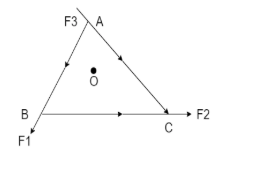
O is the centre of an equilateral triangle ABC. ${F_1},{F_2},{F_3}$are the three forces acting along the sides AB, BC and AC respectively. What should be the value of ${F_3}$so that the total torque about O is zero?
A) $2({F_1} + {F_2})$
B) $\dfrac{{{F_1} + {F_2}}}{2}$
C) ${F_1} - {F_2}$
D) ${F_1} + {F_2}$
Answer
 Verified
641.4k+ views
Hint:Recall the concept of torque. When an object rotates around a fixed axis, then the minimum force required to rotate the object is known as torque. It is a vector quantity. Therefore, it has both magnitude and directions. The fixed axis about which the object rotates is known as pivot point.
Step-By-Step solution:
Step I:
Let ‘d’ be the distance of A, B and C from point O. The torque acting on an object can be represented as the product of the force acting and the perpendicular distance from the axis of rotation. Therefore, it is clear from the diagram that the torque acting on B and C is in clockwise direction. But the torque acting on A is in anti clockwise direction.
Step II:
The torque acting on point A is $ = - {F_3}d$
The torque acting on point B is$ = {F_1}d$
And the torque acting on point C is$ = {F_2}d$
Step III:
Equilibrium is a state when all the forces in the system are balanced. A body is said to be in rotational equilibrium if the sum of torques acting on the system about an axis is equal to zero. Therefore according to this condition,
${F_1}d + {F_2}d - {F_3}d = 0$
$d({F_1} + {F_2} - {F_3}) = 0$
${F_1} + {F_2} - {F_3} = 0$
${F_3} = {F_1} + {F_2}$
Step IV:
Hence when ${F_3} = {F_1} + {F_2}$then the torque acting on the system will be equal to zero.
$ \Rightarrow $ Option D is the right answer.
Note:It is to be noted that sometimes torque is confused with work. Where torque is a vector quantity, work is a scalar quantity. The component of distance in torque is perpendicular to the axis, whereas the component of distance in work is parallel to the body.
Step-By-Step solution:
Step I:
Let ‘d’ be the distance of A, B and C from point O. The torque acting on an object can be represented as the product of the force acting and the perpendicular distance from the axis of rotation. Therefore, it is clear from the diagram that the torque acting on B and C is in clockwise direction. But the torque acting on A is in anti clockwise direction.
Step II:
The torque acting on point A is $ = - {F_3}d$
The torque acting on point B is$ = {F_1}d$
And the torque acting on point C is$ = {F_2}d$
Step III:
Equilibrium is a state when all the forces in the system are balanced. A body is said to be in rotational equilibrium if the sum of torques acting on the system about an axis is equal to zero. Therefore according to this condition,
${F_1}d + {F_2}d - {F_3}d = 0$
$d({F_1} + {F_2} - {F_3}) = 0$
${F_1} + {F_2} - {F_3} = 0$
${F_3} = {F_1} + {F_2}$
Step IV:
Hence when ${F_3} = {F_1} + {F_2}$then the torque acting on the system will be equal to zero.
$ \Rightarrow $ Option D is the right answer.
Note:It is to be noted that sometimes torque is confused with work. Where torque is a vector quantity, work is a scalar quantity. The component of distance in torque is perpendicular to the axis, whereas the component of distance in work is parallel to the body.
Recently Updated Pages
If x a + bt + ct2 where x is in meters and t is in class 11 physics CBSE

A car covers the first half distance between two places class 11 physics CBSE
The resultant of two vectors overrightarrow P and overrightarrow class 11 physics CBSE
Find the value of cos 135 class 11 maths CBSE
A mass M is held in place by an applied force F and class 11 physics CBSE
A solution of glucose in water is labelled as 10 dfracwv class 11 chemistry CBSE
Trending doubts
Find the value of the expression given below sin 30circ class 11 maths CBSE
What is the maximum height of a projectile class 11 physics CBSE
Derive an expression for maximum height and range of class 11 physics CBSE
Describe various types of epithelial tissues with the class 11 biology CBSE
Lysosomes are known as suicidal bags of cell why class 11 biology CBSE
State and derive law of conservation of momentum class 11 physics CBSE