




Number of roots of equation \[{{x}^{2}}\centerdot {{e}^{2-\left| x \right|}}=1\] is
\[\begin{align}
& \left( A \right)2 \\
& \left( B \right)4 \\
& \left( C \right)6 \\
& \left( D \right)zero \\
\end{align}\]
Answer
 Verified
542.4k+ views
Hint: This question can be solved by firstly converting the whole equation to the exponential form by converting \[{{x}^{2}}\] and \[1\] to exponent and taking \[\log \]. Then we consider the modulus term and taking the cases when \[x\]is negative or positive. Then further solving gives the number of solutions.
Formula used:
The formulae used here are:
\[\log \left( {{e}^{x}} \right)=x\]
And vice versa, i.e.
\[\exp \left( \log x \right)=x\]
For the modulus of x, formula is,
\[\left\{ \begin{align}
& \left| x \right|=x,ifx<0 \\
& \left| x \right|=-x,ifx>0 \\
\end{align} \right\}\]
Complete step by step solution:
Let us consider the given equation and start solving
\[{{x}^{2}}\centerdot {{e}^{2-\left| x \right|}}=1\]
Converting all the terms to exponential form,
\[{{e}^{\log {{x}^{2}}}}\centerdot {{e}^{2-\left| x \right|}}={{e}^{0}}\]
Taking logarithm on the both sides of the equation
\[\begin{align}
& \Rightarrow \log {{x}^{2}}+2-\left| x \right|=0 \\
& \Rightarrow 2\log x+2-\left| x \right|=0 \\
& \\
\end{align}\]
This implies that\[x\], here, cannot be zero.
i.e. \[x\ne 0\]
Considering the two cases,
\[\begin{align}
& x<0; \\
& x>0 \\
\end{align}\]
Here, the value of x modulus \[\left( \left| x \right| \right)\]varies for these two ranges.
For \[x<0\]
\[\begin{align}
& \Rightarrow \log {{x}^{2}}+2+x=0 \\
& \Rightarrow \log {{x}^{2}}=-2-x=y1\left( let \right) \\
& \\
\end{align}\]
So, the only solution exists for \[x>0\], which is a contradiction because we have taken the interval \[x<0\] above.
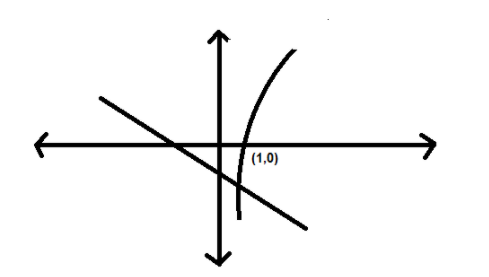
For \[x>0\],
\[\begin{align}
& \Rightarrow \log {{x}^{2}}+2-x=0 \\
& \Rightarrow \log {{x}^{2}}=-2+x=y2\left( let \right) \\
\end{align}\]
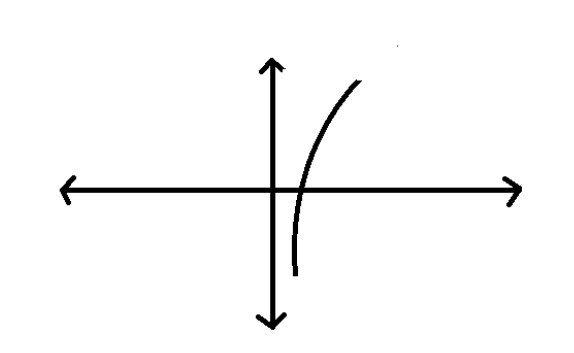
Therefore, the two equations cut themselves at the points that lie in the interval \[\left( 0,1 \right)and\left( 5,6 \right)\].
So, in total we have two solutions.
Therefore, the answer matches the option \[\left( A \right)2\].
Additional information:
The roots of an equation are the x-intercepts, i.e., y-coordinates when x is zero. To find the roots, we set \[f\left( x \right)=0\] and solve the equation. If an equation is in one variable, the degree of the leading term determines the number of roots.
Note: Taking the two intervals for the x-modulus, is the important step, it gives us the contradiction that for the interval \[x<0\], the values exist only for \[x>0\]. The interval is found by further solving the two equations, however in this question, we only need to find the number of roots.
Formula used:
The formulae used here are:
\[\log \left( {{e}^{x}} \right)=x\]
And vice versa, i.e.
\[\exp \left( \log x \right)=x\]
For the modulus of x, formula is,
\[\left\{ \begin{align}
& \left| x \right|=x,ifx<0 \\
& \left| x \right|=-x,ifx>0 \\
\end{align} \right\}\]
Complete step by step solution:
Let us consider the given equation and start solving
\[{{x}^{2}}\centerdot {{e}^{2-\left| x \right|}}=1\]
Converting all the terms to exponential form,
\[{{e}^{\log {{x}^{2}}}}\centerdot {{e}^{2-\left| x \right|}}={{e}^{0}}\]
Taking logarithm on the both sides of the equation
\[\begin{align}
& \Rightarrow \log {{x}^{2}}+2-\left| x \right|=0 \\
& \Rightarrow 2\log x+2-\left| x \right|=0 \\
& \\
\end{align}\]
This implies that\[x\], here, cannot be zero.
i.e. \[x\ne 0\]
Considering the two cases,
\[\begin{align}
& x<0; \\
& x>0 \\
\end{align}\]
Here, the value of x modulus \[\left( \left| x \right| \right)\]varies for these two ranges.
For \[x<0\]
\[\begin{align}
& \Rightarrow \log {{x}^{2}}+2+x=0 \\
& \Rightarrow \log {{x}^{2}}=-2-x=y1\left( let \right) \\
& \\
\end{align}\]
So, the only solution exists for \[x>0\], which is a contradiction because we have taken the interval \[x<0\] above.
For \[x>0\],
\[\begin{align}
& \Rightarrow \log {{x}^{2}}+2-x=0 \\
& \Rightarrow \log {{x}^{2}}=-2+x=y2\left( let \right) \\
\end{align}\]
Therefore, the two equations cut themselves at the points that lie in the interval \[\left( 0,1 \right)and\left( 5,6 \right)\].
So, in total we have two solutions.
Therefore, the answer matches the option \[\left( A \right)2\].
Additional information:
The roots of an equation are the x-intercepts, i.e., y-coordinates when x is zero. To find the roots, we set \[f\left( x \right)=0\] and solve the equation. If an equation is in one variable, the degree of the leading term determines the number of roots.
Note: Taking the two intervals for the x-modulus, is the important step, it gives us the contradiction that for the interval \[x<0\], the values exist only for \[x>0\]. The interval is found by further solving the two equations, however in this question, we only need to find the number of roots.
Recently Updated Pages
Master Class 10 Computer Science: Engaging Questions & Answers for Success

Master Class 10 General Knowledge: Engaging Questions & Answers for Success
Master Class 10 English: Engaging Questions & Answers for Success
Master Class 10 Social Science: Engaging Questions & Answers for Success
Master Class 10 Maths: Engaging Questions & Answers for Success
Master Class 10 Science: Engaging Questions & Answers for Success
Trending doubts
What is the median of the first 10 natural numbers class 10 maths CBSE
Which women's tennis player has 24 Grand Slam singles titles?
Who is the Brand Ambassador of Incredible India?
Why is there a time difference of about 5 hours between class 10 social science CBSE
Write a letter to the principal requesting him to grant class 10 english CBSE
A moving boat is observed from the top of a 150 m high class 10 maths CBSE