




Number of possible geometrical isomers for $$2,4 - hexadiene$$ are?
(A) $8$
(B) $4$
(C) $3$
(D) $2$
Answer
 Verified
623.4k+ views
Hint:Isomerism is a phenomenon of organic chemistry in which more than one species has the same chemical formula but different structures. Those compounds that have the same chemical formula but different properties and the arrangement of atoms in their molecule are called isomers.
Complete answer:
Isomerism is of two types (a) Structural and (b) Stereo. Geometrical isomerism is a type of stereoisomerism. Those molecules that have the same molecular formula but have different relative arrangements of atoms in space in their compounds are called geometrical isomers and this phenomenon is called geometrical isomerism.
This type of isomerism is shown by unsaturated compounds or by compounds that have a ring, in which rotation about the carbon bond is restricted which results in the formation of Cis and Trans configuration of the molecule. In the cis configuration, the functional group lies on the same side of the chain, and in the trans configuration, the functional group lies on the opposite side of the carbon chain.
In the question, we are given 2,4 - hexadiene. It is an alkene that is formed with a double bond ( = ) between the two carbon atoms. In the structure of 2,4 - hexadiene there are two double bonds between the carbon atoms at 2 and 4 position. So due to the presence of two double bonds, it will show three geometrical isomers as the two ends of the molecules are identically substituted. The three isomers will be:
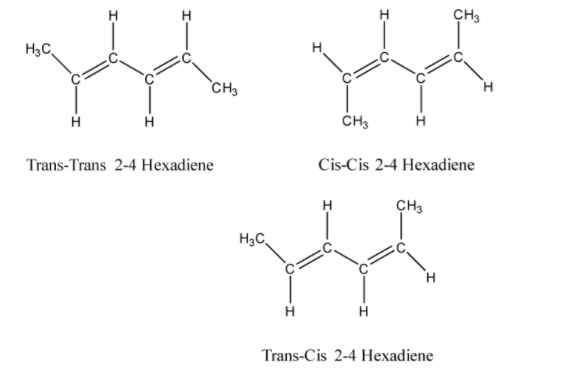
Hence, the Number of possible geometrical isomers for $$2,4 - hexadiene$$ are $3$.
Therefore, option (C) is correct.
Note:
The melting and boiling point of trans isomers is more than that of cis isomer. This is due to the reason that trans isomers are less polar and more symmetrical as compared to cis isomers who are more polar and less symmetrical.
Complete answer:
Isomerism is of two types (a) Structural and (b) Stereo. Geometrical isomerism is a type of stereoisomerism. Those molecules that have the same molecular formula but have different relative arrangements of atoms in space in their compounds are called geometrical isomers and this phenomenon is called geometrical isomerism.
This type of isomerism is shown by unsaturated compounds or by compounds that have a ring, in which rotation about the carbon bond is restricted which results in the formation of Cis and Trans configuration of the molecule. In the cis configuration, the functional group lies on the same side of the chain, and in the trans configuration, the functional group lies on the opposite side of the carbon chain.
In the question, we are given 2,4 - hexadiene. It is an alkene that is formed with a double bond ( = ) between the two carbon atoms. In the structure of 2,4 - hexadiene there are two double bonds between the carbon atoms at 2 and 4 position. So due to the presence of two double bonds, it will show three geometrical isomers as the two ends of the molecules are identically substituted. The three isomers will be:
Hence, the Number of possible geometrical isomers for $$2,4 - hexadiene$$ are $3$.
Therefore, option (C) is correct.
Note:
The melting and boiling point of trans isomers is more than that of cis isomer. This is due to the reason that trans isomers are less polar and more symmetrical as compared to cis isomers who are more polar and less symmetrical.
Recently Updated Pages
Which will be the least stable resonating structure class 11 chemistry CBSE

How many 5 digit telephone numbers can be construc-class-11-maths-CBSE
How do you find the angle of the resultant vector class 11 physics CBSE
Draw labelled diagram of the following i Gram seed class 11 biology CBSE
1 Quintal is equal to a 110 kg b 10 kg c 100kg d 1000 class 11 physics CBSE
What is the need and importance of classification class 11 biology CBSE
Trending doubts
One Metric ton is equal to kg A 10000 B 1000 C 100 class 11 physics CBSE
Find the value of the expression given below sin 30circ class 11 maths CBSE
Draw a diagram of nephron and explain its structur class 11 biology CBSE
10 examples of friction in our daily life
Proton was discovered by A Thomson B Rutherford C Chadwick class 11 chemistry CBSE
How many kilometers are there in 100 meters class 11 maths CBSE