




Number of genotypes found in ${ F }_{ 2 }$ progeny of a dihybrid cross is -
(a) 9
(b) 6
(c) 3
(d) 1
Answer
 Verified
616.8k+ views
Hint: A dihybrid cross occurs between two organisms that have two genes that are different in two traits. For example, a dihybrid cross occurs between AABB and aabb, which is the dominant and recessive trait, respectively.
Complete answer:
A dihybrid cross is a mating experiment between two organisms that are identically hybrid for two traits. This experiment was originally discovered and explained by Mendel.
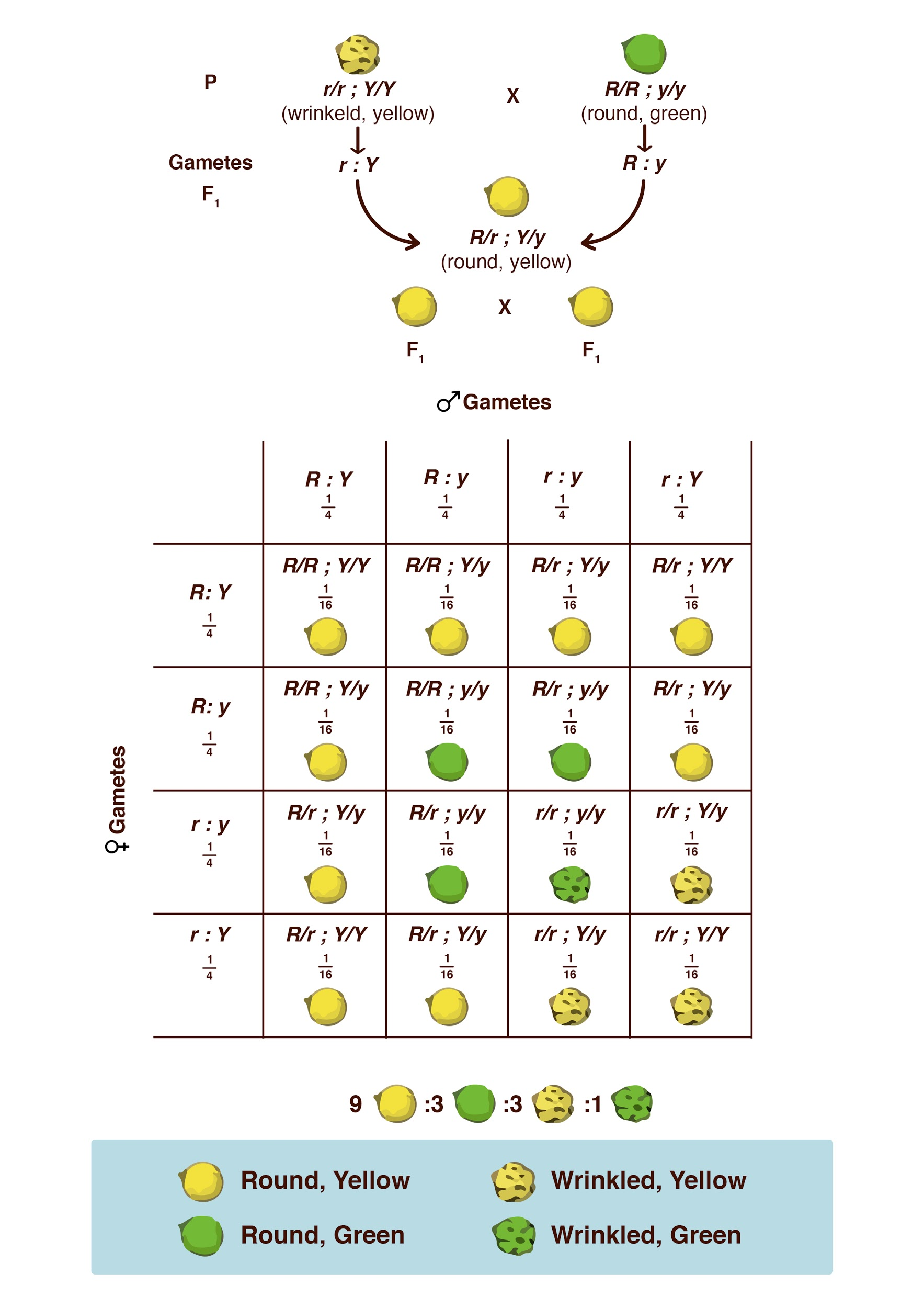
- The cross between two parent species AABB and aabb give the four identical ${ F }_{ 1 }$ progeny as all AaBb. In the ${ F }_{ 2 }$ generation that occurs by selfing the ${ F }_{ 1 }$ generation, there are different varieties of progeny obtained. We can find the genotype and the phenotype of the progeny of the generation by using the Punnett square. The ratio of the progeny genotypes is 1:2:1:2:4:2:1:2:1. As we see from the Punnett square, a total of 9 genotypes are present - AABB, AABb, AAbb, AaBB, AaBb, aaBB, aaBB, aaBb, and aabb.
- These traits are present in the following ratio - 1 AABB:2 AABb:1 AAbb:2 AaBB:4 AaBb:2 aaBB:1 aaBB:2 aaBb:1 aabb.
Additional information:
- It is based on the results of the monohybrid cross. It was hypothesized that the result of two characters segregating simultaneously would be the product of their independent occurrence, leading to a dihybrid cross.
- Mendel’s law of independent assortment states that pairs of traits in the parental generation sort independently from one another when passing from one generation to the next.
- The ratio of phenotypes of a dihybrid cross is 9:3:3:1.
So, the correct answer is ‘9’.
Note:
- The three Mendelian laws that are essential for understanding biological inheritance are as follows.
1. Law of dominance and uniformity - Some alleles in an organism are dominant while some are recessive. An organism with at least one dominant allele will show the phenotype of the dominant allele.
2. Law of segregation - During gametogenesis, the alleles for each gene segregate from each other such that each gamete carries only one allele for each gene.
3. Law of independent assortment - pairs of traits in the parental generation sort independently from one another, when passing from one generation to the next.
Complete answer:
A dihybrid cross is a mating experiment between two organisms that are identically hybrid for two traits. This experiment was originally discovered and explained by Mendel.
- The cross between two parent species AABB and aabb give the four identical ${ F }_{ 1 }$ progeny as all AaBb. In the ${ F }_{ 2 }$ generation that occurs by selfing the ${ F }_{ 1 }$ generation, there are different varieties of progeny obtained. We can find the genotype and the phenotype of the progeny of the generation by using the Punnett square. The ratio of the progeny genotypes is 1:2:1:2:4:2:1:2:1. As we see from the Punnett square, a total of 9 genotypes are present - AABB, AABb, AAbb, AaBB, AaBb, aaBB, aaBB, aaBb, and aabb.
- These traits are present in the following ratio - 1 AABB:2 AABb:1 AAbb:2 AaBB:4 AaBb:2 aaBB:1 aaBB:2 aaBb:1 aabb.
Additional information:
- It is based on the results of the monohybrid cross. It was hypothesized that the result of two characters segregating simultaneously would be the product of their independent occurrence, leading to a dihybrid cross.
- Mendel’s law of independent assortment states that pairs of traits in the parental generation sort independently from one another when passing from one generation to the next.
- The ratio of phenotypes of a dihybrid cross is 9:3:3:1.
So, the correct answer is ‘9’.
Note:
- The three Mendelian laws that are essential for understanding biological inheritance are as follows.
1. Law of dominance and uniformity - Some alleles in an organism are dominant while some are recessive. An organism with at least one dominant allele will show the phenotype of the dominant allele.
2. Law of segregation - During gametogenesis, the alleles for each gene segregate from each other such that each gamete carries only one allele for each gene.
3. Law of independent assortment - pairs of traits in the parental generation sort independently from one another, when passing from one generation to the next.
Recently Updated Pages
Master Class 12 Business Studies: Engaging Questions & Answers for Success

Master Class 12 Chemistry: Engaging Questions & Answers for Success
Master Class 12 Biology: Engaging Questions & Answers for Success
Class 12 Question and Answer - Your Ultimate Solutions Guide
Master Class 11 English: Engaging Questions & Answers for Success
Master Class 11 Social Science: Engaging Questions & Answers for Success
Trending doubts
Which are the Top 10 Largest Countries of the World?
Draw a labelled sketch of the human eye class 12 physics CBSE
Differentiate between homogeneous and heterogeneous class 12 chemistry CBSE
Differentiate between Pyramid of energy and pyramid class 12 biology CBSE
Why is the cell called the structural and functional class 12 biology CBSE
Draw the diagram of the pyramid of energy Explain In class 12 biology CBSE